
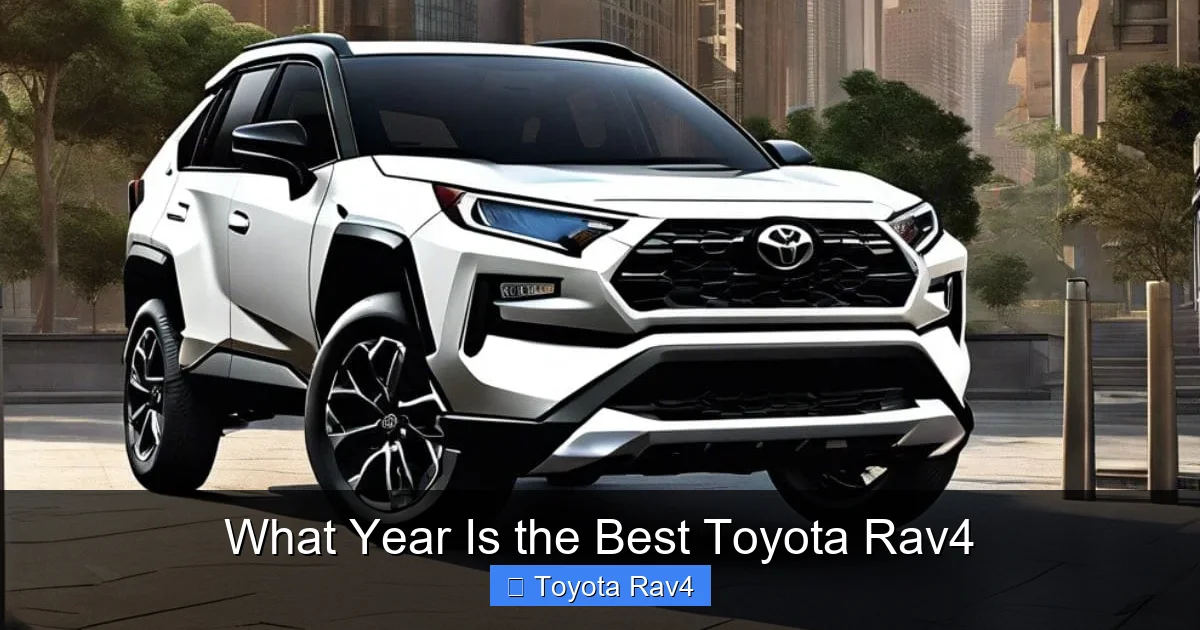
Choosing the best Toyota RAV4 year depends on your priorities—whether it’s fuel efficiency, tech features, or long-term reliability. Recent models like the 2021–2023 RAV4 offer modern safety, hybrid options, and strong resale value, making them top picks.
Key Takeaways
- 2021–2023 RAV4 models are the best overall: They offer updated styling, advanced safety tech, and improved fuel economy, especially in the hybrid version.
- The 2019 RAV4 marks a major redesign: This generation introduced a bold new look, better handling, and Toyota Safety Sense 2.0 as standard.
- Hybrid models (2019–2023) deliver excellent fuel efficiency: Expect up to 40 mpg combined, making them ideal for daily commutes and long drives.
- Avoid early 2000s models due to reliability concerns: Issues with oil consumption, transmission problems, and rust make older RAV4s less desirable.
- The 2020 RAV4 has minor transmission quirks: Some drivers report hesitation or jerking, but overall reliability remains strong.
- Resale value is consistently high: The RAV4 holds its value better than most SUVs, especially in recent years.
- Trim level matters: Higher trims like Limited and Adventure offer more features, but base models still provide great value.
📑 Table of Contents
- What Year Is the Best Toyota RAV4? A Complete Buyer’s Guide
- The Evolution of the Toyota RAV4: A Brief History
- Top Contenders: Best Toyota RAV4 Years
- Gas vs. Hybrid: Which RAV4 Is Right for You?
- Safety and Technology: What to Expect
- Reliability and Resale Value
- Common Issues and How to Avoid Them
- Conclusion: Which Year Should You Buy?
What Year Is the Best Toyota RAV4? A Complete Buyer’s Guide
If you’re in the market for a compact SUV that blends reliability, practicality, and modern features, the Toyota RAV4 is likely at the top of your list. Since its debut in the mid-1990s, the RAV4 has evolved from a quirky little off-roader into one of the most popular SUVs in America. But with so many model years and trims to choose from, it’s easy to feel overwhelmed. So, what year is the best Toyota RAV4?
The short answer? It depends on what you’re looking for. Are you prioritizing fuel economy? Do you want the latest tech and safety features? Or are you more concerned about long-term reliability and resale value? Different years shine in different areas, and understanding those nuances can save you thousands—and a lot of headaches—down the road.
In this guide, we’ll walk you through the most important model years, highlight standout features, and help you decide which RAV4 is the right fit for your lifestyle. Whether you’re buying new, used, or certified pre-owned, we’ve got you covered.
The Evolution of the Toyota RAV4: A Brief History

Visual guide about What Year Is the Best Toyota Rav4
Image source: platform.cstatic-images.com
Before diving into which year is best, it helps to understand how the RAV4 has changed over time. The first-generation RAV4 (1996–2000) was a compact, boxy SUV designed for urban adventurers. It was small, fuel-efficient, and surprisingly capable off-road. While charming, early models lacked the refinement and safety features we expect today.
The second generation (2001–2005) grew in size and power, offering a V6 option and better interior space. However, reliability issues—especially with oil consumption and rust—plagued some models. The third generation (2006–2012) brought a more car-like driving experience, improved fuel economy, and better build quality. Still, transmission problems and electrical gremlins were common complaints.
The fourth generation (2013–2018) marked a turning point. Toyota introduced a more aggressive design, better fuel efficiency, and standard safety tech like a rearview camera. But it wasn’t until the fifth generation—starting in 2019—that the RAV4 truly became a class leader.
The 2019 Redesign: A Game-Changer
The 2019 Toyota RAV4 was a complete overhaul. Toyota ditched the soft, rounded styling for a rugged, angular look inspired by the brand’s off-road trucks. The new design wasn’t just for show—it improved aerodynamics and gave the RAV4 a more commanding presence on the road.
Under the hood, the 2.5-liter four-cylinder engine delivered 203 horsepower, a noticeable bump from previous models. More importantly, Toyota introduced the RAV4 Hybrid, which paired the same engine with electric motors for a combined 219 horsepower and up to 41 mpg combined. That was a huge leap in efficiency for a non-plug-in SUV.
Safety also took a major step forward. Every 2019 RAV4 came standard with Toyota Safety Sense 2.0, a suite of driver-assist features including adaptive cruise control, lane departure warning, automatic emergency braking, and road sign recognition. This made the 2019 model one of the safest compact SUVs on the market.
What About Older Models?
While the 2019 redesign set a new standard, some buyers still consider older RAV4s for their lower price tags. But proceed with caution. Models from the early 2000s, especially 2001–2005, are known for excessive oil consumption—some owners reported burning a quart every 1,000 miles. Rust issues, particularly around the wheel wells and undercarriage, were also common in snowy climates.
The 2006–2012 models improved in reliability, but transmission shuddering and electrical problems still popped up. The 2013–2018 RAV4s were more dependable, but they lacked the advanced safety and tech features of newer models. If you’re set on an older RAV4, aim for a well-maintained 2016 or later with a clean service history.
Top Contenders: Best Toyota RAV4 Years
Now that we’ve covered the evolution, let’s focus on the best years. Based on reliability, features, fuel economy, and owner satisfaction, here are the standout models.
2021–2023 RAV4: The Sweet Spot
If you’re asking, “What year is the best Toyota RAV4?” the answer for most buyers is 2021–2023. These models build on the strong foundation of the 2019 redesign with incremental improvements in tech, comfort, and efficiency.
The 2021 RAV4 introduced a refreshed infotainment system with a larger 8-inch touchscreen (up from 7 inches), Apple CarPlay, Android Auto, and Amazon Alexa compatibility. Higher trims added wireless charging, a JBL sound system, and a 360-degree camera. The hybrid version continued to impress with up to 40 mpg combined.
In 2022, Toyota added more standard safety features, including blind-spot monitoring and rear cross-traffic alert on most trims. The 2023 model brought minor styling tweaks, improved sound insulation, and a more responsive touchscreen. All three years benefit from Toyota’s reputation for reliability and strong resale value.
One real-world example: A 2022 RAV4 Hybrid Limited owned by a nurse in Colorado averages 38 mpg on her daily 60-mile commute. She praises the quiet cabin, smooth ride, and peace of mind from the advanced safety features—especially in mountain weather.
2019 RAV4: The Pioneer of the New Era
The 2019 RAV4 deserves special mention. As the first year of the fifth generation, it set the tone for everything that followed. It was bold, capable, and packed with features that made it stand out in a crowded market.
Drivers loved the new aggressive styling, which gave the RAV4 a more rugged, adventurous look. The interior was more spacious, with better materials and a user-friendly layout. The standard 7-inch touchscreen was a bit small by today’s standards, but it worked well with the available Entune 3.0 system.
The hybrid model was a revelation. With 219 horsepower and 41 mpg combined, it outperformed rivals like the Honda CR-V and Nissan Rogue. Even the gas-only version offered solid fuel economy at 28 mpg combined.
One downside? Some early 2019 models had minor fit-and-finish issues, like loose trim or inconsistent panel gaps. But these were rare and often fixed under warranty. Overall, the 2019 RAV4 is a strong choice, especially if you find a well-maintained used model at a good price.
2020 RAV4: Almost Perfect, With a Few Quirks
The 2020 RAV4 was nearly identical to the 2019, with only minor updates. It kept the same engine, transmission, and safety features. But it wasn’t without its flaws.
Some owners reported transmission hesitation—especially during light acceleration or when shifting from park to drive. This wasn’t a widespread issue, but it showed up in enough forums and reviews to be worth noting. Toyota addressed it with a software update, but if you’re buying a used 2020, ask if the update was applied.
On the plus side, the 2020 RAV4 Hybrid continued to deliver excellent fuel economy, and the new Adventure and TRD Off-Road trims added real off-road capability with all-terrain tires, skid plates, and upgraded suspension. If you enjoy weekend adventures, these trims are worth considering.
Gas vs. Hybrid: Which RAV4 Is Right for You?
One of the biggest decisions when choosing a RAV4 is whether to go gas or hybrid. Both have their pros and cons, and the best choice depends on your driving habits and budget.
Gas RAV4: Proven Reliability and Lower Upfront Cost
The gas-powered RAV4 uses a 2.5-liter four-cylinder engine with 203 horsepower and an 8-speed automatic transmission. It’s smooth, responsive, and gets up to 28 mpg combined. For most drivers, that’s more than enough for daily commuting and weekend trips.
The gas model is also cheaper to buy upfront. A 2022 gas RAV4 LE starts around $28,000 new, while the hybrid version starts closer to $32,000. That $4,000 difference can be significant, especially if you’re on a tight budget.
Maintenance is straightforward, and parts are widely available. Toyota’s reputation for reliability means you’re unlikely to face major repairs before 150,000 miles—especially if you stick to the maintenance schedule.
Hybrid RAV4: Better Fuel Economy and Smoother Power Delivery
The RAV4 Hybrid combines the same 2.5-liter engine with two electric motors for a total of 219 horsepower. It uses an electronically controlled continuously variable transmission (e-CVT), which delivers power more smoothly than a traditional automatic.
But the real advantage is fuel economy. The hybrid gets up to 40 mpg combined—nearly 12 mpg better than the gas model. Over 15,000 miles a year, that saves about 150 gallons of gas, or roughly $500 at $3.50 per gallon. Over five years, that’s $2,500 in savings.
The hybrid also feels more responsive in city driving, thanks to instant torque from the electric motors. It’s quieter at low speeds and handles hills with ease. Plus, it comes with standard all-wheel drive (AWD), which is optional on gas models.
One thing to note: Hybrid batteries are designed to last the life of the vehicle, but replacement costs can be high ($2,000–$4,000) if they fail outside the warranty. However, Toyota’s hybrid systems have a proven track record, and most owners never face this issue.
Safety and Technology: What to Expect
Safety and tech are major selling points for the RAV4, especially in recent years. Let’s break down what you get.
Toyota Safety Sense: Standard Across All Trims
Since 2019, every RAV4 comes with Toyota Safety Sense 2.0 (TSS 2.0). This suite includes:
– Pre-Collision System with Pedestrian Detection
– Lane Departure Alert with Steering Assist
– Automatic High Beams
– Full-Speed Range Dynamic Radar Cruise Control
– Road Sign Assist
In 2021, Toyota upgraded to TSS 2.5+, which added improved lane tracing and better detection of cyclists and motorcycles. These features have helped the RAV4 earn top safety ratings from the IIHS and NHTSA.
Infotainment and Connectivity
The 2019 RAV4 started with a 7-inch touchscreen, but by 2021, most trims got an 8-inch display. Higher-end models offer a 9-inch screen with navigation, wireless Apple CarPlay, and Android Auto. The system is intuitive, with physical buttons for volume and climate control—a rarity in modern cars.
The available JBL audio system delivers crisp sound, and the 360-degree camera makes parking in tight spots a breeze. For families, the rear-seat reminder and available rear-seat entertainment options add convenience.
Reliability and Resale Value
One reason the RAV4 is so popular is its reputation for reliability. According to J.D. Power and Consumer Reports, recent models score well above average in dependability. The 2021 RAV4, for example, earned a 4.5 out of 5 reliability rating from J.D. Power.
Toyota’s rigorous testing and high-quality manufacturing play a big role. The RAV4 is built on the TNGA-K platform, which improves rigidity, reduces weight, and enhances ride comfort. Regular maintenance—like oil changes every 10,000 miles with synthetic oil—keeps it running smoothly for years.
Resale value is another strong point. The RAV4 holds its value better than most SUVs. A 2020 RAV4 typically retains about 60% of its value after three years, compared to 50–55% for competitors. This makes it a smart long-term investment.
Common Issues and How to Avoid Them
No car is perfect, and the RAV4 has had its share of minor issues. Here’s what to watch for:
Transmission Hesitation (2020 Models)
As mentioned earlier, some 2020 RAV4 owners reported a delay when accelerating from a stop. This is usually fixed with a software update from Toyota. If you’re buying a used 2020, ask for proof the update was applied.
Wind Noise at Highway Speeds
A few owners of 2019–2021 models have complained about wind noise around the A-pillars. This is more common on higher trims with panoramic sunroofs. Test drive at highway speeds to check for excessive noise.
Infotainment Glitches
Early versions of the Entune system had occasional lag or freezing. Most issues were resolved with software updates. Make sure the system is up to date before purchasing.
Rust Prevention
While modern RAV4s are better protected, rust can still be an issue in snowy or coastal areas. Regular undercarriage washes and rust-proofing treatments can help.
Conclusion: Which Year Should You Buy?
So, what year is the best Toyota RAV4? For most buyers, the answer is 2021–2023. These models offer the best blend of modern features, fuel efficiency, safety, and reliability. The hybrid versions are especially compelling for commuters and eco-conscious drivers.
If you’re on a tighter budget, a well-maintained 2019 or 2020 RAV4 can still be a great choice—just be aware of potential quirks like transmission hesitation or minor fit issues.
Avoid models before 2013 unless you’re getting a great deal and are prepared for higher maintenance costs. The early 2000s RAV4s, in particular, are best left to collectors or off-road enthusiasts willing to do extra work.
Ultimately, the best RAV4 is the one that fits your needs, budget, and driving style. Whether you prioritize fuel economy, tech, or rugged capability, Toyota’s compact SUV delivers. With strong resale value and a reputation for lasting over 200,000 miles, the RAV4 isn’t just a good buy—it’s a smart one.
Frequently Asked Questions
What year RAV4 has the least problems?
The 2021–2023 Toyota RAV4 models have the fewest reported issues, thanks to improved build quality and updated software. These years benefit from Toyota’s refined engineering and strong reliability track record.
Is the 2020 RAV4 reliable?
Yes, the 2020 RAV4 is generally reliable, though some owners reported minor transmission hesitation. Most issues were resolved with a free software update from Toyota.
Should I buy a used RAV4 or a new one?
A used RAV4 (2019 or newer) offers great value with lower depreciation, while a new one comes with the latest tech and full warranty. Both are solid choices depending on your budget.
How long does a Toyota RAV4 last?
With proper maintenance, a RAV4 can easily last 200,000 miles or more. Many owners report driving over 250,000 miles without major engine or transmission issues.
Is the RAV4 Hybrid worth the extra cost?
Yes, especially if you drive a lot. The hybrid saves hundreds in fuel costs annually and offers smoother acceleration and standard AWD, making it a smart long-term investment.
What’s the best RAV4 trim level?
The Limited and XSE Hybrid trims offer the most features, but the LE and XLE provide excellent value with standard safety and tech. Choose based on your budget and must-have features.