
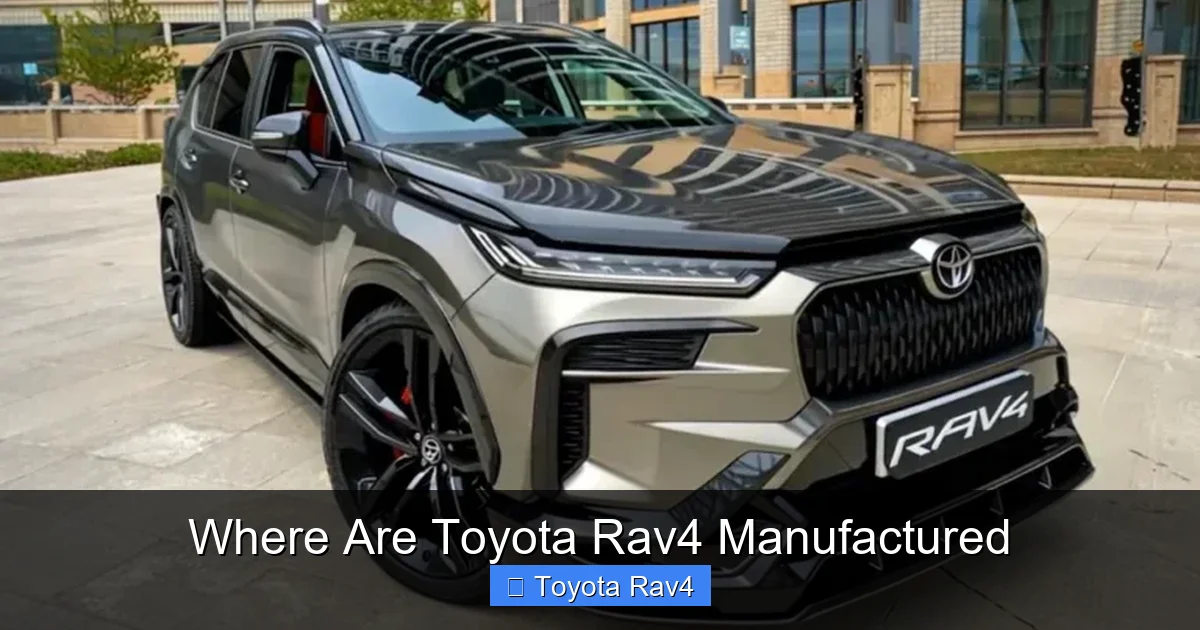
The Toyota RAV4 is manufactured in multiple countries, including the U.S., Canada, Japan, and China, ensuring global availability and high-quality standards. Each plant follows Toyota’s rigorous production system, so no matter where your RAV4 is built, you can expect reliability and performance.
If you’re in the market for a Toyota RAV4, you’ve probably noticed that this compact SUV is everywhere. From city streets to mountain trails, the RAV4 has become one of the most popular vehicles on the road. But have you ever wondered where it’s actually made? It’s a fair question—especially if you care about quality, origin, or even environmental impact. The truth is, the Toyota RAV4 isn’t built in just one place. Instead, it’s manufactured in several countries around the world, each playing a key role in meeting global demand.
Toyota’s strategy of building vehicles close to where they’re sold helps reduce shipping costs, supports local economies, and ensures faster delivery times. This global production network also allows Toyota to adapt to regional needs—like offering more hybrid models in eco-conscious markets or adjusting features for local climates. So whether you’re buying a RAV4 in Los Angeles, Toronto, Tokyo, or Shanghai, chances are it was built relatively nearby. But that doesn’t mean all RAV4s are created equal in terms of origin. Depending on the model year, trim level, and market, your RAV4 could come from the U.S., Canada, Japan, or even China.
Key Takeaways
- Global Manufacturing Network: The Toyota RAV4 is produced in several countries, including the United States, Canada, Japan, and China, allowing Toyota to meet worldwide demand efficiently.
- Primary U.S. Production: The majority of North American RAV4s are built at Toyota’s plant in Georgetown, Kentucky, which is one of the company’s largest and most advanced facilities.
- Canadian Contribution: Toyota’s plant in Woodstock, Ontario, also produces the RAV4, primarily serving the Canadian market and parts of the U.S.
- Japanese Craftsmanship: Some RAV4 models, especially hybrid versions and those sold in Asia, are manufactured in Japan, known for precision engineering and quality control.
- Chinese Production for Local Markets: Toyota produces the RAV4 in Tianjin, China, specifically for the Chinese domestic market, adapting to local regulations and consumer preferences.
- Consistent Quality Worldwide: Despite different locations, all RAV4s are built to Toyota’s strict global standards, ensuring reliability, safety, and performance across all markets.
- Impact on Pricing and Availability: The manufacturing location can influence delivery times, pricing, and trim availability, especially for imported models.
📑 Table of Contents
Why Manufacturing Location Matters
You might think, “It’s just a car—does it really matter where it’s made?” The short answer is yes, and here’s why. The location where your Toyota RAV4 is manufactured can affect everything from build quality and parts sourcing to pricing and availability. For example, vehicles built in North America often qualify for local incentives, such as tax breaks or rebates, especially for hybrid or electric models. They may also be easier to service, with parts and technicians readily available.
Moreover, manufacturing location can influence how quickly you get your vehicle. If you order a RAV4 in the U.S. and it’s built in Kentucky, it might arrive in a matter of weeks. But if it’s imported from Japan or China, shipping and customs can add several weeks—or even months—to the delivery timeline. This is especially important during supply chain disruptions, like those seen during the pandemic.
Another factor is labor practices and environmental standards. While Toyota maintains strict global quality controls, different countries have varying regulations around emissions, worker safety, and sustainability. For instance, U.S. plants often follow EPA and OSHA standards, while Japanese facilities emphasize lean manufacturing and waste reduction. Understanding where your RAV4 comes from can give you peace of mind about how it was made.
Primary Production Plants for the Toyota RAV4
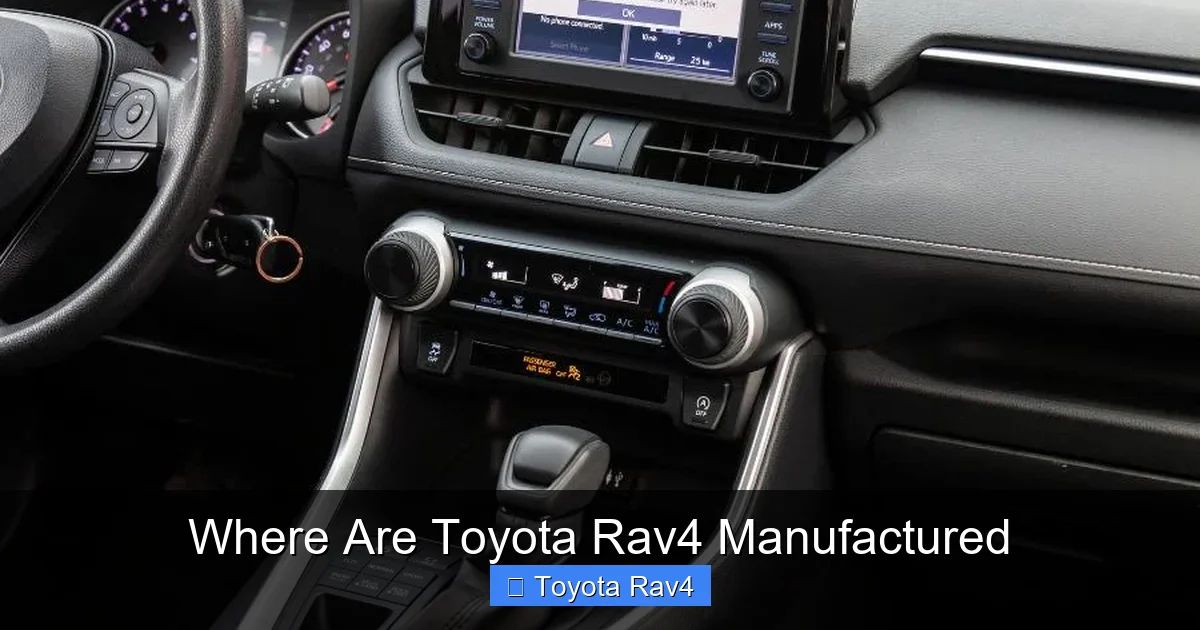
Visual guide about Where Are Toyota Rav4 Manufactured
Image source: rav4hub.com
Toyota operates a sophisticated global supply chain, and the RAV4 benefits from production in multiple strategic locations. Let’s take a closer look at the main plants responsible for building this popular SUV.
Toyota Motor Manufacturing, Kentucky (TMMK) – Georgetown, USA
The Georgetown, Kentucky plant is the largest Toyota manufacturing facility outside of Japan and one of the most important for RAV4 production. Opened in 1988, this massive 8.1 million-square-foot facility employs over 8,000 people and produces several Toyota models, including the Camry, Avalon, and Highlander. But since 2019, it has also been the primary North American production site for the RAV4.
This plant is a powerhouse. It can produce over 550,000 vehicles annually, and a significant portion of that output is dedicated to the RAV4. The Kentucky facility is known for its advanced robotics, quality control systems, and commitment to sustainability. For example, it uses solar panels and a landfill-free waste system, meaning nearly all waste is recycled or reused.
One of the biggest advantages of the Kentucky plant is its integration with North American supply chains. Many parts—like engines, transmissions, and electronics—are sourced from nearby suppliers, reducing shipping times and costs. This also means that RAV4s built here often have higher domestic content, which can be a selling point for buyers who prefer American-made vehicles.
If you’re buying a RAV4 in the U.S., there’s a very good chance it rolled off the assembly line in Georgetown. And because the plant produces both gas and hybrid versions, you’ll find a wide range of trims and configurations available locally.
Toyota Motor Manufacturing Canada (TMMC) – Woodstock, Ontario
Just north of the U.S. border, Toyota’s Woodstock plant in Ontario plays a crucial role in RAV4 production—especially for Canadian buyers. This facility opened in 2008 and was specifically designed to build compact SUVs. It currently produces the RAV4 and RAV4 Hybrid, with an annual capacity of around 140,000 vehicles.
The Woodstock plant is known for its efficiency and high-quality output. It uses Toyota’s renowned Production System (TPS), which focuses on minimizing waste, improving workflow, and empowering workers to stop the line if they spot a defect. This attention to detail ensures that every RAV4 built here meets Toyota’s strict standards.
One interesting fact: the Woodstock plant was the first in North America to produce the RAV4 Hybrid when it launched in 2016. This made Canada a leader in hybrid SUV production for Toyota. Today, the plant continues to produce both gas and hybrid models, with a growing emphasis on electrified vehicles.
For Canadian consumers, buying a RAV4 made in Woodstock means shorter wait times, easier access to service, and support for local jobs. It also means the vehicle is tailored to Canadian driving conditions—like cold-weather packages and all-wheel drive availability.
Toyota Motor Corporation – Japan (Various Plants)
While North America handles most RAV4 production for the Western market, Japan remains a key manufacturing hub—especially for hybrid models and vehicles sold in Asia. Toyota’s headquarters and several production facilities are based in Japan, including plants in Tahara (Aichi Prefecture) and Miyata (Fukuoka Prefecture).
The Tahara plant, in particular, is one of Toyota’s most advanced and prestigious facilities. Known for its precision and automation, it produces high-end models like the Lexus LS and Land Cruiser, but it also assembles RAV4s for export and domestic use. Vehicles built here often feature the latest technology and are subject to rigorous quality checks.
Japan’s role in RAV4 production is especially important for hybrid and plug-in hybrid versions. The RAV4 Prime, Toyota’s plug-in hybrid SUV, is primarily manufactured in Japan and then exported to markets like the U.S. and Europe. This is because Japan has a strong infrastructure for battery production and hybrid technology.
Buyers who prioritize cutting-edge engineering or want the latest hybrid tech might find that a Japan-built RAV4 offers slight advantages in terms of innovation. However, these models may come with longer wait times and higher import costs.
Toyota Tianjin (TTAC) – Tianjin, China
In China, the world’s largest automotive market, Toyota produces the RAV4 locally through a joint venture with FAW Group. The Tianjin plant (officially Toyota Tianjin Automobile Co., Ltd.) builds RAV4s specifically for Chinese consumers, allowing Toyota to avoid high import tariffs and respond quickly to local demand.
This localized production strategy is common among global automakers. By building vehicles in China, Toyota can offer competitive pricing, adapt features to Chinese preferences (like larger infotainment screens or premium interiors), and comply with local regulations, including emissions standards and safety requirements.
The Tianjin plant uses modern manufacturing techniques and follows Toyota’s global quality standards. However, it’s important to note that RAV4s made in China are generally not exported to other countries. They’re designed for the domestic market, so if you’re buying a RAV4 outside of China, it likely wasn’t built there.
How Manufacturing Location Affects Quality and Reliability
A common concern among car buyers is whether vehicles made in different countries vary in quality. After all, you’ve probably heard myths about “Japanese-made” cars being superior to those built elsewhere. So, does the manufacturing location of your RAV4 impact its reliability?
The good news is that Toyota enforces strict global quality standards across all its plants. Whether your RAV4 is built in Kentucky, Ontario, Japan, or China, it must pass the same rigorous inspections and testing procedures. Toyota’s Production System (TPS) is implemented worldwide, emphasizing continuous improvement, defect prevention, and worker involvement in quality control.
That said, there can be subtle differences. For example, Japanese-built vehicles often undergo additional scrutiny due to the country’s reputation for precision engineering. Some enthusiasts believe that Japan-made RAV4s have tighter tolerances or higher attention to detail, especially in hybrid models.
On the other hand, North American plants benefit from proximity to suppliers and a skilled workforce. The Kentucky and Ontario facilities have received numerous awards for quality and efficiency, including J.D. Power awards for manufacturing excellence.
In real-world terms, reliability studies—like those from Consumer Reports and J.D. Power—consistently rank the RAV4 among the most dependable SUVs, regardless of where it’s made. This suggests that Toyota’s global quality control is effective.
One practical tip: if you’re concerned about build quality, check the vehicle identification number (VIN). The 11th character in the VIN indicates the assembly plant. For example, a VIN ending in “K” typically means the vehicle was built in Kentucky, while “C” often refers to Canada. You can use online VIN decoders to find out exactly where your RAV4 was manufactured.
Environmental and Economic Impact of Global Production
Toyota’s decision to manufacture the RAV4 in multiple countries isn’t just about logistics—it’s also about sustainability and economic responsibility. By building vehicles closer to their markets, Toyota reduces the carbon footprint associated with long-distance shipping. A RAV4 built in Kentucky and sold in Chicago travels far less than one shipped from Japan, resulting in lower emissions.
Additionally, local production supports regional economies. The Georgetown plant, for instance, has created thousands of jobs in Kentucky and supports hundreds of local suppliers. Similarly, the Woodstock plant has boosted Ontario’s automotive sector and contributed to Canada’s green manufacturing initiatives.
Toyota also invests in sustainable practices at its plants. Many facilities use renewable energy, recycle water, and aim for zero waste to landfill. The Kentucky plant, for example, generates part of its electricity from solar panels and has a stormwater recycling system.
For eco-conscious buyers, this means that choosing a locally built RAV4 can align with your values—both in terms of environmental impact and community support.
Tips for Buyers: How to Know Where Your RAV4 Was Made
If you’re shopping for a Toyota RAV4 and want to know its origin, here are a few practical tips:
First, check the window sticker (Monroney label) on new vehicles. It usually includes the assembly plant location. For used cars, you can decode the VIN using free online tools. The 11th character reveals the plant code—common ones include “K” for Kentucky, “C” for Canada, and “J” for Japan.
Second, ask the dealer. Reputable dealerships should be able to provide information about the vehicle’s origin. Some may even have records showing where the RAV4 was built and when it was shipped.
Third, consider your priorities. If you prefer American-made vehicles, look for RAV4s built in Kentucky. If you want the latest hybrid tech, a Japan-built model might be worth the wait. And if you’re in Canada, a Woodstock-built RAV4 offers local support and faster delivery.
Finally, remember that no matter where it’s made, the Toyota RAV4 is designed to be reliable, safe, and efficient. The manufacturing location is just one piece of the puzzle—what matters most is how well the vehicle meets your needs.
Conclusion
The Toyota RAV4 is a global success story, and its widespread availability is thanks to a smart, decentralized manufacturing strategy. From the high-tech plants in Kentucky and Ontario to the precision facilities in Japan and the growing presence in China, Toyota ensures that RAV4s are built where they’re needed most.
While the manufacturing location can influence delivery times, pricing, and even minor features, one thing remains constant: Toyota’s commitment to quality. Every RAV4, no matter where it’s made, is built to the same high standards of reliability, safety, and performance.
So the next time you see a RAV4 on the road, you’ll know it could have come from any number of world-class facilities. And whether it was assembled in the U.S., Canada, Japan, or China, you can trust that it was built with care, precision, and a focus on long-term value.
Frequently Asked Questions
Where is the Toyota RAV4 primarily manufactured for the U.S. market?
The majority of Toyota RAV4s sold in the U.S. are manufactured at the Toyota Motor Manufacturing Kentucky (TMMK) plant in Georgetown, Kentucky. This facility produces both gas and hybrid versions of the RAV4.
Are Toyota RAV4s made in Canada?
Yes, the Toyota RAV4 is produced at the Toyota Motor Manufacturing Canada (TMMC) plant in Woodstock, Ontario. These vehicles primarily serve the Canadian market and parts of the northern U.S.
Does Toyota make the RAV4 in Japan?
Yes, some RAV4 models—especially hybrid and plug-in hybrid versions—are manufactured in Japan, primarily at plants in Tahara and Miyata. These are often exported to global markets.
Is the Toyota RAV4 made in China?
Yes, the RAV4 is produced in Tianjin, China, through a joint venture with FAW Group. However, these vehicles are intended for the Chinese domestic market and are not typically exported.
How can I find out where my Toyota RAV4 was made?
You can check the 11th character of your vehicle’s VIN (Vehicle Identification Number). This character indicates the assembly plant. Online VIN decoders can help you identify the location.
Does the manufacturing location affect the quality of the RAV4?
No, all Toyota RAV4s are built to the same global quality standards, regardless of location. Toyota’s Production System ensures consistency in reliability, safety, and performance worldwide.