
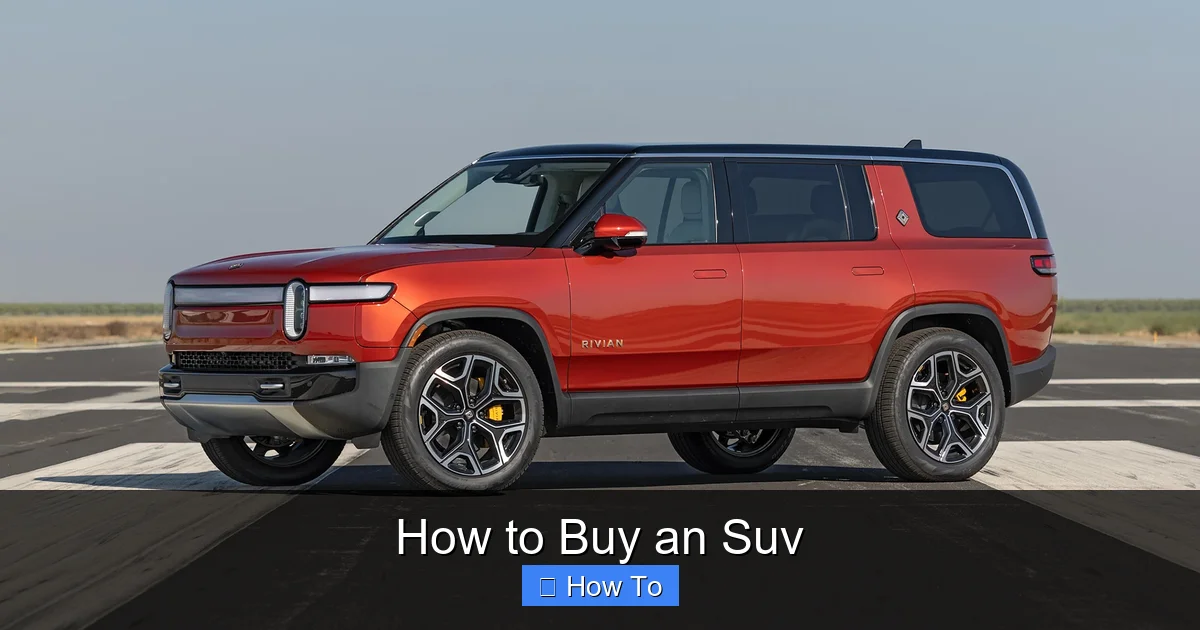
Buying an SUV doesn’t have to be overwhelming. This step-by-step guide walks you through everything from setting a budget to finalizing the purchase, helping you find the right vehicle for your lifestyle and needs.
Key Takeaways
- Set a realistic budget: Include not just the purchase price but also insurance, fuel, maintenance, and taxes to avoid financial strain.
- Choose the right size and type: Compact, midsize, full-size, or luxury—pick an SUV that fits your space, passenger, and cargo needs.
- Research reliability and safety: Use trusted sources like Consumer Reports, IIHS, and J.D. Power to compare crash ratings and long-term dependability.
- Test drive multiple models: Experience handling, comfort, visibility, and tech features firsthand before deciding.
- Negotiate smartly: Know the invoice price, current incentives, and market trends to get a fair deal without overpaying.
- Consider new vs. used: New SUVs offer latest features and warranties; certified pre-owned (CPO) models provide value with peace of mind.
- Review financing and warranty options: Compare loan rates, lease terms, and extended coverage to protect your investment.
How to Buy an SUV: A Complete Step-by-Step Guide
Buying an SUV is a big decision—whether you’re upgrading from a sedan, need more space for your growing family, or want a vehicle that can handle rough weather and off-road adventures. With so many options on the market, it’s easy to feel overwhelmed. But don’t worry. This comprehensive guide will walk you through every step of the process, from figuring out your needs to driving off the lot in your new ride.
By the end of this guide, you’ll know exactly how to buy an SUV that fits your budget, lifestyle, and long-term goals. We’ll cover everything from setting a realistic budget and choosing the right size to test driving, negotiating, and finalizing the purchase. Let’s get started.
Step 1: Determine Your Needs and Priorities
Before you even look at a single SUV, take time to reflect on what you really need. SUVs come in all shapes and sizes, and each is designed for different purposes. Asking yourself the right questions will help narrow your search.
How many passengers do you need to seat?
If you have a large family or frequently carpool, you’ll want an SUV with three rows of seating. Models like the Honda Pilot, Toyota Highlander, or Kia Telluride offer comfortable seating for seven or eight passengers. On the other hand, if you mostly drive alone or with one other person, a compact SUV like the Mazda CX-5 or Subaru Forester might be more than enough.
What will you use the SUV for?
Think about your daily routine. Do you commute long distances? Need to haul gear for weekend adventures? Tow a trailer or boat? If you plan to tow, look for SUVs with high towing capacity—like the Ford Explorer or Jeep Grand Cherokee—and make sure it has the right hitch and cooling systems.
Do you need all-wheel drive (AWD) or four-wheel drive (4WD)?
If you live in an area with snow, rain, or rough terrain, AWD or 4WD can improve traction and safety. Most modern SUVs offer AWD as an option, but 4WD is better for serious off-roading. Keep in mind that these systems can reduce fuel economy slightly.
How important is fuel efficiency?
SUVs are generally less fuel-efficient than sedans, but some models are surprisingly economical. Hybrid SUVs like the Toyota RAV4 Hybrid or Ford Escape Hybrid can get over 40 miles per gallon. If you drive a lot, fuel costs can add up, so consider efficiency early.
Do you value tech and comfort features?
Modern SUVs come packed with features like Apple CarPlay, Android Auto, adaptive cruise control, blind-spot monitoring, and premium sound systems. Decide which features are must-haves versus nice-to-haves. For example, if you rely on navigation, make sure the infotainment system is user-friendly.
Step 2: Set a Realistic Budget
One of the most important steps in how to buy an SUV is figuring out how much you can afford. It’s not just about the sticker price—there are many hidden costs to consider.
Calculate your total cost of ownership
Start by determining your maximum monthly payment. A good rule of thumb is that your car payment should not exceed 10–15% of your take-home pay. Use an online auto loan calculator to estimate payments based on different loan terms and interest rates.
But don’t stop there. Factor in:
- Insurance: SUVs often cost more to insure than smaller cars, especially if they’re luxury models or have high repair costs.
- Fuel: Larger SUVs with V6 or V8 engines consume more gas. Check EPA estimates and calculate annual fuel costs.
- Maintenance and repairs: Some brands are more reliable and cheaper to maintain than others. Research average repair costs for models you’re considering.
- Depreciation: New SUVs lose value quickly—often 20% in the first year. If you plan to sell or trade in later, this affects your long-term cost.
- Taxes and registration: These vary by state and can add hundreds to your upfront cost.
Decide: New, Used, or Certified Pre-Owned?
New SUVs come with the latest tech, full warranties, and no prior wear and tear. But they’re expensive and depreciate fast.
Used SUVs are more affordable but come with unknown history and potentially higher maintenance costs.
Certified Pre-Owned (CPO) vehicles offer a middle ground. They’re typically 1–3 years old, have been inspected and refurbished by the dealer, and come with extended warranties. CPO programs from brands like Honda Certified, Toyota Certified, and Hyundai Certified are excellent options if you want reliability without the new-car price.
Get pre-approved for financing
Before visiting a dealership, get pre-approved for an auto loan from your bank or credit union. This gives you leverage when negotiating and helps you stick to your budget. Compare interest rates and loan terms from at least three lenders.
Step 3: Research and Compare SUV Models
Now that you know your needs and budget, it’s time to research. Don’t rely solely on ads or dealer recommendations—do your homework.
Use trusted review sources
Check out expert reviews from sites like:
- Kelley Blue Book (KBB): Offers pricing, reviews, and resale value data.
- Edmunds: Provides detailed comparisons, owner reviews, and buying advice.
- Consumer Reports: Rates reliability, safety, and owner satisfaction based on surveys.
- IIHS (Insurance Institute for Highway Safety): Publishes crash test results and safety ratings.
- J.D. Power: Measures initial quality and long-term dependability.
Compare key specs side by side
Create a spreadsheet or use online comparison tools to evaluate:
- Engine power and fuel economy
- Cargo space (behind second and third rows)
- Passenger room (headroom, legroom)
- Safety ratings and standard driver aids
- Infotainment and connectivity features
- Warranty coverage
For example, if you’re deciding between the Hyundai Santa Fe and the Ford Edge, compare their standard safety tech, cargo volume, and warranty lengths. The Santa Fe often wins on value and warranty, while the Edge may offer a more powerful engine option.
Read owner reviews
Expert reviews are helpful, but real-world experiences matter too. Look for owner feedback on forums like Reddit, Edmunds, or CarComplaints.com. Pay attention to common issues—like transmission problems, electrical glitches, or poor build quality.
Step 4: Test Drive Multiple SUVs
You can’t truly know how an SUV feels until you drive it. Schedule test drives for your top 2–3 choices—and don’t rush.
Prepare for the test drive
Before you go, make a checklist of things to evaluate:
- Seat comfort and adjustability
- Visibility (blind spots, rearview camera quality)
- Ease of use for controls and touchscreen
- Noise levels at highway speeds
- Handling on curves and bumps
- Braking responsiveness
- Acceleration and passing power
Bring your family along if possible. Have them sit in the back seats and third row (if applicable) to check for comfort and space.
Test different driving conditions
Don’t just drive around the block. Ask to take the SUV on a highway, up a hill, and over rough pavement if possible. This will help you assess performance in real-world scenarios.
Pay attention to the little things
Notice how easy it is to open the tailgate, adjust the mirrors, or connect your phone. Small annoyances can become big frustrations over time.
Step 5: Check Vehicle History (For Used SUVs)
If you’re buying a used or CPO SUV, always check the vehicle history report.
Get a report from Carfax or AutoCheck
These reports show:
- Accident history
- Number of previous owners
- Service and maintenance records
- Title status (clean, salvage, rebuilt)
- Odometer readings
- Recall information
Avoid vehicles with salvage titles or major accidents unless you’re getting a steep discount and have them inspected by a mechanic.
Have it inspected by a trusted mechanic
Even if the SUV looks perfect, a pre-purchase inspection can uncover hidden problems. A mechanic can check the engine, transmission, suspension, brakes, and undercarriage for signs of wear or damage. This typically costs $100–$150 but can save you thousands in repairs.
Step 6: Negotiate the Best Price
Now comes the fun part—negotiating. Most people dread this step, but with the right approach, you can get a fair deal.
Know the market value
Use KBB or Edmunds to find the fair market price for the SUV you want. Look at the “invoice price” (what the dealer paid) and “MSRP” (sticker price). Aim to pay closer to invoice, especially if there are incentives.
Time your purchase wisely
Dealers are more willing to negotiate at the end of the month, quarter, or year when they’re trying to meet sales targets. Also, shop on weekdays when the lot is less busy.
Be ready to walk away
If the dealer won’t meet your price, don’t be afraid to leave. There are plenty of other SUVs and dealers. Being willing to walk away gives you power.
Negotiate the price, not the monthly payment
Dealers may try to distract you by focusing on low monthly payments, but this can hide a longer loan term or higher interest rate. Always negotiate the out-the-door price first.
Ask about incentives and rebates
Manufacturers often offer cash rebates, low-interest financing, or lease deals. Check the brand’s website or ask the dealer what’s currently available. These can save you thousands.
Step 7: Review Financing and Warranty Options
Once you’ve agreed on a price, it’s time to finalize the deal.
Compare financing offers
Even if you’re pre-approved, compare the dealer’s financing offer. Sometimes dealers have special rates through manufacturer financing programs. Choose the option with the lowest total cost (interest + fees).
Understand the warranty
New SUVs come with a basic warranty (usually 3 years/36,000 miles) and a powertrain warranty (5 years/60,000 miles). Some brands, like Hyundai and Kia, offer longer coverage.
Ask about:
- What’s covered and for how long
- Roadside assistance and rental car reimbursement
- Transferability if you sell the vehicle
Consider an extended warranty
Extended warranties can provide peace of mind, but they’re not always worth it. They’re often overpriced and may cover things already included in the factory warranty. Read the fine print and compare third-party providers like Endurance or CarShield.
Step 8: Finalize the Purchase
You’re almost there! Before signing, double-check everything.
Review the sales contract
Make sure the price, trade-in value, fees, and financing terms match what you agreed on. Watch out for add-ons like paint protection, fabric coating, or VIN etching—these are often unnecessary and overpriced.
Confirm trade-in value
If you’re trading in your old vehicle, ensure the offer is fair. Use KBB’s “Trade-In Value” tool to estimate what your car is worth.
Complete paperwork and take delivery
Once everything is signed, the dealer will process the title, registration, and insurance. They’ll also walk you through the SUV’s features and set up any connected services.
Take your time during the walkthrough. Ask questions about the infotainment system, maintenance schedule, and how to use safety features.
Troubleshooting Common Buying Issues
Even with careful planning, problems can arise. Here’s how to handle them:
“The dealer won’t budge on price.”
Try shopping at multiple dealerships. Use email or online quotes to compare offers. Sometimes, a competing dealer will match or beat a price to win your business.
“I found a problem after buying.”
If it’s a new SUV, contact the dealer immediately—most issues are covered under warranty. For used SUVs, check your state’s “lemon law” or consumer protection laws. Some states offer a short return period for used cars.
“My financing fell through.”
If your loan is denied at the last minute, ask the dealer for alternative financing options. You can also reapply with a co-signer or improve your credit before reapplying.
“I regret my choice.”
It happens. If you’re within the return window (some dealers offer 3–7 days), you may be able to exchange the vehicle. Otherwise, consider selling it privately or trading it in after a few months.
Conclusion
Buying an SUV is a major investment, but with the right approach, it can be a smooth and rewarding experience. By defining your needs, setting a budget, researching models, test driving, and negotiating wisely, you’ll find a vehicle that fits your life and lasts for years.
Remember, the best SUV for you isn’t necessarily the biggest, most powerful, or most expensive one—it’s the one that meets your needs, fits your budget, and makes you feel confident on the road.
Take your time, stay informed, and don’t let sales pressure rush you. When you follow this guide, you’ll know exactly how to buy an SUV the smart way.