
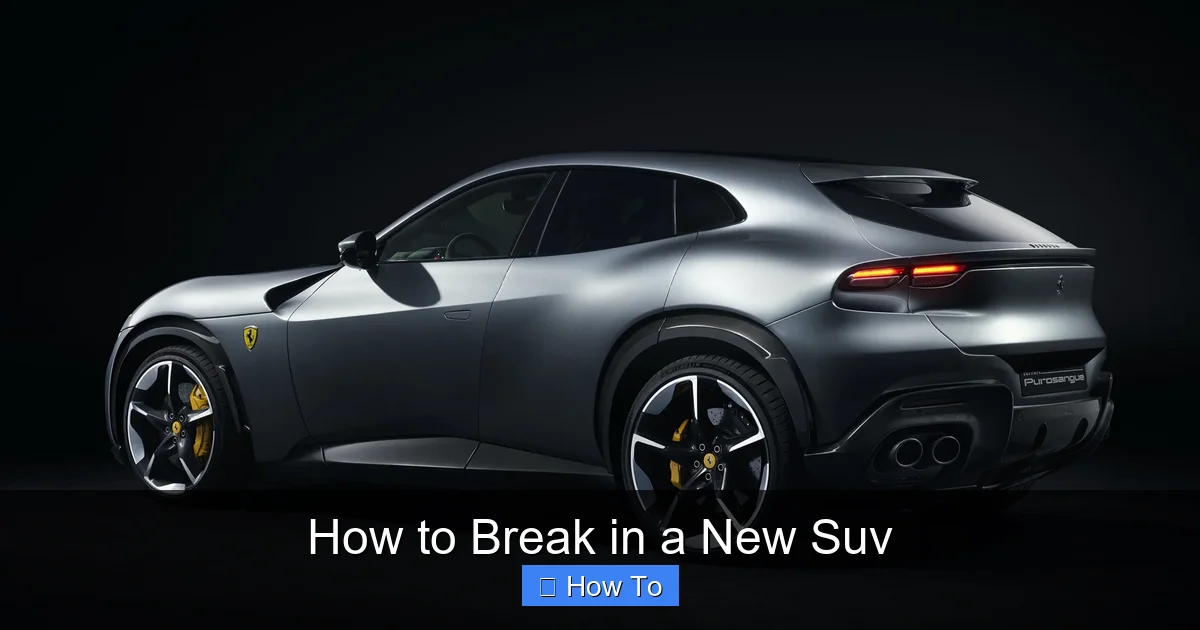
Breaking in a new SUV properly helps ensure optimal engine performance, fuel efficiency, and longevity. This guide walks you through essential steps—from gentle driving to scheduled maintenance—so your vehicle runs smoothly for years.
Key Takeaways
- Drive gently for the first 500–1,000 miles: Avoid hard acceleration, high speeds, and heavy loads to allow engine components to seat properly.
- Follow the manufacturer’s break-in recommendations: Check your owner’s manual for specific guidelines tailored to your SUV model.
- Vary your driving speed: Frequent speed changes help seat piston rings and improve engine efficiency over time.
- Change the oil early: Many experts recommend an early oil change (around 500–1,000 miles) to remove metal particles from initial wear.
- Monitor tire pressure and alignment: Proper inflation and alignment reduce uneven wear and improve handling during the break-in period.
- Avoid towing or hauling heavy loads: Wait until after the first 1,000 miles before using your SUV for heavy-duty tasks.
- Keep records of maintenance and driving habits: Documenting your break-in process helps with future service and resale value.
How to Break in a New SUV
Congratulations on your new SUV! Whether you’re driving a rugged off-roader or a sleek family crossover, one of the most important things you can do to protect your investment is to properly break in your vehicle. The break-in period—typically the first 500 to 1,000 miles—is a critical time when engine components, transmission, brakes, and tires are settling into their optimal performance state. Doing it right can lead to better fuel economy, smoother operation, and a longer lifespan for your SUV.
In this guide, we’ll walk you through everything you need to know about how to break in a new SUV. You’ll learn the best driving practices, maintenance tips, and common mistakes to avoid. By following these steps, you’ll help ensure your SUV performs at its best from day one and for many years to come.
Why Breaking In a New SUV Matters

Visual guide about How to Break in a New Suv
Image source: cdn2.allevents.in
You might be wondering: “Isn’t my new SUV already tested at the factory?” The answer is yes—but that doesn’t mean it’s fully “broken in.” Modern manufacturing is incredibly precise, but engines still have microscopic imperfections in moving parts like pistons, rings, and cylinder walls. During the first few hundred miles, these parts wear against each other in a controlled way, creating a perfect seal and smooth operation.
Think of it like breaking in a new pair of shoes. At first, they might feel stiff or uncomfortable, but after a few wears, they mold to your feet and feel just right. The same principle applies to your SUV’s engine and drivetrain. A proper break-in allows components to seat correctly, reduces internal friction, and improves overall efficiency.
Skipping or rushing this process can lead to premature wear, reduced fuel economy, and even engine damage down the line. So, while it might be tempting to floor the gas and take your new SUV on a road trip right away, patience during the break-in period pays off in the long run.
Step 1: Read the Owner’s Manual

Visual guide about How to Break in a New Suv
Image source: motortrend.com
Before you even start the engine, grab your owner’s manual. Every SUV manufacturer provides specific break-in recommendations based on the vehicle’s design, engine type, and intended use. These guidelines are your best source of truth.
For example, some manufacturers recommend avoiding speeds over 55 mph for the first 500 miles, while others suggest varying your RPMs during highway driving. Luxury SUVs with turbocharged engines may have different requirements than diesel-powered models. Hybrid SUVs might also have unique instructions for battery and motor conditioning.
Don’t assume all SUVs are the same—what works for your friend’s truck might not apply to your crossover. Take 10 minutes to read the break-in section in your manual. It could save you thousands in repairs later.
Step 2: Drive Gently for the First 500–1,000 Miles
The golden rule of breaking in a new SUV is to drive gently. This doesn’t mean you can’t enjoy your vehicle—it just means being mindful of how you drive during the initial phase.
Avoid Hard Acceleration and Sudden Braking
When you press the gas pedal, do it smoothly and gradually. Avoid “flooring it” from a stop, especially when the engine is cold. Sudden bursts of power put extra stress on the engine, transmission, and drivetrain—components that haven’t yet settled into their optimal positions.
Similarly, avoid slamming on the brakes. Instead, anticipate stops and brake early and gently. This helps the brake pads and rotors wear in evenly, improving stopping power and reducing the risk of warping.
Keep Speeds Moderate
Most experts recommend keeping your speed under 55–60 mph during the first 500 miles. On highways, use cruise control sparingly—or not at all—during this period. Constant speed can prevent proper piston ring seating, which relies on varying engine loads.
If you must drive on the highway, try to vary your speed slightly. For example, drive at 55 mph for a few minutes, then ease up to 60 mph, then back down. This variation helps the engine components wear in more effectively.
Don’t Redline the Engine
Avoid revving the engine to its redline, especially when cold. High RPMs increase internal friction and heat, which can cause premature wear. Most SUVs are designed to operate efficiently at lower RPMs, so there’s no need to push the engine hard.
A good rule of thumb: keep the engine below 3,000–3,500 RPM during the first 500 miles. After that, you can gradually increase your RPM range, but still avoid sustained high revs.
Step 3: Vary Your Driving Conditions
One of the most effective ways to break in a new SUV is to expose it to a variety of driving conditions. This helps different systems—engine, transmission, suspension, and brakes—adapt and wear in properly.
Mix City and Highway Driving
Don’t just drive on highways or only in stop-and-go traffic. A mix of both is ideal. City driving allows for frequent acceleration and braking, which helps seat brake components. Highway driving, when done at moderate speeds, helps the engine and transmission operate under steady load.
Try to take your SUV on a short road trip during the break-in period—just keep speeds moderate and avoid long stretches at constant RPMs.
Use Different Gears (If Manual or Sport Mode)
If your SUV has a manual transmission or a sport mode with paddle shifters, use them to vary gear engagement. Shift through the gears smoothly, avoiding lugging the engine (driving in too high a gear at low speeds) or over-revving.
For automatic transmissions, avoid using “sport” or “tow/haul” modes during break-in. These modes increase shift firmness and engine load, which can be too harsh for new components.
Step 4: Avoid Heavy Loads and Towing
Your new SUV may be capable of towing a trailer or carrying heavy cargo, but now is not the time to test its limits. Wait until after the first 1,000 miles before towing or hauling heavy loads.
Why? Because the engine, transmission, and cooling system are still settling in. Adding extra weight increases stress on these components, potentially leading to overheating, premature wear, or even failure.
If you absolutely must carry a heavy load during the break-in period, do so sparingly and at reduced speeds. Keep the load well below the vehicle’s maximum capacity, and monitor engine temperature closely.
Step 5: Warm Up the Engine Properly
Modern SUVs don’t need long warm-up periods like older models, but it’s still important to let the engine reach operating temperature before driving aggressively.
Start with a 30-Second Idle
When you start your SUV in cold weather, let it idle for about 30 seconds. This allows oil to circulate and reach critical engine parts. Then, drive gently for the first few minutes until the engine warms up.
Avoid revving the engine while it’s cold. Cold oil is thicker and doesn’t lubricate as effectively, so sudden acceleration can cause increased wear.
Use the Heater and Defroster Wisely
If it’s cold outside, use the heater and defroster to warm up the cabin, but don’t blast them at maximum right away. Let the engine warm up naturally. This also helps the transmission fluid reach optimal temperature, improving shift quality.
Step 6: Follow the First Oil Change Schedule
One of the most debated topics in break-in procedures is the first oil change. While some manufacturers say it’s fine to wait until the first scheduled maintenance (usually around 5,000–7,500 miles), many mechanics and experts recommend changing the oil earlier—around 500 to 1,000 miles.
Why an Early Oil Change Helps
During the break-in period, tiny metal particles from engine components wear off and mix with the oil. These particles, while microscopic, can act like sandpaper inside the engine if left too long. An early oil change removes these contaminants, helping protect your engine.
Check your owner’s manual—some manufacturers actually recommend an early oil change. If not, consider doing it yourself or having it done at a trusted service center. Use the same high-quality oil specified by the manufacturer.
Use the Right Oil
Always use the oil grade and type recommended in your manual. For most modern SUVs, this is synthetic or synthetic blend oil. Don’t switch to a different brand or viscosity during break-in unless advised by the manufacturer.
Step 7: Check Tire Pressure and Alignment
Your SUV’s tires are the only part of the vehicle that touches the road, so proper care during break-in is essential.
Maintain Correct Tire Pressure
Check tire pressure at least once a week during the break-in period. Underinflated tires increase rolling resistance, reduce fuel economy, and cause uneven wear. Overinflated tires reduce traction and can lead to blowouts.
Use the pressure listed on the driver’s side door jamb—not the maximum pressure on the tire sidewall. Cold tires should be checked in the morning before driving.
Get a Wheel Alignment
If your SUV pulls to one side or you notice uneven tire wear after a few hundred miles, schedule a wheel alignment. Misaligned wheels can cause premature tire wear and affect handling, especially during the break-in phase when suspension components are settling.
Most dealerships offer a free alignment check with purchase, so take advantage of it.
Step 8: Monitor Fluid Levels and Dashboard Warnings
During the break-in period, keep an eye on all fluid levels—engine oil, coolant, transmission fluid, brake fluid, and windshield washer fluid. Top them off as needed, and report any leaks or low levels to your dealer.
Also, pay attention to dashboard warning lights. If the check engine light, oil pressure light, or temperature warning comes on, stop driving and have the vehicle inspected immediately. Early detection of issues can prevent major problems.
Step 9: Break In the Brakes
Your SUV’s brake system also needs a gentle break-in period. New brake pads and rotors need to wear in evenly to provide optimal stopping power.
Avoid Hard Braking
For the first 200–300 miles, avoid sudden or hard braking. Instead, brake early and gradually. This allows the brake pads to transfer a thin, even layer of material onto the rotors—a process called “bedding in.”
Do a Controlled Brake Bedding (Optional)
Some drivers choose to perform a controlled brake bedding process after the first few hundred miles. This involves driving at a steady speed (around 50 mph), then applying the brakes firmly (but not to a full stop) to slow to 20 mph. Repeat this 5–10 times, allowing the brakes to cool between cycles.
This process helps maximize braking performance and reduce the risk of brake fade. However, it’s not required for most drivers—gentle driving usually suffices.
Step 10: Keep a Break-In Log
Consider keeping a simple log of your break-in activities. Note the date, mileage, driving conditions, fuel economy, and any observations (e.g., “engine sounds smoother,” “brakes feel more responsive”).
This log can be helpful for future maintenance, warranty claims, or when selling the vehicle. It also helps you track your progress and stay accountable to gentle driving habits.
Troubleshooting Common Break-In Issues
Even with careful driving, you might encounter some issues during the break-in period. Here’s how to handle them:
Engine Noise or Knocking
If you hear unusual noises from the engine, such as knocking or ticking, don’t ignore them. While some minor noise is normal, persistent knocking could indicate a problem with fuel quality, oil level, or engine timing. Visit your dealer for a diagnostic check.
Poor Fuel Economy
It’s normal for fuel economy to be lower during break-in. Engine components are still wearing in, and the computer is learning your driving habits. If mileage doesn’t improve after 1,000 miles, have the vehicle inspected.
Vibrations or Pulling
If your SUV vibrates at certain speeds or pulls to one side, it could be a tire, alignment, or suspension issue. Schedule a service appointment to rule out problems.
Transmission Hesitation
Some SUVs may hesitate or shift roughly during break-in, especially if driven too aggressively. Gentle driving and an early transmission fluid check can help. If the issue persists, consult your dealer.
When Can You Drive Normally?
After the first 1,000 miles, most SUVs are considered fully broken in. At this point, you can gradually return to normal driving habits—accelerating more confidently, using higher speeds, and even towing (if your vehicle is rated for it).
However, continue to follow regular maintenance schedules and avoid consistently pushing the engine to its limits. Even after break-in, your SUV will perform best with consistent care.
Conclusion
Breaking in a new SUV doesn’t have to be complicated, but it does require patience and attention to detail. By driving gently, varying your conditions, following maintenance guidelines, and avoiding heavy loads, you’ll help your vehicle reach its full potential.
Remember, the break-in period is an investment in your SUV’s long-term health. A little extra care now can lead to years of smooth, reliable performance. So take it slow, enjoy the ride, and trust that your patience will pay off every time you turn the key.
Your new SUV is ready to take on the road—just give it the break-in it deserves.