
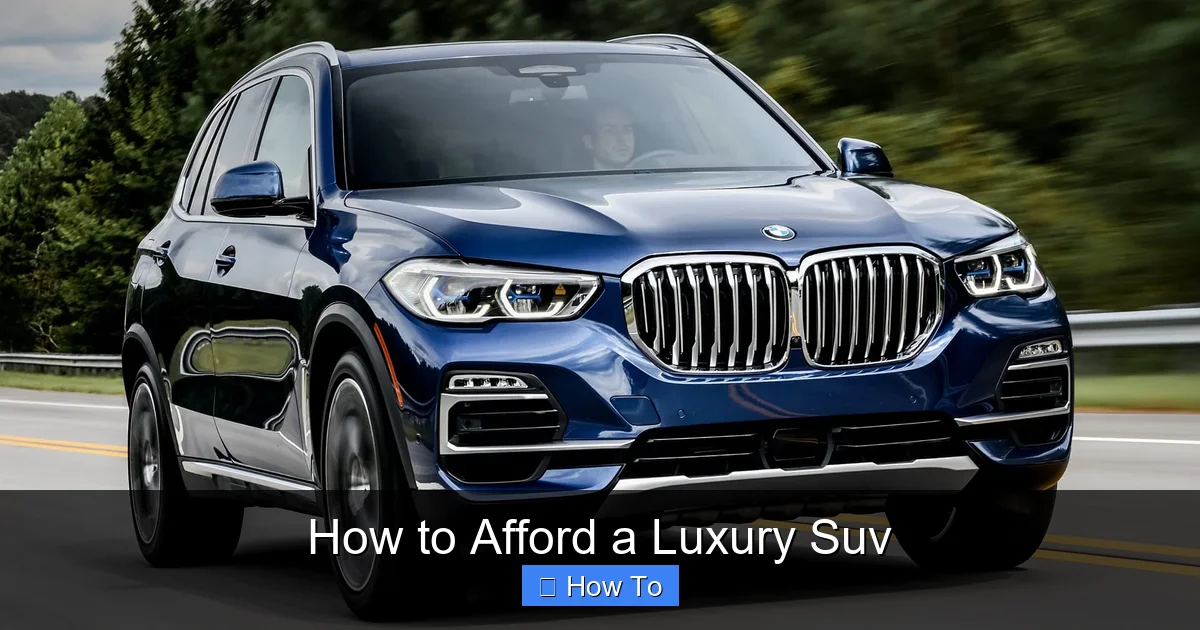
Owning a luxury SUV is more achievable than you think with the right plan. This guide breaks down practical steps—from budgeting and saving to smart financing and timing your purchase—so you can drive your dream vehicle without financial stress.
Key Takeaways
- Start with a realistic budget: Know your income, expenses, and how much you can comfortably afford to spend on a luxury SUV each month.
- Save aggressively with a dedicated fund: Open a high-yield savings account and automate monthly contributions to build your down payment faster.
- Improve your credit score: A higher credit score means lower interest rates and better loan terms, saving you thousands over time.
- Consider certified pre-owned (CPO) models: You get near-new quality at a lower price with extended warranties and thorough inspections.
- Time your purchase wisely: Shop at the end of the month, quarter, or year when dealers are most motivated to meet sales targets.
- Negotiate like a pro: Research prices, use competing offers, and don’t be afraid to walk away for the best deal.
- Factor in total ownership costs: Include insurance, fuel, maintenance, and depreciation—not just the monthly payment.
How to Afford a Luxury SUV: A Step-by-Step Guide
Dreaming of driving a sleek, powerful luxury SUV? You’re not alone. From the refined comfort of a Lexus RX to the bold presence of a BMW X5 or the tech-packed cabin of a Tesla Model Y, luxury SUVs offer style, performance, and status. But let’s be honest—they come with a hefty price tag. The good news? With smart planning, discipline, and a few insider strategies, you can afford a luxury SUV without derailing your financial future.
This guide will walk you through every step—from setting a realistic budget to negotiating the best deal and managing ongoing costs. Whether you’re aiming for a new or certified pre-owned model, these actionable tips will help you make a confident, informed decision. By the end, you’ll know exactly how to afford a luxury SUV the smart way.
Step 1: Assess Your Financial Readiness

Visual guide about How to Afford a Luxury Suv
Image source: imagine-club.com
Before you even look at car models, take a hard look at your finances. Can you truly afford a luxury SUV without stretching yourself too thin? The goal isn’t just to make the monthly payment—it’s to own the vehicle comfortably, including insurance, fuel, maintenance, and unexpected repairs.
Calculate Your Monthly Take-Home Pay
Start by determining your net monthly income—the amount you actually bring home after taxes and deductions. This is your true spending power. Don’t use your gross income; that number is misleading and can lead to overspending.
For example, if you earn $80,000 a year, your gross monthly income is about $6,667. But after taxes, retirement contributions, and health insurance, your take-home pay might be closer to $4,800. That’s the number you should base your budget on.
Track Your Monthly Expenses
Next, list all your monthly expenses. Use a budgeting app like Mint, YNAB (You Need A Budget), or even a simple spreadsheet. Include:
– Rent or mortgage
– Utilities (electric, gas, water, internet)
– Groceries and dining out
– Transportation (gas, public transit, current car payment)
– Insurance (health, renters, etc.)
– Debt payments (credit cards, student loans)
– Entertainment and subscriptions
– Savings and investments
Once you’ve tallied everything, subtract your total expenses from your take-home pay. The result is your discretionary income—the money you can use for non-essentials like a luxury SUV payment.
Apply the 20/4/10 Rule
A smart rule of thumb for car buying is the 20/4/10 rule:
– **20% down payment**: Aim to put at least 20% of the car’s price down to reduce your loan amount and avoid being “upside down” on your loan.
– **4-year loan term**: Avoid long-term loans (6+ years). They may lower your monthly payment but cost more in interest over time.
– **10% of income**: Your total car expenses (payment + insurance + fuel + maintenance) should not exceed 10% of your monthly take-home pay.
For example, if you take home $5,000 a month, your total car costs should stay under $500 per month.
If your numbers don’t add up yet, don’t panic. That’s what the next steps are for.
Step 2: Build a Down Payment Fund
Visual guide about How to Afford a Luxury Suv
Image source: rollsauto.com
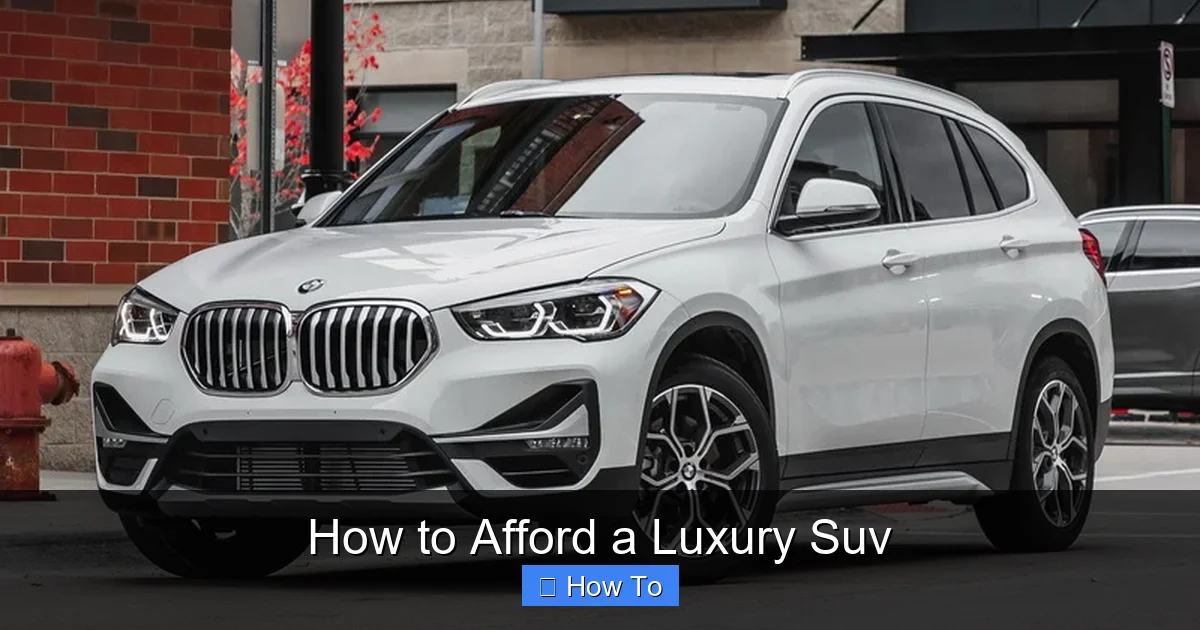
A larger down payment is your secret weapon for affording a luxury SUV. It lowers your loan amount, reduces monthly payments, and helps you avoid negative equity (owing more than the car is worth).
Set a Realistic Savings Goal
Let’s say you’re eyeing a $60,000 luxury SUV. A 20% down payment would be $12,000. That’s a big number, but it’s achievable with a plan.
Break it down: If you save $500 a month, you’ll reach $12,000 in 24 months. If you can save $750 a month, you’ll get there in just 16 months.
Open a High-Yield Savings Account
Don’t keep your car fund in a regular checking account where it earns little to no interest. Instead, open a high-yield savings account (HYSA) with an online bank like Ally, Marcus by Goldman Sachs, or Discover. These accounts offer 4–5% annual interest, helping your money grow faster.
Set up automatic transfers from your checking to your savings account right after payday. Out of sight, out of mind—this “pay yourself first” strategy builds discipline.
Cut Expenses and Boost Income
To accelerate your savings, look for ways to free up cash:
– Cancel unused subscriptions (streaming services, gym memberships)
– Cook at home more often
– Downsize your phone plan
– Sell unused items (electronics, clothing, furniture)
You can also boost income with a side hustle—freelancing, tutoring, driving for rideshare apps, or selling handmade goods online. Even an extra $200 a month can cut months off your savings timeline.
Use Windfalls Wisely
Tax refunds, bonuses, or gifts from family can give your down payment a serious boost. Instead of splurging, commit to putting at least half of any windfall toward your luxury SUV fund.
Step 3: Improve Your Credit Score
Your credit score is one of the biggest factors in determining your auto loan interest rate. The higher your score, the lower your rate—and the less you’ll pay over the life of the loan.
Check Your Credit Report
Start by getting a free copy of your credit report from AnnualCreditReport.com. Review it for errors—incorrect balances, accounts you didn’t open, or late payments that were actually on time. Dispute any inaccuracies with the credit bureaus.
Pay Down Debt
Credit utilization—the percentage of your available credit you’re using—is a major factor in your score. Aim to keep it below 30%, ideally under 10%.
For example, if you have a $5,000 credit limit and a $2,000 balance, your utilization is 40%. Paying that down to $500 brings it to 10%, which can significantly boost your score.
Focus on paying off high-interest credit cards first. Consider a balance transfer card with a 0% introductory rate to save on interest while you pay down debt.
Make On-Time Payments
Payment history makes up 35% of your credit score. Set up automatic payments for at least the minimum amount due on all your accounts. Even one missed payment can hurt your score for months.
Avoid New Credit Applications
Each time you apply for credit, a “hard inquiry” appears on your report and can lower your score slightly. Avoid opening new credit cards or loans in the months leading up to your car purchase.
Become an Authorized User
If a family member has a long history of on-time payments and low credit utilization, ask to be added as an authorized user on their credit card. Their positive history can help boost your score—just make sure they use the card responsibly.
Step 4: Research and Compare Luxury SUVs
Not all luxury SUVs are created equal. Some offer better value, lower maintenance costs, or stronger resale value. Do your homework to find the best fit for your budget and lifestyle.
Define Your Needs vs. Wants
Ask yourself:
– How many passengers do I need to seat?
– Do I need all-wheel drive for snow or off-roading?
– Is fuel efficiency a priority?
– Do I want advanced tech features (like adaptive cruise control or a premium sound system)?
For example, if you live in a city and rarely drive long distances, a hybrid luxury SUV like the Lexus NX 350h might save you money on gas. If you need space for a growing family, the Acura MDX or Volvo XC90 could be better options.
Compare Total Cost of Ownership
The sticker price isn’t the full story. Use tools like Kelley Blue Book (KBB), Edmunds, or Edmunds’ True Cost to Own (TCO) calculator to compare:
– Depreciation (how much value the car loses over time)
– Fuel costs
– Insurance premiums
– Maintenance and repair expenses
– Financing costs
For instance, a Porsche Cayenne may have a lower monthly payment than a Range Rover, but its maintenance costs are significantly higher. A BMW X3 might depreciate faster than a Toyota Highlander, even though it’s a luxury model.
Consider Certified Pre-Owned (CPO)
Buying a CPO luxury SUV can save you 20–30% off the price of a new model. These vehicles are typically 1–3 years old, have low mileage, and come with:
– A thorough inspection by the manufacturer
– An extended warranty (often 1–2 years beyond the original)
– Roadside assistance
– A clean vehicle history report
CPO programs from brands like Mercedes-Benz, Audi, and Lexus are especially reliable. You get near-new quality with peace of mind—and a much lower price tag.
Step 5: Get Pre-Approved for Financing
Before you visit a dealership, get pre-approved for an auto loan. This gives you negotiating power and helps you avoid high dealer markups.
Shop Around for the Best Rate
Don’t just accept the dealer’s financing offer. Compare rates from:
– Your bank or credit union
– Online lenders (like LightStream, Capital One, or MyAutoloan)
– The manufacturer’s financing arm (e.g., Ford Credit, Toyota Financial)
Credit unions often offer the lowest rates, especially if you’re a member. Online lenders can provide quick pre-approval with competitive terms.
Understand Loan Terms
Focus on the annual percentage rate (APR), not just the monthly payment. A lower APR means less interest paid over time.
For example:
– A $40,000 loan at 3% APR over 4 years = $904/month, $2,384 total interest
– The same loan at 6% APR = $932/month, $4,736 total interest
That’s over $2,300 in extra costs—just for a higher rate.
Avoid loans longer than 48–60 months. While they lower your monthly payment, they increase total interest and the risk of being upside down on your loan.
Get Pre-Approval in Writing
Once you find the best rate, get a pre-approval letter. This shows dealers you’re a serious buyer and helps you stick to your budget.
Step 6: Time Your Purchase Strategically
When you buy can be just as important as what you buy. Dealers are often more willing to negotiate at certain times of the month, quarter, or year.
Shop at the End of the Month
Salespeople have monthly quotas. If you visit a dealership on the last day of the month, they may be more motivated to close a deal—even if it means lowering the price.
Buy at the End of the Quarter or Year
Dealers also have quarterly and annual sales targets. December, in particular, is a great time to buy. Manufacturers often offer year-end incentives, and dealers are eager to clear out inventory for new models.
Avoid Peak Seasons
Luxury SUVs are in high demand during spring and summer. Prices may be higher, and incentives lower. Fall and winter often bring better deals.
Watch for Model Year-End Clearances
When a new model year arrives (usually in late summer or early fall), dealers discount outgoing models. You can save thousands on a 2023 model when the 2024 version hits the lot.
Step 7: Negotiate the Best Deal
Negotiating doesn’t have to be stressful. With preparation, you can get a fair price—even on a luxury vehicle.
Know the Market Value
Use KBB, Edmunds, or TrueCar to find the fair market price for the SUV you want. Look at the “invoice price” (what the dealer paid) and the “MSRP” (sticker price). Aim to pay closer to invoice.
Get Multiple Quotes
Contact several dealerships and ask for their best out-the-door price (including taxes, fees, and any add-ons). Use competing offers as leverage.
For example: “Dealer A offered me $58,000. Can you match that?”
Negotiate the Price, Not the Payment
Dealers may try to focus on lowering your monthly payment by extending the loan term. This can cost you more in interest. Instead, negotiate the total price of the car.
Watch for Add-Ons and Fees
Dealers often add extras like paint protection, fabric coating, or VIN etching—services that cost them little but can add hundreds to your bill. Politely decline anything you don’t need.
Also, ask for a breakdown of all fees. Some dealers inflate “documentation fees” or “destination charges.” Know what’s reasonable.
Be Ready to Walk Away
If the deal doesn’t feel right, don’t be afraid to leave. There are plenty of dealerships and vehicles. Walking away can sometimes prompt the dealer to call you back with a better offer.
Step 8: Factor in Ongoing Ownership Costs
Affording the monthly payment is just the beginning. Luxury SUVs come with higher costs for insurance, fuel, maintenance, and repairs.
Get Insurance Quotes Early
Insurance for luxury vehicles is typically 20–50% higher than for mainstream models. Get quotes from multiple insurers before you buy. Consider raising your deductible to lower premiums, but only if you can afford the out-of-pocket cost if you need to file a claim.
Budget for Maintenance and Repairs
Luxury brands often require specialized parts and service. While CPO warranties cover major issues, routine maintenance (oil changes, brake pads, tires) can still be costly.
Set aside $100–$200 per month in a dedicated maintenance fund. This prevents surprise expenses from derailing your budget.
Consider Fuel Efficiency
Many luxury SUVs are heavy and powerful, which means lower gas mileage. A BMW X5 gets around 23 mpg combined, while a Toyota RAV4 gets 30+. If you drive a lot, fuel costs can add up quickly.
Look for hybrid or plug-in hybrid options (like the Lexus RX 450h or Volvo XC90 Recharge) to save on gas.
Plan for Depreciation
Luxury SUVs lose value fast—often 50% or more in the first three years. If you plan to sell or trade in the vehicle later, choose a model with strong resale value (like Lexus or Porsche).
Troubleshooting Common Challenges
“I Can’t Save Enough for a Down Payment”
If saving $10,000+ feels impossible, consider a less expensive luxury SUV or delay your purchase. Rushing into a loan with a small down payment can lead to negative equity and financial stress.
Alternatively, look for entry-level luxury models like the Acura RDX, Genesis GV70, or Lincoln Corsair. They offer premium features at a lower price point.
“My Credit Score Is Too Low”
If your score is below 650, focus on improving it before applying for a loan. Pay down debt, make on-time payments, and avoid new credit applications. Even a 50-point increase can qualify you for a better rate.
“I’m Worried About Maintenance Costs”
Stick to the manufacturer’s recommended maintenance schedule to avoid costly repairs. Use independent mechanics for routine service—they’re often cheaper than dealerships. And always keep your warranty active.
Conclusion
Affording a luxury SUV isn’t about luck or lucking into a windfall—it’s about planning, discipline, and smart decision-making. By assessing your finances, saving for a strong down payment, improving your credit, and timing your purchase wisely, you can drive away in the luxury vehicle of your dreams without compromising your financial health.
Remember, the goal isn’t just to afford the monthly payment—it’s to own the SUV comfortably, including all the hidden costs. Whether you choose a brand-new model or a certified pre-owned gem, the key is to stay informed, negotiate confidently, and keep your long-term goals in mind.
With the steps in this guide, you’re not just buying a car—you’re making a smart investment in your lifestyle. So start saving, do your research, and get ready to enjoy the ride.