

The Toyota RAV4 measures between 180.9 and 182.7 inches in length depending on the model year and trim. This compact SUV balances interior space, cargo capacity, and city-friendly maneuverability, making it a top choice for families and adventurers alike.
[FEATURED_IMAGE_PLACEHOGER]
If you’re considering buying a Toyota RAV4—or just curious about how it fits into your lifestyle—one of the first questions that might come to mind is: *How long is a Toyota RAV4?* It’s a simple question, but the answer matters more than you might think. Whether you’re squeezing into a tight parking spot, loading up camping gear, or wondering if it’ll fit in your garage, knowing the exact dimensions can make a big difference.
The Toyota RAV4 has been a favorite among compact SUV buyers for decades, and for good reason. It blends the comfort and space of a larger vehicle with the agility and fuel efficiency of a smaller one. But size isn’t just about numbers on a spec sheet—it’s about how those numbers translate into real-world usability. From city driving to weekend getaways, the RAV4’s length plays a crucial role in its popularity.
In this guide, we’ll dive deep into the dimensions of the Toyota RAV4, breaking down its length across different model years, trims, and powertrains. We’ll also explore how its size compares to competitors, what that means for cargo and passenger space, and why this seemingly small detail is so important for everyday driving. Whether you’re a first-time buyer or upgrading from an older model, understanding the RAV4’s length will help you make a smarter, more confident decision.
Key Takeaways
- Overall Length: The Toyota RAV4 ranges from 180.9 to 182.7 inches (about 15 feet) across recent model years, with slight variations by trim and generation.
- Generational Changes: Each new generation has seen subtle increases in length to improve interior space and modernize the design, especially from the fourth to the fifth generation.
- Cargo and Passenger Space: Despite its compact exterior, the RAV4 offers generous cargo room—up to 69.8 cubic feet with seats folded—thanks to smart packaging.
- Maneuverability: Its length makes it easy to park in tight urban spaces while still offering SUV-like visibility and ground clearance.
- Towing and Hauling: The RAV4’s size supports a towing capacity of up to 3,500 pounds when properly equipped, ideal for small trailers or boats.
- Hybrid and Prime Variants: Electrified versions maintain nearly identical exterior dimensions, ensuring no compromise on space or usability.
- Practical for Daily Use: The RAV4’s length strikes a perfect balance between functionality and drivability, making it one of the most versatile compact SUVs on the market.
📑 Table of Contents
- Understanding the Toyota RAV4’s Overall Length
- Breaking Down the RAV4’s Dimensions by Generation
- How the RAV4’s Length Affects Interior and Cargo Space
- RAV4 Length vs. Competitors: How Does It Stack Up?
- Practical Implications of the RAV4’s Length
- Hybrid and Plug-In Hybrid: Same Length, More Power
- Conclusion: Why the RAV4’s Length Matters
Understanding the Toyota RAV4’s Overall Length
When people ask, “How long is a Toyota RAV4?” they’re usually referring to its overall length—the distance from the front bumper to the rear bumper. This measurement is essential for parking, garage storage, and understanding how the vehicle will behave on the road.
For the most recent models (2023–2024), the Toyota RAV4 measures **182.7 inches** in length. That’s about **15 feet and 3 inches**—a size that places it squarely in the compact SUV category. To put that in perspective, it’s slightly longer than a Honda CR-V (180.6 inches) and a bit shorter than a Ford Escape (180.5–181.3 inches, depending on trim). This places the RAV4 in a sweet spot: long enough to offer generous interior space, but short enough to remain nimble in traffic and easy to park.
But it wasn’t always this way. The RAV4 has evolved significantly since its debut in the mid-1990s. The first-generation RAV4 (1996–2000) was much smaller, measuring just 169.7 inches in length—more akin to a tall hatchback than a modern SUV. As consumer demand shifted toward more spacious interiors and rugged styling, Toyota gradually increased the RAV4’s dimensions with each new generation.
The second generation (2001–2005) grew to 173.2 inches, the third (2006–2012) reached 178.7 inches, and the fourth (2013–2018) expanded to 181.1 inches. The current fifth generation, introduced in 2019, added another 1.6 inches, bringing the total to 182.7 inches. These incremental increases reflect Toyota’s focus on improving passenger comfort, cargo capacity, and aerodynamic efficiency without sacrificing the RAV4’s signature agility.
It’s also worth noting that length can vary slightly depending on the trim level and optional features. For example, the RAV4 TRD Off-Road and Adventure trims may include additional body cladding or skid plates that add a fraction of an inch to the overall length. However, these differences are minimal—usually less than half an inch—and don’t significantly impact functionality.
Breaking Down the RAV4’s Dimensions by Generation
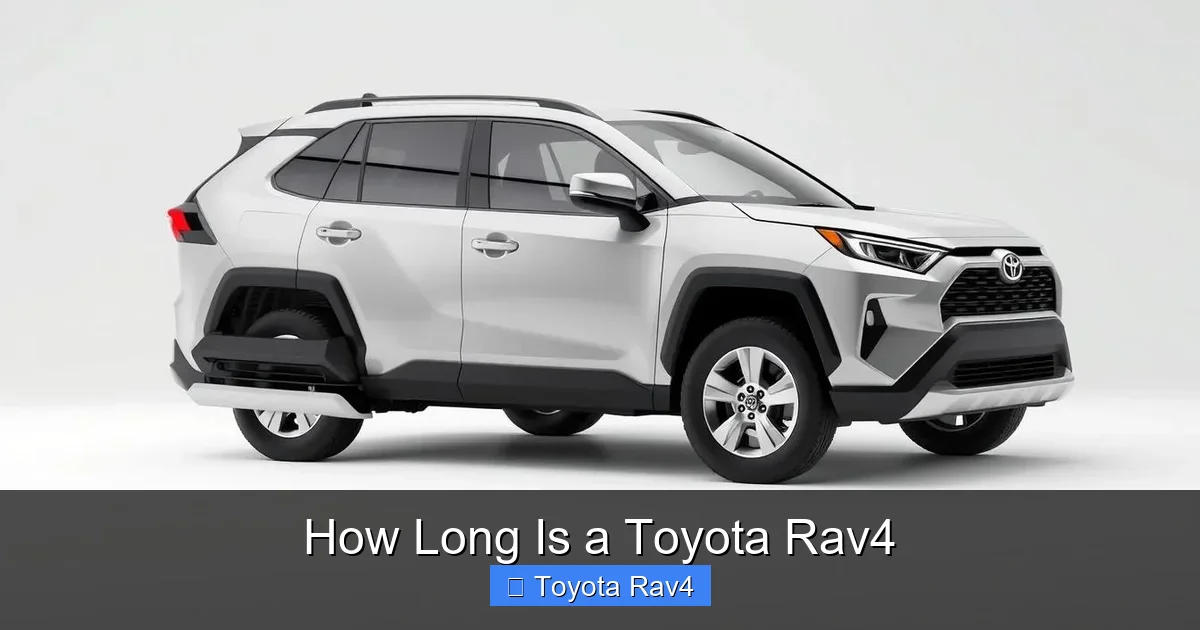
Visual guide about How Long Is a Toyota Rav4
Image source: vehiclerides.com
To truly understand how long a Toyota RAV4 is, it helps to look at how its size has changed over time. Each generation reflects shifting consumer preferences, technological advancements, and design philosophies. Let’s take a closer look at the RAV4’s evolution in terms of length and overall dimensions.
First Generation (1996–2000): The Compact Pioneer
The original Toyota RAV4 was revolutionary for its time. Launched in 1996, it was one of the first vehicles to blend SUV capability with car-like handling. Measuring just **169.7 inches** in length, it was smaller than most sedans today. Available in both three-door and five-door configurations, the first-gen RAV4 was designed for urban drivers who wanted a bit of off-road flair without the bulk of a traditional SUV.
Despite its small size, it offered surprising versatility, with fold-flat rear seats and optional all-wheel drive. However, interior space was tight, especially in the three-door version. This generation set the foundation for what would become a global phenomenon, but its compact dimensions limited its appeal to families and long-distance travelers.
Second Generation (2001–2005): Growing Up
With the second generation, Toyota responded to feedback by making the RAV4 bigger and more refined. The length increased to **173.2 inches**, a gain of about 3.5 inches. This allowed for a more spacious cabin, improved legroom, and better cargo capacity. The five-door model became the standard, and the three-door was eventually phased out.
This generation also introduced more powerful engine options and enhanced safety features. The longer wheelbase (the distance between the front and rear axles) improved ride comfort and stability, making the RAV4 a more viable option for longer trips. It was during this era that the RAV4 began to gain serious traction in North America and Europe.
Third Generation (2006–2012): The Modern SUV Takes Shape
The third-generation RAV4, launched in 2006, marked a major shift in design and functionality. At **178.7 inches** long, it was significantly larger than its predecessors. Toyota introduced a rear-mounted spare tire (on some trims), giving the RAV4 a more rugged, traditional SUV appearance.
This generation also offered a third-row seat option in North America, making it one of the few compact SUVs to accommodate seven passengers. While the third row was cramped and best suited for children, it highlighted Toyota’s effort to maximize space. The increased length allowed for better crash protection, more advanced infotainment systems, and improved aerodynamics.
Fourth Generation (2013–2018): Refined and Road-Ready
By the fourth generation, the RAV4 had firmly established itself as a top contender in the compact SUV market. Measuring **181.1 inches** in length, it was now closer in size to midsize SUVs like the Honda Pilot, but still retained the agility of a smaller vehicle.
Toyota dropped the third-row option and rear spare tire, focusing instead on interior quality, fuel efficiency, and technology. This generation introduced the RAV4 Hybrid, which offered improved fuel economy without sacrificing performance. The longer wheelbase and wider track (distance between wheels) enhanced handling and ride comfort, making it a favorite among commuters and families.
Fifth Generation (2019–Present): The Current Champion
The current fifth-generation RAV4, introduced in 2019, is the longest and most advanced version to date. At **182.7 inches**, it’s nearly 13 inches longer than the original model. This growth has allowed Toyota to create a more spacious interior, with best-in-class rear legroom and cargo volume.
The design is more aggressive, with a bold grille, angular headlights, and a higher hood line. Despite the increase in size, the RAV4 remains highly maneuverable, thanks to a tight turning radius and responsive steering. The hybrid and plug-in hybrid (RAV4 Prime) versions maintain the same exterior dimensions, ensuring no compromise on space or usability.
How the RAV4’s Length Affects Interior and Cargo Space
One of the biggest advantages of the RAV4’s length is how it translates into interior space. Despite being a compact SUV, the RAV4 offers interior room that rivals some midsize models. Let’s break down how its dimensions impact passenger comfort and cargo capacity.
Passenger Space: Room to Breathe
The RAV4’s length contributes directly to its generous legroom and headroom. In the front seats, drivers and passengers enjoy ample space, with plenty of room to adjust seating positions for long drives. The rear seats are equally impressive, offering **37.7 inches of legroom** in the 2023 model—more than many competitors, including the Nissan Rogue and Subaru Forester.
This extra space makes the RAV4 a great choice for families, carpoolers, or anyone who frequently transports passengers. The flat floor in the back (no center hump) allows three adults to sit comfortably, and the reclining rear seats add to the comfort on longer trips.
Cargo Capacity: Pack It All In
When it comes to cargo, the RAV4 shines. With the rear seats up, it offers **37.5 cubic feet** of storage—enough for groceries, luggage, or sports equipment. Fold down the 60/40 split rear seats, and that number jumps to **69.8 cubic feet**, rivaling larger SUVs like the Toyota Highlander.
The low load floor and wide opening make it easy to load heavy or bulky items. Optional features like a power liftgate, cargo cover, and under-floor storage add even more convenience. Whether you’re packing for a weekend camping trip or hauling furniture from the store, the RAV4’s cargo space is one of its strongest selling points.
Smart Storage Solutions
Beyond the main cargo area, the RAV4 includes numerous small storage compartments throughout the cabin. There’s a large center console, door pockets, cup holders, and even a shelf above the glove box. These thoughtful details make it easy to keep your belongings organized and within reach.
The available wireless charging pad and USB ports ensure your devices stay powered on the go. For tech-savvy drivers, the RAV4’s interior is designed to support modern lifestyles without cluttering the space.
RAV4 Length vs. Competitors: How Does It Stack Up?
When shopping for a compact SUV, size matters—but so does how that size is used. Let’s compare the Toyota RAV4’s length to some of its closest rivals to see how it measures up.
Toyota RAV4 vs. Honda CR-V
The Honda CR-V is one of the RAV4’s biggest competitors. The 2023 CR-V measures **180.6 inches** in length—about 2 inches shorter than the RAV4. Despite being slightly smaller, the CR-V offers similar interior space, with 37.8 inches of rear legroom and 39.3 cubic feet of cargo space (75.8 with seats down).
However, the RAV4 edges out the CR-V in towing capacity (3,500 lbs vs. 1,500 lbs) and available all-wheel drive performance. The RAV4 also offers a more rugged design and better off-road capability, especially in the TRD Off-Road and Adventure trims.
Toyota RAV4 vs. Subaru Forester
The Subaru Forester is another strong contender, measuring **182.1 inches** in length—just 0.6 inches shorter than the RAV4. It offers slightly more cargo space (35.4 cubic feet behind rear seats, 76.1 max) and standard all-wheel drive.
But the RAV4 wins in fuel efficiency, especially with the hybrid model (40 mpg combined vs. 29 mpg for the Forester). The RAV4 also has a more modern infotainment system and a wider range of trim options, including the high-performance RAV4 Prime plug-in hybrid.
Toyota RAV4 vs. Ford Escape
The Ford Escape is one of the shorter vehicles in this segment, measuring between **180.5 and 181.3 inches**, depending on the trim. It offers a sportier driving experience and a more car-like feel, but falls short in cargo space (37.5 cubic feet max) and towing capacity (up to 3,500 lbs only on certain trims).
The RAV4’s longer wheelbase and wider stance give it a more stable ride, especially on highways. It also has a more rugged appearance and better resale value, making it a smarter long-term investment.
Toyota RAV4 vs. Nissan Rogue
The Nissan Rogue measures **183.8 inches**—actually longer than the RAV4 by about an inch. It offers a smooth ride, advanced safety features, and a stylish interior. However, the RAV4 outperforms it in fuel economy (especially the hybrid), towing capacity, and off-road capability.
The RAV4 also has a more durable feel and better reliability ratings, according to sources like J.D. Power and Consumer Reports. For buyers who prioritize longevity and versatility, the RAV4 is often the preferred choice.
Practical Implications of the RAV4’s Length
So, how does the RAV4’s length affect your daily life? Let’s look at some real-world scenarios where its size makes a difference.
Parking and Maneuverability
At just over 15 feet long, the RAV4 is easy to park in most urban environments. It fits comfortably in standard parking spaces and can navigate tight city streets with ease. The tight turning radius (about 36.1 feet) allows for quick U-turns and smooth navigation in crowded areas.
Many drivers appreciate the high seating position, which provides excellent visibility. Rearview cameras and parking sensors (standard on most trims) make parallel parking a breeze, even for new drivers.
Garage and Storage
If you have a standard single-car garage (typically 18–20 feet long), the RAV4 will fit with room to spare. Even in tighter spaces, the compact footprint makes it a practical choice for suburban and urban homeowners.
For those with larger garages or storage needs, the RAV4’s size allows for additional storage along the sides or front. Some owners even use the space to store bikes, tools, or seasonal items.
Towing and Hauling
The RAV4’s length and wheelbase contribute to its stability when towing. With a maximum towing capacity of **3,500 pounds** (when properly equipped), it can handle small trailers, jet skis, or pop-up campers. The available Tow Prep Package includes a transmission cooler, heavy-duty radiator, and wiring harness, making it easy to set up for towing.
Compared to shorter SUVs with lower towing limits, the RAV4 offers a rare combination of size, power, and efficiency.
Fuel Efficiency and Driving Dynamics
Despite its length, the RAV4 remains fuel-efficient. The gas-powered model gets up to **30 mpg combined**, while the hybrid version achieves **40 mpg combined**. The RAV4 Prime plug-in hybrid can travel up to **42 miles on electric power alone**, making it ideal for short commutes.
The longer wheelbase improves ride comfort, reducing bumps and vibrations on rough roads. The available Dynamic Torque Vectoring AWD system enhances handling, especially in wet or snowy conditions.
Hybrid and Plug-In Hybrid: Same Length, More Power
One of the RAV4’s standout features is its electrified options—the RAV4 Hybrid and RAV4 Prime. Both maintain the same exterior dimensions as the gas-only model, so there’s no compromise on space or usability.
RAV4 Hybrid: Efficiency Meets Performance
The RAV4 Hybrid combines a 2.5-liter four-cylinder engine with electric motors, producing **219 horsepower**. It’s available in front-wheel drive or all-wheel drive, with the AWD version offering improved traction and control.
Despite the added battery and motors, the hybrid model has the same cargo space and passenger room as the gas version. The batteries are cleverly packaged under the rear seats, so there’s no loss of interior volume.
RAV4 Prime: The Plug-In Powerhouse
The RAV4 Prime is Toyota’s first plug-in hybrid SUV. It delivers **302 horsepower** and can travel up to **42 miles on electric power alone**. That means many drivers can complete their daily commute without using any gasoline.
Like the hybrid, the Prime maintains the same length and interior space. The larger battery is housed under the floor, preserving cargo room and ride height. It also includes a charge port on the driver’s side, making it easy to plug in at home or public stations.
Both electrified models offer a quiet, smooth ride and lower emissions, making them ideal for eco-conscious drivers who don’t want to sacrifice space or capability.
Conclusion: Why the RAV4’s Length Matters
So, how long is a Toyota RAV4? The answer is **182.7 inches** for the latest models—a length that strikes the perfect balance between functionality, comfort, and maneuverability. Over the years, Toyota has carefully increased the RAV4’s size to meet evolving consumer needs, without losing the agility that made it popular in the first place.
This length allows for a spacious interior, generous cargo room, and a stable ride, all while remaining easy to park and drive in the city. Whether you’re choosing the gas, hybrid, or plug-in hybrid version, you get the same practical dimensions and real-world usability.
Compared to competitors, the RAV4 holds its own—and often comes out ahead—in key areas like towing, fuel efficiency, and off-road capability. Its size isn’t just a number; it’s a reflection of Toyota’s commitment to building a vehicle that works for real people in real situations.
If you’re looking for a compact SUV that does it all—without feeling too big or too small—the Toyota RAV4 is hard to beat. Its length is just one part of what makes it one of the most popular vehicles on the road today.
Frequently Asked Questions
How long is a Toyota RAV4 in feet?
The Toyota RAV4 is approximately 15 feet and 3 inches long, or 182.7 inches, in the latest models. This makes it easy to park while still offering plenty of interior space.
Has the RAV4 gotten longer over the years?
Yes, the RAV4 has gradually increased in length with each new generation. The first model was 169.7 inches, while the current version is 182.7 inches—nearly 13 inches longer.
Does the RAV4 Hybrid have the same length as the gas model?
Yes, the RAV4 Hybrid and RAV4 Prime maintain the same exterior dimensions as the gas-powered version, so there’s no difference in length or interior space.
Can a Toyota RAV4 fit in a standard garage?
Absolutely. A standard single-car garage is typically 18–20 feet long, so the RAV4 (15.2 feet) fits comfortably with room to spare on both sides.
How does the RAV4’s length compare to the Honda CR-V?
The RAV4 is slightly longer than the Honda CR-V. The 2023 RAV4 is 182.7 inches, while the CR-V is 180.6 inches—a difference of about 2 inches.
Is the RAV4 too long for city driving?
Not at all. Despite its length, the RAV4 has a tight turning radius and high seating position, making it highly maneuverable and easy to drive in urban areas.