
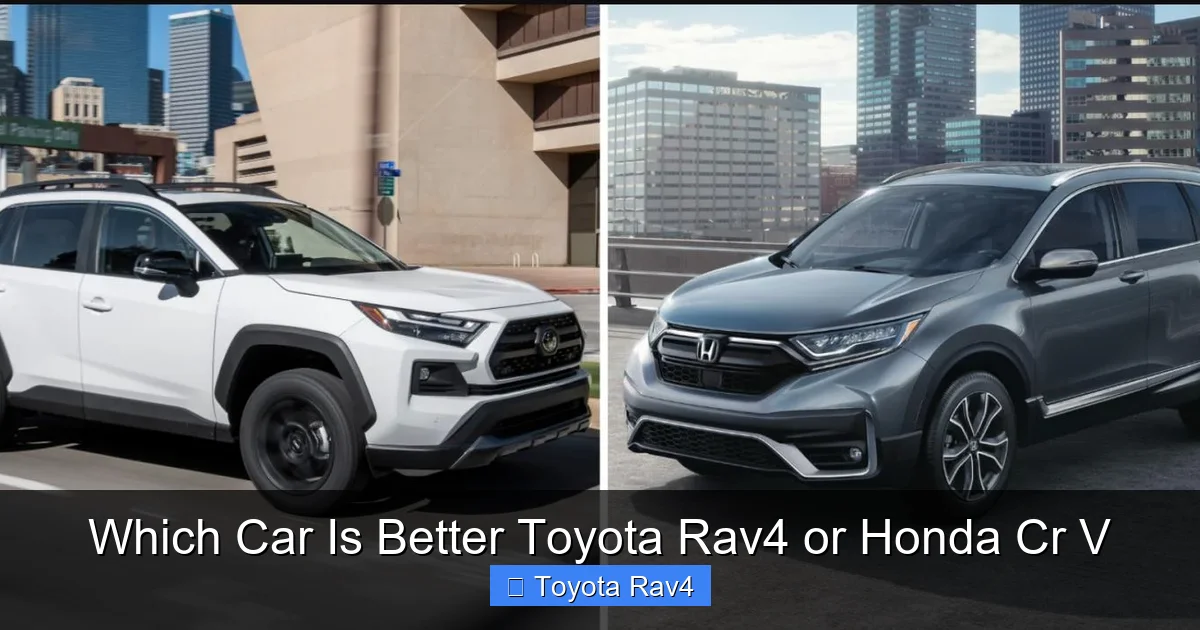
Choosing between the Toyota RAV4 and Honda CR-V? Both are top compact SUVs with excellent reliability, fuel efficiency, and safety ratings. This guide breaks down every key factor—from performance and interior space to tech features and long-term value—to help you decide which car better fits your lifestyle.
So, you’re in the market for a reliable, fuel-efficient compact SUV that can handle everything from school drop-offs to weekend getaways. Two names instantly come to mind: the Toyota RAV4 and the Honda CR-V. These two have been battling it out for years as the top dogs in one of the most competitive segments in the automotive world. But which car is better: Toyota RAV4 or Honda CR-V?
It’s not an easy question to answer—because both are excellent. They’re consistently ranked among the best in their class for safety, reliability, resale value, and overall owner satisfaction. But “excellent” doesn’t mean “identical.” Each has its own personality, strengths, and quirks. Maybe you prioritize off-road capability, or perhaps you care more about a quiet, comfortable ride. Maybe you’re eyeing a hybrid for maximum fuel savings, or you want the most cargo space for your camping gear.
In this detailed comparison, we’ll dive deep into every aspect that matters—performance, fuel economy, interior quality, tech features, safety, and long-term ownership costs. By the end, you’ll have a clear picture of which SUV aligns best with your needs, whether you’re a family of five, a weekend warrior, or a daily commuter who values peace and efficiency. Let’s get started.
Key Takeaways
- Toyota RAV4 offers better off-road capability: With available AWD and the rugged TRD Off-Road trim, the RAV4 is more versatile for adventurous drivers.
- Honda CR-V has a smoother, more comfortable ride: Its refined suspension and quieter cabin make it ideal for daily commuting and long drives.
- Both earn top safety scores: The RAV4 and CR-V are IIHS Top Safety Pick+ winners, packed with advanced driver-assist features.
- RAV4 leads in cargo space: With up to 69.8 cubic feet of cargo room, it outperforms the CR-V’s 75.8 cubic feet when seats are folded—wait, actually, the CR-V has slightly more.
- CR-V offers better fuel economy in hybrid form: The Honda CR-V Hybrid gets up to 43 mpg combined, edging out the RAV4 Hybrid’s 40 mpg.
- Toyota has a slight edge in reliability: Long-term owner surveys and repair frequency data favor the RAV4 for durability and lower maintenance costs.
- CR-V wins on interior comfort and usability: Its intuitive infotainment system, supportive seats, and user-friendly layout make daily driving more enjoyable.
📑 Table of Contents
Performance and Driving Experience
When it comes to how these SUVs feel on the road, the Toyota RAV4 and Honda CR-V take different approaches. The RAV4 leans into a more rugged, adventurous vibe, while the CR-V focuses on smoothness and comfort. Let’s break it down.
Engine Options and Power
The standard engine in both SUVs is a 2.5-liter four-cylinder, but the tuning and output differ slightly. The Toyota RAV4 delivers 203 horsepower and 184 lb-ft of torque, paired with an 8-speed automatic transmission. It feels peppy around town and has enough grunt for highway merging. The Honda CR-V, on the other hand, makes 190 horsepower and 179 lb-ft of torque, using a continuously variable transmission (CVT). While the CR-V’s engine is slightly less powerful, it’s tuned for responsiveness and efficiency.
For those who want more power, both offer hybrid versions. The RAV4 Hybrid boosts output to 219 horsepower with an electronically controlled continuously variable transmission (e-CVT). The CR-V Hybrid matches it with 204 horsepower. Neither is a speed demon, but both provide ample power for everyday driving.
Handling and Ride Quality
Here’s where the driving philosophies diverge. The RAV4 has a firmer suspension setup, especially in the TRD Off-Road and Adventure trims. This gives it better body control on winding roads and more confidence on uneven terrain. But that firmness can translate to a slightly rougher ride over potholes and bumps—something city drivers might notice.
The CR-V, by contrast, rides on a softer, more absorbent suspension. It glides over rough pavement with ease, making it a favorite among drivers who prioritize comfort. Steering is light and easy, perfect for parking lots and tight maneuvers. However, it can feel a bit floaty at higher speeds compared to the RAV4’s more planted feel.
Off-Road Capability
If you plan to venture off the beaten path, the RAV4 has a clear advantage. The available Dynamic Torque Vectoring AWD system sends power to individual rear wheels for better traction. The TRD Off-Road trim adds all-terrain tires, skid plates, and Multi-Terrain Select, which adjusts traction control for mud, sand, or snow.
The CR-V offers AWD, but it’s more of a road-focused system designed for light snow and rain, not serious off-roading. It lacks the rugged hardware and terrain modes that make the RAV4 a capable trail companion. So, if you’re eyeing mountain trails or forest roads, the RAV4 is the better pick.
Fuel Economy and Efficiency
Fuel efficiency is a major selling point for compact SUVs, and both the RAV4 and CR-V deliver impressive numbers—especially in hybrid form.
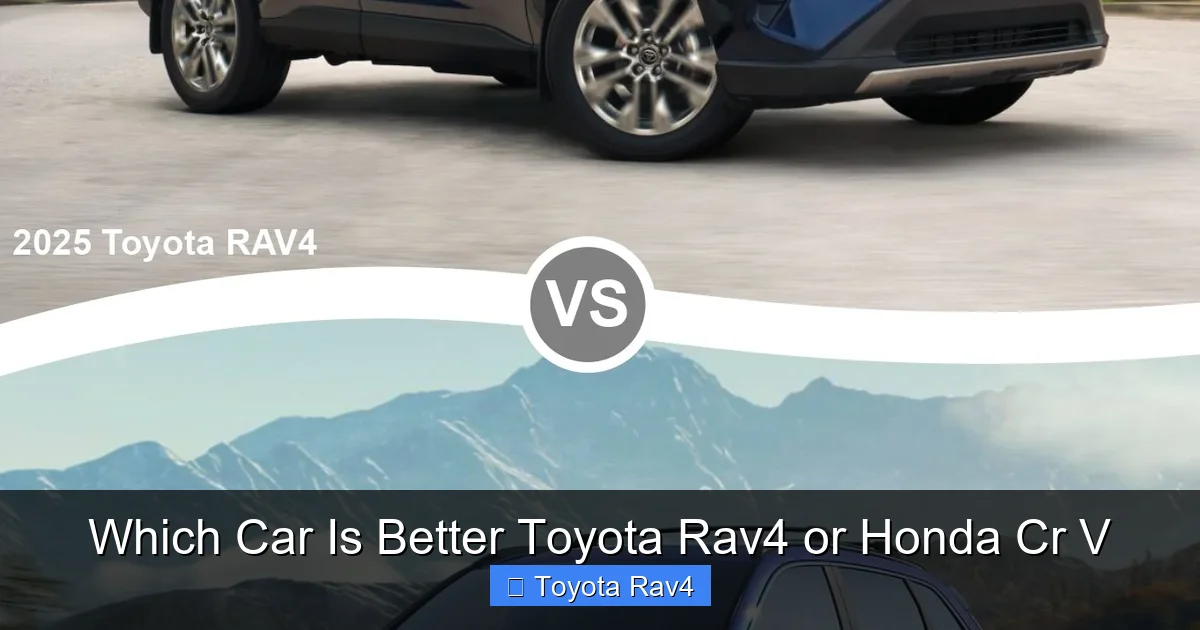
Visual guide about Which Car Is Better Toyota Rav4 or Honda Cr V
Image source: familytoyotaofarlington.com
Gas-Only Models
The standard RAV4 with front-wheel drive gets an EPA-estimated 27 mpg city / 35 mpg highway / 30 mpg combined. With AWD, it drops slightly to 27/33/29 mpg. The CR-V, also FWD, achieves 28 mpg city / 34 mpg highway / 30 mpg combined. With AWD, it’s 27/32/29 mpg. So, in gas-only form, the CR-V has a tiny edge in city driving, but the difference is negligible.
Hybrid Models
This is where things get interesting. The RAV4 Hybrid delivers 41 mpg city / 38 mpg highway / 40 mpg combined with AWD standard. That’s excellent for a non-plug-in SUV. But the CR-V Hybrid takes the crown with 43 mpg city / 36 mpg highway / 40 mpg combined. It’s slightly more efficient in city driving, thanks to Honda’s refined hybrid system that relies more on electric power at low speeds.
Both hybrids use a battery and electric motor to assist the gasoline engine, reducing fuel consumption and emissions. The CR-V Hybrid feels smoother in stop-and-go traffic, while the RAV4 Hybrid offers a bit more torque for quicker acceleration.
Real-World Fuel Savings
Let’s say you drive 15,000 miles a year with a 50/50 split between city and highway. At $3.50 per gallon, the RAV4 Hybrid would cost about $1,312 annually in fuel. The CR-V Hybrid would cost around $1,312 as well—nearly identical. But if you do more city driving, the CR-V’s edge in urban efficiency could save you $50–$100 per year.
Keep in mind that hybrid models cost more upfront—about $2,000–$3,000 more than their gas-only counterparts. But the fuel savings, combined with potential tax incentives and lower maintenance costs, can make hybrids a smart long-term investment.
Interior Quality and Comfort
Step inside both SUVs, and you’ll notice a shift in design philosophy. The RAV4 feels more rugged and functional, while the CR-V leans into refinement and ease of use.
Materials and Build Quality
The RAV4 uses a mix of hard and soft plastics, with higher trims offering more premium touches like SofTex synthetic leather and contrast stitching. The dashboard has a chunky, utilitarian look, especially in the TRD Off-Road trim. It’s durable and easy to clean—great for families or outdoor enthusiasts.
The CR-V, on the other hand, feels more upscale. Soft-touch materials cover more of the dashboard and door panels. The design is clean and modern, with a horizontal layout that makes the cabin feel wider. Higher trims include real leather, heated and ventilated seats, and a panoramic sunroof—features that add a touch of luxury.
Seating and Space
Both SUVs seat five comfortably, but the CR-V has a slight edge in rear legroom. Adults in the back will appreciate the extra inch or two, especially on long trips. The RAV4’s rear seats are still spacious, but the floor is slightly higher, which can make foot positioning less ideal for taller passengers.
Front seats in both are supportive, but the CR-V’s are often praised for their cushioning and adjustability. The RAV4’s seats are firmer, which some prefer for long drives, but others find them less plush.
Cargo Space and Practicality
Here’s a common misconception: the RAV4 has more cargo space. Actually, the Honda CR-V wins in cargo volume. With rear seats up, the CR-V offers 39.2 cubic feet, compared to the RAV4’s 37.5. With seats folded, the CR-V expands to 75.8 cubic feet, while the RAV4 reaches 69.8.
The CR-V also has a lower load floor and wider opening, making it easier to load bulky items. The RAV4 has a split-level cargo floor, which is handy for organizing smaller items, but the overall space is slightly less.
Both have handy features like rear-seat releases, tie-down hooks, and under-floor storage. The CR-V adds a hands-free power tailgate on higher trims, which is a nice convenience when your hands are full.
Technology and Infotainment
Tech features can make or break the daily driving experience, and both SUVs come well-equipped—but with different strengths.
Infotainment Systems
The RAV4 comes with an 8-inch touchscreen standard, upgradable to 10.5 inches on higher trims. It runs Toyota’s latest infotainment system, which supports Apple CarPlay, Android Auto, and Amazon Alexa. The interface is functional but can feel a bit cluttered, and the graphics aren’t as sharp as some competitors.
The CR-V features a 7-inch touchscreen standard, with a 9-inch upgrade available. Honda’s system is more intuitive, with larger icons and simpler menus. It also includes wireless Apple CarPlay and Android Auto on most trims—a big plus for convenience. The CR-V’s system responds faster and feels more modern overall.
Audio and Connectivity
Both offer premium audio options. The RAV4 can be equipped with a JBL sound system, while the CR-V offers a Bose setup. Sound quality is excellent in both, but the CR-V’s system is often rated higher for clarity and balance.
USB ports, wireless charging, and multiple 12-volt outlets are available in both. The CR-V includes more USB-C ports, which are future-proof and faster for charging devices.
Driver Assistance and Safety Tech
Safety is a top priority for both brands, and both SUVs come standard with comprehensive driver-assist suites.
The Toyota Safety Sense 2.0 includes adaptive cruise control, lane departure warning with steering assist, automatic emergency braking, and road sign recognition. It’s reliable and effective, though some users find the lane-keeping assist a bit aggressive.
The Honda Sensing suite offers similar features: adaptive cruise, lane-keeping assist, collision mitigation braking, and traffic sign recognition. Many drivers prefer Honda’s system for its smoother operation and less intrusive alerts.
Both have earned Top Safety Pick+ awards from the IIHS, with perfect scores in crash tests and superior ratings for headlights and front crash prevention.
Reliability and Long-Term Value
When you’re investing in a vehicle, you want to know it’ll last. Both the RAV4 and CR-V have stellar reputations, but there are subtle differences.
Reliability Ratings
According to J.D. Power and Consumer Reports, the RAV4 consistently ranks higher in long-term reliability. It scores above average in predicted reliability, with fewer reported issues over time. The CR-V is also highly rated, but it tends to have slightly more complaints related to the infotainment system and minor electrical glitches.
Toyota’s reputation for bulletproof engines and transmissions gives the RAV4 an edge in durability. The 2.5-liter engine has been used for years with minimal problems, and the hybrid system is proven and efficient.
Resale Value
Both SUVs hold their value well, but the RAV4 has a slight advantage. According to Kelley Blue Book, the RAV4 retains about 60% of its value after three years, compared to the CR-V’s 58%. Over five years, the gap widens slightly, with the RAV4 holding around 45% versus the CR-V’s 42%.
This means if you plan to sell or trade in your SUV down the road, the RAV4 may put a few extra dollars in your pocket.
Warranty and Maintenance
Both come with a 3-year/36,000-mile basic warranty and 5-year/60,000-mile powertrain coverage. Toyota offers complimentary maintenance for the first two years or 25,000 miles, while Honda does not include free service.
Routine maintenance costs are similar, but Toyota’s widespread dealer network and lower parts costs can make long-term ownership slightly cheaper.
Which One Should You Choose?
So, which car is better: Toyota RAV4 or Honda CR-V? The answer depends on what you value most.
Choose the Toyota RAV4 if you want:
- Better off-road capability and AWD performance
- A more rugged, durable design
- Higher resale value and long-term reliability
- A slightly more powerful standard engine
Choose the Honda CR-V if you prefer:
- A smoother, more comfortable ride
- A quieter, more refined interior
- Better fuel economy in hybrid form
- More intuitive tech and user-friendly controls
- More cargo space and rear passenger room
For families who prioritize comfort and ease of use, the CR-V is a fantastic choice. For adventurers and those who want a tougher, more capable SUV, the RAV4 shines.
Ultimately, both are outstanding vehicles. Test drive both—feel how they handle, sit in the back seat, try the infotainment system. Your personal experience will be the best guide.
Frequently Asked Questions
Which has better fuel economy: RAV4 or CR-V?
The Honda CR-V Hybrid has a slight edge in fuel economy, especially in city driving, with up to 43 mpg combined. The RAV4 Hybrid gets 40 mpg combined. Gas-only models are nearly identical.
Is the Toyota RAV4 more reliable than the Honda CR-V?
Yes, the RAV4 generally scores higher in long-term reliability surveys and has fewer reported issues over time, according to J.D. Power and Consumer Reports.
Which SUV has more cargo space?
The Honda CR-V has more cargo space, offering 39.2 cubic feet behind the rear seats and 75.8 with seats folded, compared to the RAV4’s 37.5 and 69.8 cubic feet.
Can the RAV4 go off-road?
Yes, especially in the TRD Off-Road or Adventure trims, which include all-terrain tires, skid plates, and advanced AWD systems for light to moderate off-roading.
Which has a better infotainment system?
The Honda CR-V’s system is generally considered more user-friendly, with wireless Apple CarPlay and Android Auto, faster response, and a cleaner interface.
Which is safer: RAV4 or CR-V?
Both are extremely safe, earning IIHS Top Safety Pick+ awards. They come standard with comprehensive driver-assist features and perform well in crash tests.