
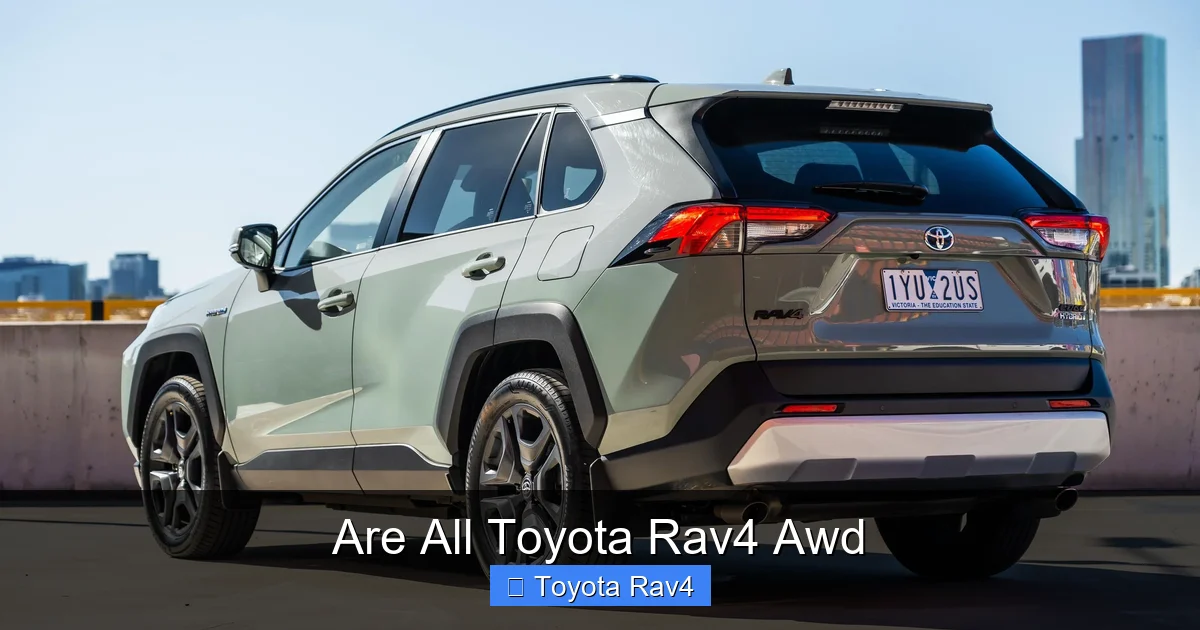
No, not all Toyota RAV4 models come with all-wheel drive (AWD). While AWD is available on most trims, some base models are front-wheel drive (FWD) only. Choosing the right drivetrain depends on your climate, driving habits, and budget.
Key Takeaways
- Not all RAV4s have AWD: Base LE and XLE trims often come standard with FWD, with AWD as an optional upgrade.
- AWD is standard on higher trims: Trims like the Adventure, TRD Off-Road, and Limited typically include AWD as standard equipment.
- Hybrid models always have AWD: Every Toyota RAV4 Hybrid comes with Electronic On-Demand AWD, enhancing traction and efficiency.
- AWD improves traction in tough conditions: Ideal for snow, rain, or light off-roading, AWD helps maintain control on slippery surfaces.
- FWD is more fuel-efficient: Front-wheel drive models generally offer better gas mileage than their AWD counterparts.
- Consider your driving environment: If you live in a mild climate with dry roads, FWD may be sufficient. For harsh weather, AWD is worth the extra cost.
- AWD adds cost and weight: Expect a higher purchase price and slightly reduced fuel economy with AWD models.
📑 Table of Contents
- Are All Toyota RAV4 AWD? The Short Answer
- Understanding FWD vs. AWD in the Toyota RAV4
- Which RAV4 Trims Come with AWD?
- Should You Choose AWD on Your RAV4?
- Performance and Handling Differences
- Maintenance and Longevity of AWD Systems
- Future of AWD in the RAV4 Lineup
- Final Thoughts: Is AWD Right for You?
Are All Toyota RAV4 AWD? The Short Answer
If you’re shopping for a Toyota RAV4 and wondering whether every model comes with all-wheel drive (AWD), the quick answer is no—not all RAV4s are AWD. While Toyota has made AWD increasingly common across the lineup, especially in recent years, several trims still offer front-wheel drive (FWD) as the standard configuration. This means your choice of trim, model year, and even region can affect whether your RAV4 comes equipped with AWD.
The RAV4 is one of the most popular compact SUVs on the market, praised for its reliability, fuel efficiency, and versatility. But with so many options—LE, XLE, XLE Premium, Adventure, TRD Off-Road, Limited, and the Hybrid variants—it’s easy to get confused about which models include AWD. Some buyers assume that because the RAV4 is a capable SUV, it must come with all-wheel drive standard. But that’s not the case. Understanding the differences between FWD and AWD, and knowing which trims offer which drivetrain, is essential to making the right choice for your needs.
Understanding FWD vs. AWD in the Toyota RAV4

Visual guide about Are All Toyota Rav4 Awd
Image source: i.ytimg.com
Before diving into which RAV4 models have AWD, it helps to understand what FWD and AWD actually mean—and how they affect your driving experience.
Front-wheel drive (FWD) means that only the front wheels receive power from the engine. This setup is common in compact SUVs because it’s simpler, lighter, and more fuel-efficient. FWD vehicles tend to handle well in normal driving conditions, especially on dry pavement. They’re also generally less expensive to buy and maintain.
All-wheel drive (AWD), on the other hand, sends power to all four wheels, either full-time or on-demand. In the RAV4, Toyota uses a system called Dynamic Torque Control AWD (or Electronic On-Demand AWD in hybrids). This system primarily powers the front wheels but can send up to 50% of the torque to the rear wheels when needed—like when the front wheels start to slip. This improves traction in rain, snow, gravel, or during sudden acceleration.
How Toyota’s AWD System Works
Toyota’s AWD system in the RAV4 is intelligent and automatic. Sensors monitor wheel speed, steering angle, and throttle input. If the system detects slippage—say, you’re accelerating on a snowy road—it instantly redirects power to the rear wheels. You don’t need to flip a switch or engage anything manually. It’s seamless and designed to help you maintain control without thinking about it.
This system is particularly useful in regions with unpredictable weather. For example, if you live in the Pacific Northwest or the Midwest, where rain and snow are common, AWD can give you added confidence behind the wheel. It’s not meant for serious off-roading like a 4WD system, but it handles light trails, muddy paths, and snowy driveways with ease.
Fuel Efficiency Trade-Offs
One downside of AWD is that it typically reduces fuel economy. The extra components—like the rear differential and driveshaft—add weight and mechanical resistance, which means the engine has to work harder. For example, a 2023 RAV4 FWD gets an EPA-estimated 27 mpg city / 35 mpg highway, while the AWD version drops to 25 mpg city / 33 mpg highway. That’s a small but noticeable difference, especially if you drive a lot of highway miles.
If fuel efficiency is a top priority and you don’t face harsh weather, FWD might be the smarter choice. But if you value safety and stability in slippery conditions, the slight drop in mileage is often worth it.
Which RAV4 Trims Come with AWD?
Now let’s break down which Toyota RAV4 trims offer AWD—and which ones don’t. This can vary slightly by model year, but the general pattern has remained consistent in recent years (2021–2024).
Base Trims: LE and XLE
The LE and XLE trims are the most affordable options in the RAV4 lineup. As of 2023 and 2024, both come standard with front-wheel drive. However, AWD is available as an optional upgrade. This means you can choose FWD to save money and boost fuel economy, or pay extra for AWD if you want better traction.
For example, a 2024 RAV4 LE FWD starts around $28,000, while the AWD version adds about $1,500 to $2,000 to the price. That’s a significant jump, so it’s important to weigh the benefits. If you live in a sunny, dry climate like Arizona or Southern California, you might not need AWD. But if you’re in Minnesota or Colorado, it could be a worthwhile investment.
Mid-Level Trims: XLE Premium and Adventure
The XLE Premium trim also offers FWD as standard, with AWD available as an option. However, the Adventure trim is where things change. The RAV4 Adventure is designed for outdoor enthusiasts and comes standard with AWD. It also includes features like all-terrain tires, increased ground clearance, and a more rugged exterior design.
This makes the Adventure a great choice if you enjoy camping, hiking, or driving on unpaved roads. The standard AWD gives it an edge over the base trims, especially in off-road or slippery conditions. Plus, the Adventure trim often includes additional safety and tech features, making it a well-rounded option for active drivers.
Off-Road and Premium Trims: TRD Off-Road and Limited
The TRD Off-Road and Limited trims are the top-tier options in the non-hybrid RAV4 lineup—and both come standard with AWD. The TRD Off-Road is built for adventure, with features like multi-terrain select, crawl control, and skid plates. It’s one of the most capable compact SUVs for light off-roading, and the standard AWD is a big reason why.
The Limited trim, on the other hand, focuses more on luxury and comfort. It includes premium materials, advanced infotainment, and driver-assistance features. But like the TRD Off-Road, it comes standard with AWD, giving you peace of mind in all weather conditions.
Hybrid and Prime Models: Always AWD
Here’s a key point: every Toyota RAV4 Hybrid and RAV4 Prime (plug-in hybrid) comes with AWD as standard. That’s right—no FWD option exists for hybrid models. Toyota uses a system called Electronic On-Demand AWD, which uses a rear electric motor to power the back wheels when needed.
This setup is not only efficient but also highly responsive. Because the rear motor is electric, it can deliver instant torque without waiting for mechanical engagement. This makes the hybrid AWD system particularly effective in snowy or icy conditions. Plus, the RAV4 Hybrid gets excellent fuel economy—up to 41 mpg combined—making it a smart choice for eco-conscious drivers who still want all-weather capability.
Should You Choose AWD on Your RAV4?
Deciding whether to go with AWD comes down to your lifestyle, location, and priorities. Let’s look at some real-world scenarios to help you decide.
Living in a Snowy or Rainy Climate
If you live in a region with heavy snow, ice, or frequent rain—like New England, the Upper Midwest, or the Pacific Northwest—AWD is highly recommended. It won’t turn your RAV4 into a snowmobile, but it will significantly improve traction and stability. For example, accelerating from a stoplight on a snowy morning is much smoother with AWD, and you’re less likely to get stuck in a snowbank.
One driver in Michigan shared that switching from a FWD sedan to an AWD RAV4 made winter driving “stress-free.” She no longer worried about slipping on icy roads or getting stuck in her driveway. While snow tires are still important, AWD gives you an extra layer of safety.
Frequent Highway or City Driving
If you mostly drive on highways or in urban areas with well-maintained roads, FWD might be perfectly fine. Most city driving doesn’t require AWD, and the fuel savings can add up over time. For example, a commuter driving 15,000 miles a year could save over $100 annually on fuel with FWD versus AWD, depending on gas prices.
That said, even in cities, unexpected weather can happen. A sudden downpour or early-season snowstorm can make roads slippery. If you want that extra confidence, AWD is worth considering—even if you don’t use it every day.
Outdoor Adventures and Light Off-Roading
If you enjoy weekend camping trips, hiking, or exploring forest roads, AWD is a smart choice. The RAV4 Adventure and TRD Off-Road trims, with their standard AWD and rugged features, are ideal for this lifestyle. You’ll have better control on gravel, mud, or wet trails, and you’re less likely to get stuck.
One outdoors enthusiast in Colorado uses his RAV4 Adventure to access mountain trailheads. “The AWD makes a huge difference on steep, rocky paths,” he says. “I’ve never had to turn back because of traction issues.”
Budget Considerations
AWD adds cost—not just at purchase, but also over time. The upfront price difference can be $1,500 to $2,000. Maintenance and repairs may also be slightly higher due to the additional components. And as mentioned, fuel economy takes a small hit.
If you’re on a tight budget and don’t face challenging driving conditions, FWD could save you money. But if safety and versatility are priorities, the extra cost of AWD is often justified.
Performance and Handling Differences
Beyond traction, AWD can affect how the RAV4 feels on the road. In general, AWD models feel more planted and stable, especially during cornering or sudden maneuvers. The added weight of the AWD system can make the car feel slightly heavier, but most drivers don’t notice a major difference in daily driving.
One test drive comparison showed that the AWD RAV4 handled better in wet conditions, with less understeer (when the front wheels lose grip and the car pushes wide in a turn). This can be especially helpful in emergency situations, like avoiding a pothole or swerving to miss debris.
However, in dry conditions, the difference is minimal. Most drivers won’t feel a significant change in handling between FWD and AWD models. The real benefit of AWD shows up when the roads are less than ideal.
Maintenance and Longevity of AWD Systems
Toyota’s AWD system is known for its reliability, but like any mechanical system, it requires some maintenance. The key components—transfer case, driveshaft, and rear differential—should be inspected during regular service intervals. Most experts recommend checking the AWD system every 30,000 to 50,000 miles, especially if you drive in harsh conditions.
One common myth is that AWD systems need frequent fluid changes. While it’s true that differential and transfer case fluids should be replaced periodically, it’s not as often as engine oil. Toyota typically recommends AWD fluid changes every 60,000 to 100,000 miles, depending on driving habits.
Also, keep in mind that AWD doesn’t eliminate the need for proper tires. In fact, using mismatched or worn tires can damage the AWD system. Always use the same type and size of tires on all four wheels, and replace them in sets to maintain balance.
Future of AWD in the RAV4 Lineup
As Toyota continues to evolve the RAV4, AWD is becoming more standard—especially as hybrid models gain popularity. The RAV4 Hybrid now accounts for a large portion of sales, and since all hybrids come with AWD, the overall percentage of AWD RAV4s on the road is increasing.
There’s also a growing trend toward electrification. The RAV4 Prime, Toyota’s plug-in hybrid, offers up to 42 miles of electric-only range and standard AWD. As more drivers look for eco-friendly options with all-weather capability, we may see even more AWD integration in future models.
Additionally, Toyota is investing in advanced driver-assistance systems (ADAS) that work hand-in-hand with AWD. Features like traction control, stability control, and hill-start assist are enhanced by AWD, creating a safer, more confident driving experience.
Final Thoughts: Is AWD Right for You?
So, are all Toyota RAV4 AWD? The answer is clear: no. But AWD is widely available, standard on many trims, and included on every hybrid model. Whether you should choose it depends on your needs.
If you live in a mild climate, drive mostly on paved roads, and want to save money and fuel, FWD is a solid choice. But if you face snow, rain, or rough terrain—or simply want the added safety and confidence of all-wheel drive—then upgrading to AWD is a smart move.
Ultimately, the RAV4 is designed to be versatile, and Toyota gives you the flexibility to choose the right drivetrain for your life. Take a test drive in both FWD and AWD models if possible. Feel the difference in handling, especially in wet or slippery conditions. And remember: the best RAV4 for you is the one that matches your driving environment, budget, and lifestyle.
Frequently Asked Questions
Do all Toyota RAV4 models come with AWD?
No, not all RAV4 models come with AWD. Base trims like the LE and XLE offer front-wheel drive (FWD) as standard, with AWD available as an optional upgrade.
Which RAV4 trims have AWD standard?
The Adventure, TRD Off-Road, Limited, and all hybrid models (including the RAV4 Prime) come with AWD standard. These trims are designed for better traction and all-weather performance.
Is AWD worth the extra cost on a RAV4?
It depends on your driving conditions. If you live in an area with snow, rain, or rough terrain, AWD improves safety and control. For mild climates, FWD may be more cost-effective.
Does AWD reduce fuel economy in the RAV4?
Yes, slightly. AWD models typically get 1–2 mpg less than FWD versions due to added weight and mechanical resistance. For example, a 2023 RAV4 FWD gets 35 mpg highway, while AWD gets 33 mpg.
Can I add AWD to a FWD RAV4 later?
No, AWD cannot be added after purchase. It must be selected at the time of ordering or purchasing the vehicle. Once built, the drivetrain cannot be retrofitted.
Is the RAV4 Hybrid always AWD?
Yes, every Toyota RAV4 Hybrid and RAV4 Prime comes with Electronic On-Demand AWD as standard. There is no front-wheel-drive option for hybrid models.