
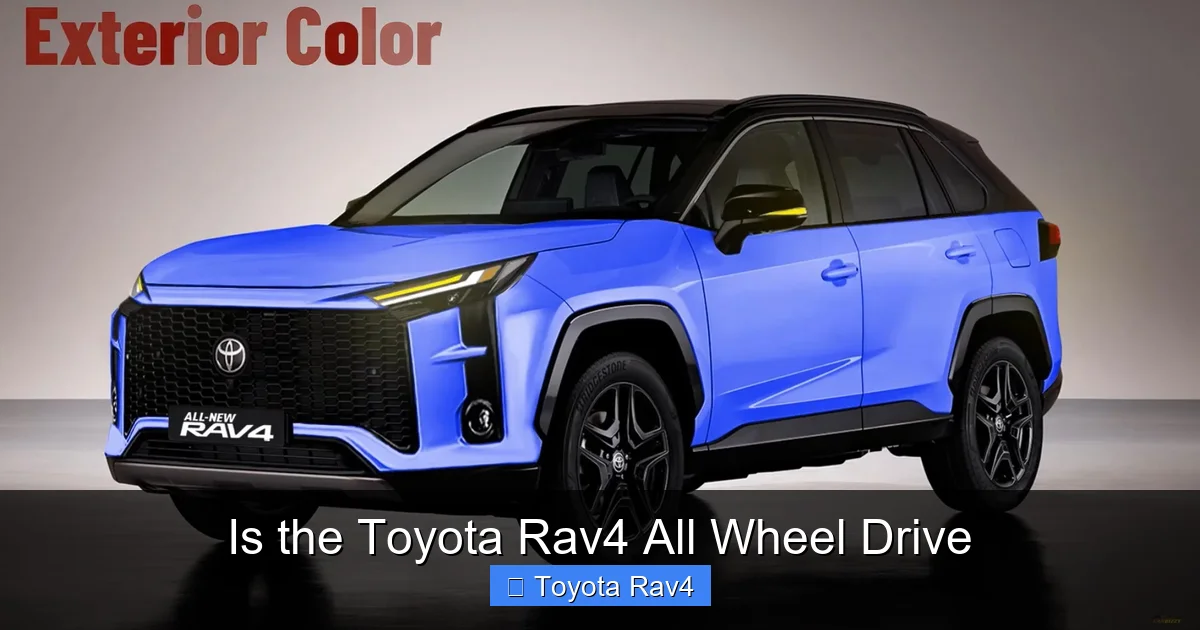
The Toyota RAV4 comes standard with all-wheel drive (AWD) on most trims, offering enhanced traction and stability in rain, snow, and off-road conditions. With advanced AWD systems like Dynamic Torque Vectoring and AWD-i, the RAV4 delivers confident performance whether you’re commuting or exploring.
Key Takeaways
- Most RAV4 trims include AWD: All-wheel drive is standard on LE, XLE, XLE Premium, Limited, and Adventure trims, giving drivers better control in slippery conditions.
- Two AWD systems available: The RAV4 offers Dynamic Torque Vectoring AWD and AWD-i (for hybrid models), each optimized for performance and efficiency.
- Improved safety and handling: AWD enhances grip during acceleration, cornering, and braking, especially in rain, snow, or gravel.
- Not all RAV4s are AWD: The base gas-only LE trim is front-wheel drive (FWD) by default, but AWD is available as an upgrade.
- Hybrid models come standard with AWD: Every RAV4 Hybrid includes AWD-i, combining electric motors and a gas engine for seamless power delivery.
- Off-road capability with AWD: The RAV4 Adventure and TRD Off-Road trims use AWD to tackle light trails and rugged terrain with confidence.
- Fuel efficiency remains strong: Thanks to smart AWD technology, the RAV4 maintains competitive fuel economy even with all-wheel drive engaged.
📑 Table of Contents
- Is the Toyota RAV4 All Wheel Drive? A Complete Guide
- Understanding All-Wheel Drive in the Toyota RAV4
- Which RAV4 Trims Come with All-Wheel Drive?
- Performance and Handling: How AWD Enhances the RAV4 Experience
- Fuel Economy: Does AWD Hurt Efficiency?
- AWD vs. FWD: Which Should You Choose?
- Maintenance and Longevity of the RAV4 AWD System
- Conclusion: Is the Toyota RAV4 All Wheel Drive?
Is the Toyota RAV4 All Wheel Drive? A Complete Guide
If you’re shopping for a compact SUV that can handle everything from daily commutes to weekend adventures, the Toyota RAV4 is likely on your shortlist. One of the most common questions buyers ask is: *Is the Toyota RAV4 all wheel drive?* The short answer is yes—but with some important nuances depending on the model, trim, and powertrain you choose.
The RAV4 has long been praised for its reliability, practicality, and versatility. But what really sets it apart in its class is its intelligent all-wheel-drive system. Whether you live in a snowy climate, frequently drive on wet roads, or just want extra peace of mind, AWD can make a big difference. In this guide, we’ll break down everything you need to know about the RAV4’s AWD capabilities, how it works, and whether it’s worth the investment.
You’ll learn about the different AWD systems Toyota uses, which trims come with AWD standard, and how real-world drivers benefit from this technology. We’ll also compare AWD vs. FWD models, explore fuel economy impacts, and help you decide if the RAV4’s AWD system fits your lifestyle.
Understanding All-Wheel Drive in the Toyota RAV4
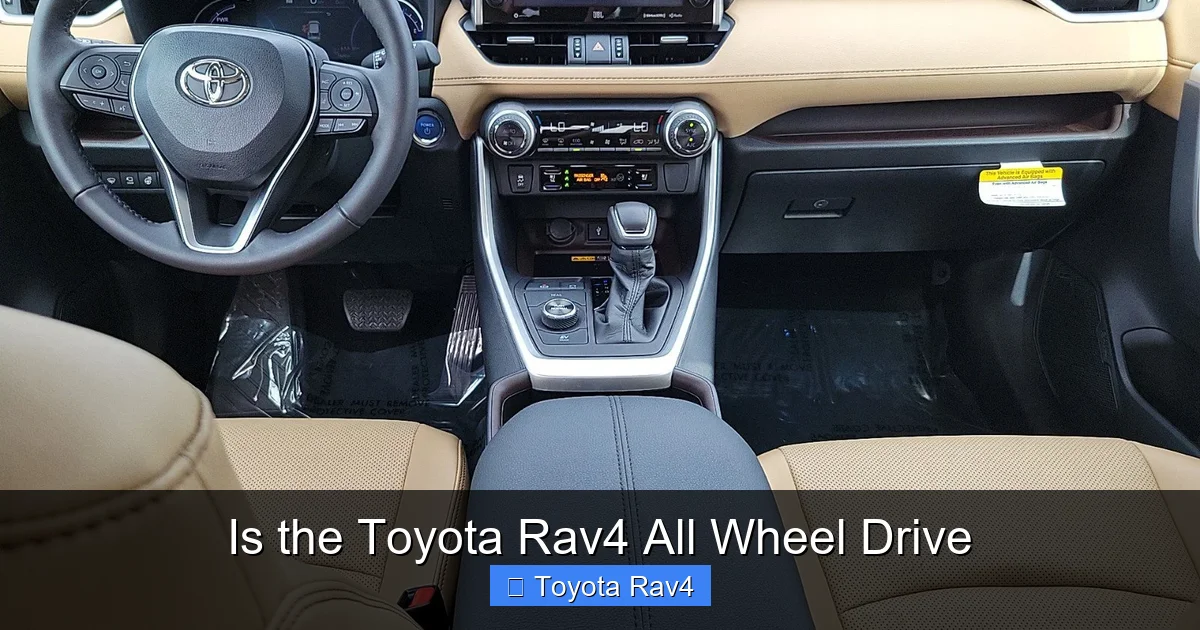
Visual guide about Is the Toyota Rav4 All Wheel Drive
Image source: rav4resource.com
What Is All-Wheel Drive (AWD)?
All-wheel drive (AWD) is a drivetrain system that sends power to all four wheels of a vehicle, either full-time or on-demand. Unlike four-wheel drive (4WD), which is typically used for serious off-roading and requires manual engagement, AWD operates automatically and is designed for everyday driving conditions.
In the context of the RAV4, AWD improves traction and stability by detecting wheel slip and redistributing power to the wheels with the most grip. This is especially helpful in rain, snow, mud, or loose gravel. The system works seamlessly in the background, so you don’t need to think about it—just drive with confidence.
How Does the RAV4’s AWD System Work?
Toyota equips the RAV4 with one of two advanced AWD systems, depending on whether you choose a gas-only or hybrid model:
– **Dynamic Torque Vectoring AWD (Gas Models):** Available on most gas-powered RAV4 trims, this system uses a rear differential and electronic controls to send up to 50% of the engine’s torque to the rear wheels when needed. It also uses brake-based torque vectoring to apply slight braking to the inside wheel during cornering, improving handling and reducing understeer.
– **AWD-i (Hybrid Models):** Found exclusively in the RAV4 Hybrid, AWD-i uses an additional electric motor to power the rear wheels independently. This means the rear wheels are driven by electricity, not mechanical linkage, allowing for faster and more precise torque delivery. The system can send up to 80% of available torque to the rear when traction is needed.
Both systems are proactive, meaning they anticipate loss of traction before it happens. Sensors monitor wheel speed, steering angle, throttle input, and other factors to make split-second adjustments. This results in smoother, safer driving in challenging conditions.
Real-World Benefits of AWD in the RAV4
Let’s say you’re driving home during a sudden downpour. Your tires hit a patch of standing water, and for a split second, you feel a loss of grip. With AWD, the RAV4 instantly detects the slip and redirects power to the wheels that still have traction, helping you maintain control.
Or imagine you’re driving up a snowy driveway in winter. A front-wheel-drive vehicle might spin its wheels, but the RAV4 with AWD will engage the rear wheels to help pull you forward. This isn’t just about performance—it’s about safety.
Even on dry pavement, AWD enhances stability during sharp turns or sudden maneuvers. It’s especially useful for families, outdoor enthusiasts, or anyone who values a composed, confident driving experience.
Which RAV4 Trims Come with All-Wheel Drive?
One of the most important things to know is that **not every RAV4 comes with AWD standard**. Toyota offers a range of trims, and AWD availability varies depending on the model and powertrain.
Gas-Only RAV4 Trims and AWD Availability
Here’s a breakdown of the gas-powered RAV4 lineup:
– **LE (Base Trim):** Front-wheel drive (FWD) is standard. AWD is available as an optional upgrade for an additional cost (typically around $1,400). If you want AWD on the LE, you’ll need to select it during configuration.
– **XLE, XLE Premium, Limited, and Adventure:** These trims come with AWD standard. You don’t have to pay extra—it’s included in the price. This makes higher trims a great value if you want AWD without paying for features you don’t need.
– **TRD Off-Road:** This rugged trim also includes AWD standard, along with enhanced suspension, all-terrain tires, and off-road driving modes.
So, if you’re set on AWD and want to avoid paying extra, consider skipping the base LE and going for the XLE or higher.
RAV4 Hybrid and AWD: Standard Across the Board
Here’s where things get even better: **every RAV4 Hybrid comes with AWD standard**. That’s right—no matter which hybrid trim you choose (LE Hybrid, XLE Hybrid, XLE Premium Hybrid, Limited Hybrid, or Woodland Edition), AWD-i is included at no extra cost.
This is a major selling point for the hybrid model. Not only do you get excellent fuel economy (up to 40 mpg combined), but you also get the added safety and performance of all-wheel drive. For buyers in colder climates or those who prioritize efficiency and capability, the RAV4 Hybrid is a standout choice.
RAV4 Prime (Plug-in Hybrid): AWD Included
The RAV4 Prime, Toyota’s plug-in hybrid variant, also comes with AWD standard. In fact, it uses an even more advanced version of AWD-i, with a more powerful rear electric motor. This allows for quicker acceleration and better off-road performance, making the Prime a great option for eco-conscious drivers who still want power and versatility.
Performance and Handling: How AWD Enhances the RAV4 Experience
Better Traction in Adverse Weather
Let’s face it—no one likes driving in the rain or snow. But with AWD, the RAV4 handles these conditions with ease. The system constantly monitors road conditions and adjusts power distribution to keep you moving safely.
For example, if you’re accelerating from a stoplight on a wet road, AWD helps prevent wheel spin by sending power to all four wheels. In snowy conditions, it reduces the chance of getting stuck by engaging the rear wheels when the front wheels lose grip.
Even in light off-road scenarios—like a gravel driveway or a muddy trail—AWD gives the RAV4 a significant advantage over FWD competitors.
Improved Cornering and Stability
Dynamic Torque Vectoring AWD doesn’t just help with traction—it also improves handling. By applying brake force to the inside rear wheel during a turn, the system helps the RAV4 rotate more precisely, reducing understeer (when the front wheels push wide in a corner).
This makes the RAV4 feel more agile and responsive, especially on winding roads or during emergency maneuvers. It’s a subtle but noticeable improvement that enhances driver confidence.
Off-Road Capability with AWD
While the RAV4 isn’t a rock-crawling SUV like the 4Runner, it’s more than capable on light off-road terrain—especially with AWD.
The Adventure and TRD Off-Road trims take this a step further with features like:
– Multi-Terrain Select (lets you choose driving modes for mud, sand, or rock)
– Crawl Control (automatically manages speed on steep or uneven terrain)
– Increased ground clearance
With AWD engaged, these trims can handle forest roads, snowy trails, and even mild rock crawling. It’s perfect for weekend campers, hikers, or anyone who wants a vehicle that can keep up with an active lifestyle.
Fuel Economy: Does AWD Hurt Efficiency?
A common concern with AWD is fuel economy. After all, sending power to four wheels instead of two requires more energy, right? While that’s true in theory, Toyota has engineered the RAV4’s AWD system to minimize efficiency losses.
AWD and Fuel Economy in Gas Models
The gas-powered RAV4 with AWD gets an EPA-estimated 27 mpg city / 35 mpg highway / 30 mpg combined. That’s only slightly lower than the FWD version (28/35/30 mpg). The difference is minimal—about 1 mpg in the city—thanks to the system’s ability to disengage when not needed.
In normal driving, the RAV4 primarily operates in front-wheel drive to save fuel. AWD only kicks in when sensors detect slippage or when the driver demands more power (like during hard acceleration). This on-demand approach keeps fuel consumption low while still providing AWD benefits when necessary.
Hybrid AWD: The Best of Both Worlds
The RAV4 Hybrid with AWD-i is even more impressive. It achieves up to 41 mpg city / 38 mpg highway / 40 mpg combined—numbers that rival many front-wheel-drive compact cars.
How? The electric motor powers the rear wheels independently, so there’s no mechanical drag from a driveshaft or differential. This means the system is both efficient and responsive. You get the traction benefits of AWD without sacrificing fuel economy.
For eco-conscious drivers, the RAV4 Hybrid with AWD is one of the most efficient all-wheel-drive SUVs on the market.
Real-World Fuel Economy Tips
To get the best fuel economy from your AWD RAV4:
– Keep tires properly inflated—underinflated tires increase rolling resistance.
– Avoid aggressive driving—rapid acceleration and hard braking waste fuel.
– Use cruise control on highways—it helps maintain a steady speed.
– Remove roof racks when not in use—they create wind resistance.
Even with AWD, the RAV4 remains one of the most fuel-efficient SUVs in its class.
AWD vs. FWD: Which Should You Choose?
Now that you know the RAV4 offers both AWD and FWD options, how do you decide which is right for you? It comes down to your driving needs, climate, and budget.
When to Choose AWD
Consider AWD if:
– You live in a region with frequent rain, snow, or ice.
– You frequently drive on unpaved roads or light trails.
– You want extra safety and confidence in slippery conditions.
– You plan to tow a small trailer or carry heavy loads (AWD improves traction under load).
For many buyers, the peace of mind that comes with AWD is worth the small increase in cost and slight reduction in fuel economy.
When FWD Might Be Enough
Front-wheel drive could be sufficient if:
– You live in a warm, dry climate with minimal winter weather.
– You mostly drive on paved roads and highways.
– You’re on a tight budget and want to save on upfront cost and fuel.
The base LE with FWD starts around $28,000, while the same trim with AWD adds about $1,400. If you don’t need AWD, that’s money you could save or spend on other features.
The Hybrid Advantage
If you’re torn between AWD and fuel economy, the RAV4 Hybrid is a game-changer. It gives you both—standard AWD and class-leading efficiency. For many buyers, it’s the sweet spot in the lineup.
Maintenance and Longevity of the RAV4 AWD System
One of the biggest concerns with AWD is maintenance. More components mean more potential for wear and repair costs, right? In the case of the RAV4, Toyota has designed the AWD system to be durable and low-maintenance.
No Special Maintenance Required
Unlike older AWD systems that required regular fluid changes or manual engagement, the RAV4’s AWD is fully automatic and sealed for life. There are no user-serviceable parts, and no scheduled maintenance is needed for the AWD components.
That said, it’s still important to follow Toyota’s recommended service schedule, including:
– Regular oil changes
– Tire rotations (every 5,000–7,500 miles)
– Brake inspections
– Wheel alignments
Proper tire maintenance is especially important with AWD. Since all four wheels are driven, uneven tire wear can cause drivetrain stress. Rotate your tires regularly and replace them in sets of four to keep the system running smoothly.
Long-Term Reliability
Toyota is known for building reliable vehicles, and the RAV4 is no exception. The AWD system has been used in the RAV4 for over a decade and has a proven track record of durability.
Owners consistently report trouble-free operation, even after 100,000+ miles. As long as you follow basic maintenance, the AWD system should last the life of the vehicle.
Warranty Coverage
The RAV4 comes with Toyota’s standard warranty:
– 3 years/36,000 miles basic coverage
– 5 years/60,000 miles powertrain coverage
The AWD components are covered under the powertrain warranty, so you’re protected against major failures during the first five years or 60,000 miles.
Conclusion: Is the Toyota RAV4 All Wheel Drive?
So, is the Toyota RAV4 all wheel drive? The answer is: **most of them are, and many come with AWD standard**.
While the base gas-only LE trim starts with front-wheel drive, AWD is available as an option. Higher trims like the XLE, Limited, Adventure, and TRD Off-Road include AWD at no extra cost. And if you choose the RAV4 Hybrid or Prime, AWD comes standard across the board.
The RAV4’s AWD systems—Dynamic Torque Vectoring and AWD-i—are smart, efficient, and designed to enhance safety and performance without sacrificing fuel economy. Whether you’re driving in the rain, snow, or on a gravel road, AWD gives you the confidence to keep going.
For buyers who value reliability, efficiency, and capability, the RAV4 with AWD is one of the best compact SUVs on the market. It’s practical for daily use, capable enough for weekend adventures, and built to last.
If you’re considering the RAV4, ask yourself: Do I need AWD? If you live in a challenging climate or just want extra peace of mind, the answer is likely yes. And with so many trims offering AWD standard, it’s easier than ever to get the features you want without paying extra.
In the end, the Toyota RAV4 proves that you don’t have to choose between efficiency and capability. With AWD, you can have both.
Frequently Asked Questions
Is AWD standard on all Toyota RAV4 models?
No, AWD is not standard on all RAV4 models. The base gas-only LE trim comes with front-wheel drive (FWD) standard, but AWD is available as an option. All other gas trims (XLE and above) include AWD standard. Every RAV4 Hybrid and Prime comes with AWD standard.
What’s the difference between Dynamic Torque Vectoring AWD and AWD-i?
Dynamic Torque Vectoring AWD is used in gas models and sends power mechanically to the rear wheels via a driveshaft. AWD-i, used in hybrid models, uses an electric motor to power the rear wheels independently, offering faster response and better efficiency.
Does AWD reduce fuel economy in the RAV4?
AWD has a minimal impact on fuel economy. The gas RAV4 with AWD gets about 1 mpg less in the city than the FWD version. The RAV4 Hybrid with AWD-i actually achieves up to 40 mpg combined, making it one of the most efficient AWD SUVs available.
Can the RAV4 with AWD handle off-road conditions?
Yes, especially the Adventure and TRD Off-Road trims. With AWD, increased ground clearance, and off-road driving modes, the RAV4 can handle light trails, gravel roads, and snowy terrain. It’s not designed for extreme rock crawling, but it’s more than capable for weekend adventures.
Do I need AWD if I live in a warm climate?
If you rarely encounter rain, snow, or slippery conditions, FWD may be sufficient. However, AWD can still improve stability during sudden maneuvers or wet roads. It’s a matter of personal preference and how much you value added safety.
Is the RAV4 AWD system expensive to maintain?
No, the AWD system requires no special maintenance. It’s sealed for life and covered under Toyota’s powertrain warranty. Regular tire rotations and alignments help ensure even wear and long-term reliability.