
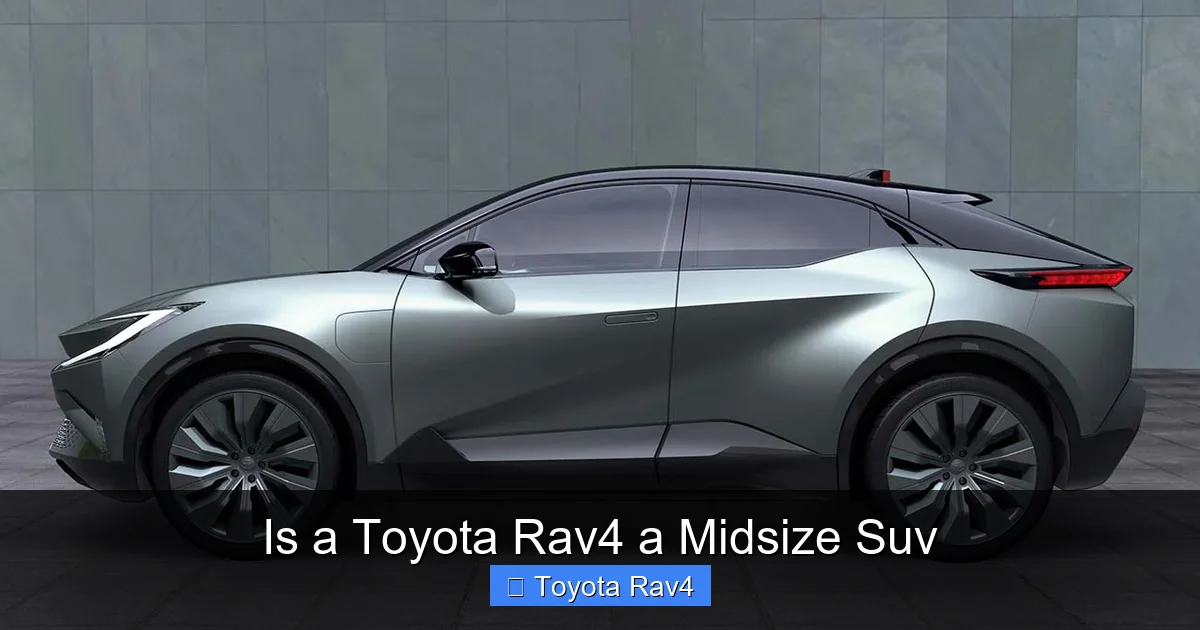
The Toyota RAV4 is classified as a compact SUV, not a midsize SUV, despite its spacious interior and strong performance. It offers a blend of efficiency, reliability, and modern tech, making it a top choice in its class.
Key Takeaways
- Compact SUV Classification: The Toyota RAV4 falls under the compact SUV category, not midsize, based on exterior dimensions and cargo space.
- Spacious Interior: Despite its compact label, the RAV4 offers generous passenger and cargo room, rivaling some midsize models.
- Fuel Efficiency: With up to 30 mpg combined, the RAV4 excels in fuel economy, a key advantage over larger midsize SUVs.
- All-Wheel Drive Available: Optional AWD enhances traction and handling, especially in adverse weather or light off-roading.
- Advanced Safety Features: Standard Toyota Safety Sense 2.0 includes adaptive cruise control, lane departure warning, and automatic emergency braking.
- Hybrid and Plug-In Options: The RAV4 Hybrid and RAV4 Prime plug-in hybrid deliver improved efficiency and performance without sacrificing space.
- Strong Resale Value: Known for reliability, the RAV4 retains value better than most competitors in its segment.
📑 Table of Contents
Is a Toyota RAV4 a Midsize SUV? Understanding the Classification
When shopping for a new SUV, size matters—not just for parking ease or fuel economy, but for how well the vehicle fits your lifestyle. One of the most common questions buyers ask about the Toyota RAV4 is: “Is a Toyota RAV4 a midsize SUV?” The short answer is no—it’s officially classified as a compact SUV. But that doesn’t mean it lacks the space, power, or features you’d expect from a larger vehicle. In fact, the RAV4 often feels more spacious and capable than many of its compact peers, blurring the lines between categories.
The confusion is understandable. Over the years, the RAV4 has grown in size and capability. What started as a small, car-based utility vehicle in the 1990s has evolved into a rugged, feature-packed SUV that competes with larger models. With its bold styling, available all-wheel drive, and hybrid powertrains, the RAV4 delivers a driving experience that feels more substantial than its compact label suggests. But when it comes to official classifications—based on exterior dimensions, wheelbase, and cargo volume—the RAV4 still fits squarely in the compact SUV segment.
How SUV Sizes Are Defined
SUV classifications aren’t arbitrary. Automakers and industry experts use specific criteria to determine whether a vehicle is subcompact, compact, midsize, or full-size. These categories are based on key measurements like overall length, wheelbase, passenger volume, and cargo capacity. For example, compact SUVs typically measure between 170 and 185 inches in length, have a wheelbase of around 105 to 110 inches, and offer 25 to 35 cubic feet of cargo space behind the rear seats.
The Toyota RAV4 fits neatly into this range. The 2024 model, for instance, measures 180.9 inches long with a 105.9-inch wheelbase. It offers 37.5 cubic feet of cargo space behind the second row—more than many competitors in its class. That extra room gives it an edge over smaller compact SUVs like the Honda CR-V or Mazda CX-5, and even rivals some midsize models like the Subaru Outback in practicality.
Midsize SUVs, by contrast, are generally longer—often exceeding 185 inches—and offer more interior volume. Vehicles like the Toyota Highlander, Honda Pilot, or Ford Explorer fall into this category. They typically seat seven or eight passengers, have larger cargo areas, and are built on longer platforms. While the RAV4 offers optional third-row seating in some older models, the current generation is strictly a five-seater, reinforcing its compact classification.
Why the RAV4 Feels Larger Than It Is
Even though the RAV4 is technically a compact SUV, it often feels more spacious than its size suggests. Toyota has done an excellent job maximizing interior space through smart design. The dashboard is low and uncluttered, giving the cabin an open, airy feel. The rear seats slide and recline, allowing passengers to stretch out or prioritize cargo space as needed. Plus, the high roofline provides ample headroom for taller passengers.
Cargo versatility is another area where the RAV4 shines. With the rear seats up, you get 37.5 cubic feet of storage—enough for groceries, luggage, or camping gear. Fold the seats down, and that number jumps to 69.8 cubic feet, which is impressive for a compact SUV. That’s more than the Nissan Rogue (61.2 cu ft) and close to the Subaru Forester (76.1 cu ft). For weekend trips or moving day, the RAV4 handles cargo with ease.
The available Adventure and TRD Off-Road trims add even more ruggedness, with features like all-terrain tires, increased ground clearance, and skid plates. These upgrades make the RAV4 feel like a mini version of a midsize adventure SUV, capable of handling dirt roads, snow, and light trails with confidence.
RAV4 vs. Midsize SUVs: A Side-by-Side Comparison
Visual guide about Is a Toyota Rav4 a Midsize Suv
Image source: team-bhp.com
To truly understand where the RAV4 stands, it helps to compare it directly with actual midsize SUVs. Let’s look at how it stacks up against the Toyota Highlander, its larger sibling in the Toyota lineup.
Size and Seating
The Highlander is clearly the bigger vehicle. It measures 194.9 inches long with a 112.2-inch wheelbase—nearly 14 inches longer than the RAV4. This extra length translates to a third row of seating, allowing the Highlander to accommodate up to eight passengers. The RAV4, on the other hand, is strictly a five-seater. If you regularly transport more than five people, the Highlander or another midsize SUV like the Kia Sorento or Hyundai Palisade would be a better fit.
But for families of four or couples who occasionally host friends, the RAV4’s five-passenger layout is more than sufficient. The rear seats are comfortable, with good legroom and supportive cushions. Taller passengers might find the Highlander more accommodating, but the RAV4 holds its own in daily driving.
Cargo and Practicality
Here’s where the RAV4 surprises many buyers. Despite being smaller, it offers competitive cargo space. The Highlander provides 16.0 cubic feet behind the third row, 48.4 with the third row folded, and 84.3 with all rear seats down. That’s more total space, but the RAV4’s 37.5 cubic feet behind the second row is actually larger than the Highlander’s third-row cargo area.
For everyday use—grocery runs, school drop-offs, weekend getaways—the RAV4’s cargo capacity is more than adequate. And because it’s smaller and lighter, it’s easier to maneuver in tight parking lots or city streets. The Highlander, while more spacious, can feel bulky in urban environments.
Fuel Economy and Efficiency
One of the RAV4’s biggest advantages over midsize SUVs is fuel efficiency. The standard 2.5-liter four-cylinder engine delivers an EPA-estimated 27 mpg city / 35 mpg highway / 30 mpg combined. The RAV4 Hybrid improves on that with 41 mpg city / 38 mpg highway / 40 mpg combined—numbers that are hard to beat in the SUV segment.
Compare that to the Highlander, which gets 21 mpg city / 29 mpg highway / 24 mpg combined with its V6 engine. Even the Highlander Hybrid manages only 36 mpg combined. For drivers who prioritize fuel savings, the RAV4 is a clear winner.
Performance and Capability
The RAV4 may be smaller, but it’s no slouch in performance. The base engine produces 203 horsepower, which is plenty for daily driving and highway merging. The hybrid version boosts output to 219 horsepower, offering a nice balance of power and efficiency. The RAV4 Prime plug-in hybrid takes it further with 302 horsepower, making it one of the quickest compact SUVs on the market.
Midsize SUVs like the Highlander offer more power—especially with V6 or turbocharged engines—but they also weigh more, which can dull acceleration. The RAV4’s lighter build and responsive steering make it feel more agile, especially on winding roads or during quick lane changes.
Both vehicles offer all-wheel drive, but the RAV4’s AWD system is particularly impressive. The Dynamic Torque Vectoring AWD (TV-AWD) available on higher trims can send up to 50% of torque to the rear wheels and distribute it left or right for better traction. This makes the RAV4 capable in snow, rain, or light off-road conditions—something many midsize SUVs aren’t designed for.
Who Should Choose the RAV4 Over a Midsize SUV?
The RAV4 isn’t for everyone, but it’s an excellent choice for a wide range of buyers. Here’s who might benefit most from choosing this compact SUV over a larger model.
Urban and Suburban Drivers
If you live in a city or densely populated suburb, the RAV4’s smaller size is a major advantage. It’s easier to park, more maneuverable in traffic, and less intimidating on narrow streets. The higher seating position still gives you good visibility, but you won’t feel like you’re driving a tank.
Commuters will also appreciate the RAV4’s fuel efficiency. Whether you’re driving 20 miles each way to work or running errands around town, the RAV4 saves money at the pump compared to larger SUVs.
Small Families and Couples
For families with one or two children, the RAV4 offers plenty of space. The rear seats are comfortable, and there’s enough room for car seats, strollers, and backpacks. The cargo area handles school supplies, sports gear, and weekend trips with ease.
Couples who enjoy outdoor activities will love the RAV4’s versatility. Load up bikes, camping gear, or fishing equipment, and head out for adventure. The available roof rails and tow rating (up to 3,500 pounds with the proper equipment) add even more utility.
Eco-Conscious Buyers
The RAV4 Hybrid and RAV4 Prime are standout options for drivers who want to reduce their carbon footprint without sacrificing space or capability. The hybrid delivers excellent fuel economy and lower emissions, while the plug-in hybrid offers up to 42 miles of all-electric range—perfect for short commutes or errands.
Compared to midsize hybrids, the RAV4 Prime is more efficient and often more affordable. It qualifies for federal tax credits, further reducing the cost of ownership.
Budget-Minded Shoppers
The RAV4 offers strong value for the money. Starting around $28,000, it’s significantly less expensive than most midsize SUVs, which often start above $35,000. Even with options and upgrades, the RAV4 remains competitive on price.
Plus, Toyota’s reputation for reliability means lower maintenance costs and higher resale value. According to Kelley Blue Book, the RAV4 retains over 60% of its value after three years—better than most rivals.
RAV4 Trim Levels and Features
One reason the RAV4 feels so capable is its wide range of trim levels and available features. From the base LE to the top-tier Limited and plug-in RAV4 Prime, there’s a version for nearly every need and budget.
LE and XLE: Practical and Affordable
The LE is the entry-level trim, but it’s far from basic. It comes with Toyota Safety Sense 2.0, an 8-inch touchscreen, Apple CarPlay, Android Auto, and a rearview camera. The XLE adds dual-zone automatic climate control, power-adjustable driver’s seat, and optional all-wheel drive.
These trims are ideal for buyers who want a reliable, no-frills SUV with modern safety and tech features.
XLE Premium and Limited: Upscale Comfort
Step up to the XLE Premium for leather-trimmed seats, a power moonroof, and a premium audio system. The Limited trim adds heated and ventilated front seats, a hands-free power liftgate, and a 7-inch digital instrument cluster.
These trims offer a more luxurious experience, with materials and features that rival luxury compact SUVs.
Adventure and TRD Off-Road: Rugged Capability
For outdoor enthusiasts, the Adventure and TRD Off-Road trims are worth considering. Both feature all-terrain tires, increased ground clearance, and unique styling. The TRD Off-Road adds tuned suspension, all-terrain drive modes, and crawl control for serious off-roading.
These trims prove the RAV4 can handle more than just city streets.
Hybrid and Prime: Efficiency and Power
The RAV4 Hybrid comes in LE, XLE, XLE Premium, and Limited trims, all with standard all-wheel drive. It’s a great choice for drivers who want better fuel economy without sacrificing performance.
The RAV4 Prime is the performance king, with 302 horsepower, 42 miles of electric range, and a 0-60 mph time of just 5.7 seconds. It’s one of the fastest and most efficient plug-in hybrids on the market.
Safety, Reliability, and Ownership Experience
Toyota has built a reputation for building vehicles that last, and the RAV4 is no exception. It consistently earns top safety ratings and high reliability scores.
Safety Ratings and Features
The 2024 RAV4 earned a Top Safety Pick+ award from the Insurance Institute for Highway Safety (IIHS), the organization’s highest honor. It received “Good” ratings in all crash tests and superior ratings for front crash prevention.
Standard safety features include:
– Pre-Collision System with Pedestrian Detection
– Lane Departure Alert with Steering Assist
– Full-Speed Range Dynamic Radar Cruise Control
– Automatic High Beams
– Road Sign Assist
These features help prevent accidents and reduce driver fatigue, making the RAV4 one of the safest SUVs in its class.
Reliability and Longevity
According to J.D. Power and Consumer Reports, the RAV4 ranks among the most reliable compact SUVs. Owners report few mechanical issues, and many vehicles exceed 200,000 miles with proper maintenance.
Toyota’s 3-year/36,000-mile basic warranty and 5-year/60,000-mile powertrain warranty provide peace of mind. Hybrid components are covered for 8 years/100,000 miles.
Ownership Costs
The RAV4 is affordable to own. Insurance rates are moderate, and maintenance costs are low thanks to Toyota’s widespread service network and durable components. Fuel savings—especially with the hybrid—add up over time.
Resale value is another strength. The RAV4 holds its value better than most competitors, making it a smart long-term investment.
Conclusion: The RAV4 Is a Compact SUV That Acts Like a Midsize
So, is a Toyota RAV4 a midsize SUV? Technically, no. But in practice, it often feels like one. With its spacious interior, strong performance, advanced safety features, and impressive efficiency, the RAV4 delivers much of what buyers want from a larger SUV—without the bulk, higher price, or lower fuel economy.
For urban drivers, small families, eco-conscious shoppers, and budget-minded buyers, the RAV4 is an outstanding choice. It’s practical, reliable, and packed with features that enhance everyday driving. Whether you’re commuting to work, exploring the outdoors, or simply need a dependable vehicle for daily life, the RAV4 proves that bigger isn’t always better.
If you need three rows of seating or maximum cargo space, a midsize SUV like the Highlander may be the better fit. But for most drivers, the RAV4 strikes the perfect balance of size, capability, and value. It’s a compact SUV that punches above its weight—and one of the best-selling vehicles in America for good reason.
Frequently Asked Questions
Is the Toyota RAV4 considered a midsize SUV?
No, the Toyota RAV4 is classified as a compact SUV based on its exterior dimensions, wheelbase, and cargo capacity. However, it offers interior space and features that rival some midsize models.
How does the RAV4 compare to the Toyota Highlander?
The Highlander is a true midsize SUV with three rows of seating and more cargo space, while the RAV4 is a compact SUV with two rows. The RAV4 is more fuel-efficient and easier to maneuver, making it better for city driving.
Can the RAV4 handle off-road conditions?
Yes, especially the Adventure and TRD Off-Road trims, which feature increased ground clearance, all-terrain tires, and advanced AWD systems. It’s capable on dirt roads, snow, and light trails.
What is the fuel economy of the RAV4?
The standard RAV4 gets up to 27 mpg city / 35 mpg highway / 30 mpg combined. The RAV4 Hybrid achieves 41 mpg city / 38 mpg highway / 40 mpg combined, making it one of the most efficient SUVs in its class.
Does the RAV4 come with all-wheel drive?
Yes, all-wheel drive is available on most trims and standard on the hybrid and plug-in hybrid versions. The system improves traction in rain, snow, and off-road conditions.
Is the RAV4 a good value for the money?
Absolutely. The RAV4 offers strong reliability, low ownership costs, excellent resale value, and a wide range of features, making it one of the best values in the compact SUV segment.