
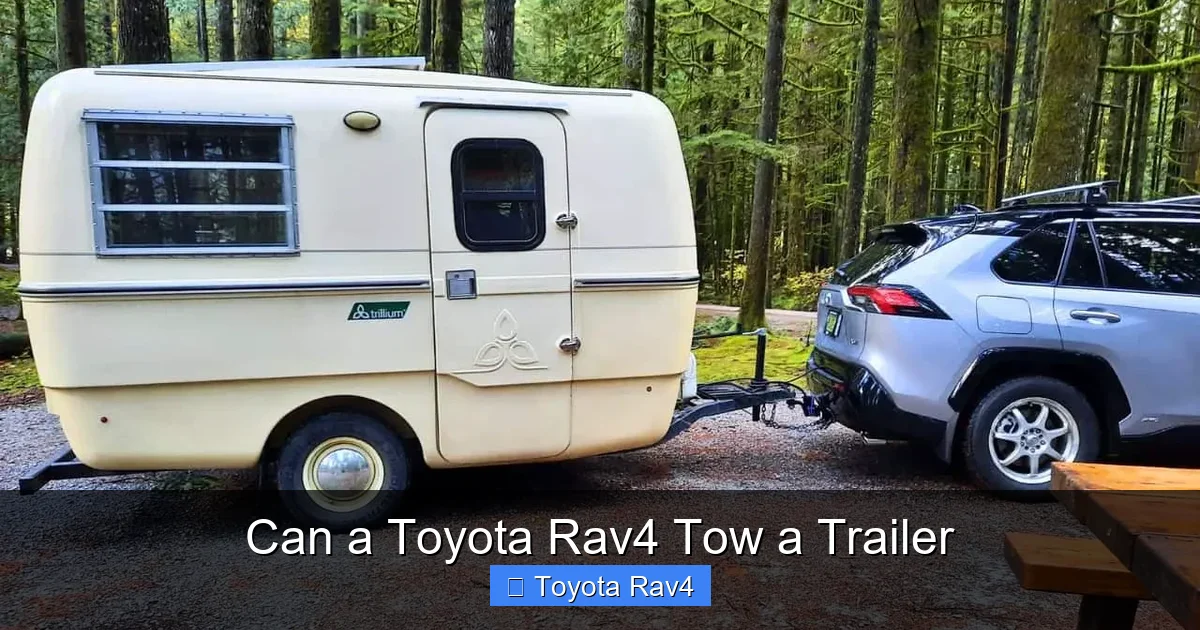
Yes, a Toyota RAV4 can tow a trailer—depending on the model year, engine, and drivetrain. Most modern RAV4s can safely tow between 1,500 and 3,500 pounds, making them ideal for small trailers, pop-up campers, or lightweight boats.
Key Takeaways
- Towing capacity varies by model: The RAV4’s towing ability ranges from 1,500 to 3,500 pounds, depending on engine type and trim level.
- Hybrid models can tow too: Even the RAV4 Hybrid offers solid towing performance, with some trims rated up to 1,750 pounds.
- All-wheel drive (AWD) improves towing: AWD models generally have higher towing capacities and better stability when hauling a trailer.
- Proper equipment is essential: A hitch, wiring harness, and brake controller (if needed) are required for safe towing.
- Know your trailer’s weight: Always check the trailer’s gross vehicle weight rating (GVWR) and stay within your RAV4’s limits.
- Fuel efficiency drops when towing: Expect reduced MPG when pulling a trailer, especially on hills or highways.
- Regular maintenance helps: Keep up with oil changes, brake checks, and tire inspections to ensure safe towing performance.
📑 Table of Contents
- Can a Toyota RAV4 Tow a Trailer? The Short Answer
- Understanding Towing Capacity: What It Means and Why It Matters
- Toyota RAV4 Towing Capacity by Model Year and Trim
- What Can You Tow with a Toyota RAV4?
- Essential Equipment for Towing with a RAV4
- Driving Tips for Towing with a Toyota RAV4
- Fuel Economy and Maintenance When Towing
- Common Mistakes to Avoid
- Conclusion: Is the RAV4 the Right Towing Vehicle for You?
Can a Toyota RAV4 Tow a Trailer? The Short Answer
Yes—the Toyota RAV4 can tow a trailer, but not all models are created equal. Whether you’re planning a weekend camping trip with a small pop-up camper or hauling a lightweight utility trailer full of gear, the RAV4 is a capable compact SUV that can handle light to moderate towing tasks. However, it’s not designed for heavy-duty hauling like a full-size truck. Understanding your specific RAV4’s towing capacity is key to safe and successful towing.
The RAV4 has evolved significantly over the years, and so has its towing capability. Earlier models from the 1990s and early 2000s were limited to just 1,500 pounds, but newer versions—especially those with all-wheel drive and turbocharged engines—can pull up to 3,500 pounds. This makes the RAV4 a surprisingly versatile option for outdoor enthusiasts, DIYers, and families who need a little extra hauling power without upgrading to a larger vehicle.
Understanding Towing Capacity: What It Means and Why It Matters
Towing capacity refers to the maximum weight your vehicle can safely pull behind it. This number isn’t just a suggestion—it’s a critical safety limit set by the manufacturer based on the vehicle’s engine strength, transmission, suspension, brakes, and cooling system. Exceeding this limit can lead to mechanical failure, poor handling, brake overheating, and even accidents.

Visual guide about Can a Toyota Rav4 Tow a Trailer
Image source: towstats.com
For the Toyota RAV4, towing capacity depends on several factors, including the engine type, drivetrain (front-wheel drive or all-wheel drive), model year, and whether it’s a gas or hybrid version. Always refer to your owner’s manual or Toyota’s official towing guide for the exact rating of your specific vehicle. Never assume all RAV4s can tow the same amount—even two identical models from the same year might differ if one has a tow package and the other doesn’t.
How to Find Your RAV4’s Towing Capacity
The easiest way to find your RAV4’s towing capacity is to check the door jamb sticker (usually on the driver’s side), your owner’s manual, or Toyota’s online towing guide. You can also use your VIN on Toyota’s website to get precise specs. Look for terms like “maximum towing capacity” or “trailer weight rating.” These numbers are tested and certified by Toyota, so they’re the most reliable source.
Another helpful tip: if your RAV4 came with a factory-installed tow package, it likely has a higher towing capacity than a base model. The tow package typically includes a heavy-duty radiator, transmission cooler, wiring harness, and sometimes a hitch receiver. Even if you don’t have the full package, adding a Class II or Class III hitch can still allow safe towing within the vehicle’s limits.
Toyota RAV4 Towing Capacity by Model Year and Trim
Let’s break down the towing capabilities of the RAV4 across recent generations. This will help you understand what your specific model can handle.
2013–2018 RAV4 (Fourth Generation)
The fourth-generation RAV4 (2013–2018) marked a big improvement in towing ability. Most models with all-wheel drive and the 2.5L four-cylinder engine could tow up to 1,500 pounds. However, if your RAV4 had the optional tow package (available on Limited and some XLE trims), the capacity jumped to 3,500 pounds. Front-wheel drive models without the tow package were typically limited to 1,500 pounds.
This generation also introduced the RAV4 Hybrid, which could tow up to 1,750 pounds—more than the base gas model. That’s impressive for a hybrid SUV and shows Toyota’s commitment to making eco-friendly vehicles that don’t sacrifice utility.
2019–2023 RAV4 (Fifth Generation)
The current fifth-generation RAV4 (2019–2023) continues to offer strong towing performance. Gas models with AWD and the 2.5L engine can tow up to 3,500 pounds when properly equipped. Front-wheel drive versions are usually rated at 1,500 pounds. The RAV4 Hybrid maintains its 1,750-pound towing capacity, while the plug-in hybrid RAV4 Prime can tow up to 2,500 pounds—making it one of the most capable electrified SUVs in its class.
One thing to note: the RAV4 TRD Off-Road and Adventure trims often come with the tow package standard, so they’re great choices if you plan to tow regularly. These trims also feature upgraded suspension and all-terrain tires, which improve stability when hauling a trailer over rough roads.
2024 RAV4 and Beyond
While Toyota hasn’t announced major changes to the 2024 RAV4’s towing specs, it’s expected to maintain similar capacities to the 2023 model. The RAV4 Prime remains a standout for towing among hybrids, thanks to its powerful electric motors and robust chassis. As Toyota continues to expand its hybrid and electric lineup, we may see even more capable towing options in future models.
What Can You Tow with a Toyota RAV4?
Now that you know the RAV4 can tow up to 3,500 pounds (in the right configuration), let’s talk about what that actually means in real life. Here are some common trailers and loads that fit within the RAV4’s towing range:
- Pop-up campers: These lightweight campers typically weigh between 1,500 and 3,000 pounds when loaded. They’re a perfect match for the RAV4, especially for weekend getaways.
- Small travel trailers: Teardrop trailers, A-frame campers, and compact RVs under 3,500 pounds can be towed safely. Just make sure to account for gear, water, and propane weight.
- Utility trailers: A 5×8 or 6×10 enclosed utility trailer loaded with landscaping materials, furniture, or tools usually stays under 1,500–2,500 pounds.
- Boat trailers: Small fishing boats, kayaks on a trailer, or jet skis can be hauled with ease. A typical 16-foot aluminum boat with trailer weighs around 2,000–2,500 pounds.
- Motorcycle trailers: Single or dual motorcycle trailers are well within the RAV4’s capacity, even when fully loaded.
Always remember to include the weight of everything inside the trailer—cargo, water tanks, batteries, and accessories. It’s easy to underestimate how much a “light” trailer actually weighs when fully equipped. Use a trailer scale or visit a truck stop with public scales to check your loaded weight before hitting the road.
Example: Towing a Pop-Up Camper
Let’s say you’re planning a camping trip with a 2021 RAV4 Hybrid AWD. Your camper weighs 2,200 pounds fully loaded. Since your RAV4 Hybrid can tow up to 1,750 pounds, this camper is too heavy. However, if you downsize to a lighter pop-up under 1,700 pounds, you’re in the clear. Alternatively, upgrading to a gas RAV4 with the tow package (3,500-pound capacity) would allow you to tow the heavier camper safely.
Essential Equipment for Towing with a RAV4
Towing isn’t just about having the right vehicle—it’s also about having the right gear. Even if your RAV4 can handle the weight, you need proper equipment to tow safely and legally.
Tow Hitch and Receiver
A Class II or Class III hitch receiver is essential. Class II hitches are rated for up to 3,500 pounds and are common on RAV4s. Make sure the hitch is properly installed—either by a professional or using a bolt-on kit designed for your specific model. Never use a hitch that’s not rated for your vehicle’s towing capacity.
Wiring Harness
You’ll need a 4-pin or 7-pin wiring harness to connect your trailer’s lights to your RAV4. This ensures your brake lights, turn signals, and running lights work in sync. Many RAV4s come with a pre-wired connector, making installation easier. If not, you can purchase a plug-and-play harness that connects to the vehicle’s taillight assembly.
Trailer Brakes (If Needed)
Trailers over 1,500 pounds typically require electric brakes. If your trailer has brakes, you’ll need a brake controller installed in your RAV4. This device lets you adjust brake pressure from the driver’s seat, improving control and safety. Some RAV4 trims come with a brake controller pre-installed; otherwise, you can add one for around $150–$300.
Weight Distribution and Sway Control
For heavier trailers (over 2,500 pounds), consider a weight distribution hitch. This helps balance the load and prevents the trailer from swaying. Sway control devices, like friction bars or hydraulic dampers, add extra stability, especially in windy conditions or when passing large trucks.
Safety Chains and Breakaway System
Always use safety chains crossed under the trailer tongue to catch the trailer if it detaches. If your trailer has brakes, it should also have a breakaway system—a battery-powered brake activator that engages if the trailer becomes disconnected.
Driving Tips for Towing with a Toyota RAV4
Towing changes how your RAV4 handles, accelerates, and brakes. Here are some practical tips to make your towing experience smoother and safer:
Take It Slow
Your RAV4 will feel heavier and less responsive when towing. Accelerate gently, leave extra space between you and the vehicle ahead, and avoid sudden lane changes. Top speed should be reduced—especially on highways—to maintain control.
Use Lower Gears on Hills
When climbing steep grades, shift into a lower gear (like “L” or “S” mode) to reduce strain on the engine and transmission. This also helps prevent overheating. On descents, use engine braking to avoid riding the brakes, which can cause them to overheat and fail.
Check Tire Pressure
Both your RAV4 and trailer tires should be inflated to the recommended PSI. Underinflated tires can overheat and blow out, especially when carrying heavy loads. Check pressures before every trip.
Distribute Weight Evenly
Load your trailer so that about 60% of the weight is on the front half (near the tongue). This prevents swaying and improves steering. Avoid overloading the rear of the trailer, which can cause fishtailing.
Make Wide Turns
Trailers take up more space and can clip curbs or obstacles during turns. Take wide arcs, especially in parking lots and tight spaces. Practice backing up in an empty lot before your trip—reversing with a trailer takes practice.
Monitor Temperature Gauges
Keep an eye on your engine and transmission temperature gauges, especially when towing uphill or in hot weather. If either starts to climb, pull over and let the engine cool. Consider installing an aftermarket transmission cooler if you plan to tow frequently.
Fuel Economy and Maintenance When Towing
Towing reduces your RAV4’s fuel efficiency—sometimes significantly. Expect a drop of 20–40% in MPG, depending on the load, terrain, and driving style. For example, a RAV4 that normally gets 30 MPG might drop to 18–22 MPG when towing a 2,500-pound trailer.
To minimize fuel loss, avoid speeding, use cruise control on flat highways, and reduce aerodynamic drag by removing roof racks or cargo boxes when not in use. Also, keep your trailer as streamlined as possible—boxy trailers create more wind resistance.
Regular maintenance is even more important when towing. The extra strain on your engine, transmission, and brakes means you should stay on top of oil changes, brake inspections, and coolant levels. Consider using synthetic oil, which handles heat better than conventional oil. If you tow often, you might want to shorten your maintenance intervals—your local mechanic can advise based on your usage.
Common Mistakes to Avoid
Even experienced drivers make towing mistakes. Here are a few to watch out for:
- Overloading the trailer: Just because your RAV4 can tow 3,500 pounds doesn’t mean you should. Leave a safety margin—aim to stay 10–15% below the max.
- Ignoring trailer brakes: If your trailer has brakes, don’t skip the brake controller. It’s a legal requirement in many states and a critical safety feature.
- Towing without practice: Backing up, turning, and parking with a trailer is tricky. Practice in a safe, open area before your trip.
- Forgetting to secure cargo: Loose items in the trailer can shift and affect balance. Use tie-downs, nets, or straps to keep everything in place.
- Driving too fast: High speeds increase sway and reduce reaction time. Stick to posted speed limits and reduce speed in windy or rainy conditions.
Conclusion: Is the RAV4 the Right Towing Vehicle for You?
The Toyota RAV4 is a solid choice for light to moderate towing, especially if you’re hauling a small camper, boat, or utility trailer. With towing capacities ranging from 1,500 to 3,500 pounds, it offers surprising versatility for a compact SUV. The availability of hybrid models with respectable towing power makes it an even more appealing option for eco-conscious drivers.
However, if you regularly tow heavy loads—like large travel trailers, horse trailers, or full-size boats—you may want to consider a larger vehicle like the Toyota Highlander, 4Runner, or a pickup truck. But for weekend adventures, DIY projects, and occasional hauling, the RAV4 strikes a great balance between efficiency, comfort, and capability.
Just remember: always check your specific model’s towing capacity, equip your RAV4 properly, and drive safely. With the right preparation, your RAV4 can be a reliable partner for all your towing needs.
Frequently Asked Questions
Can a Toyota RAV4 Hybrid tow a trailer?
Yes, the RAV4 Hybrid can tow a trailer. Most hybrid models have a towing capacity of 1,750 pounds, making them suitable for small campers, boats, or utility trailers. Just ensure your trailer’s weight stays within this limit.
What is the maximum towing capacity of a Toyota RAV4?
The maximum towing capacity of a Toyota RAV4 is 3,500 pounds. This applies to gas-powered models with all-wheel drive and the optional tow package. Front-wheel drive and base models may have lower limits.
Do I need a special hitch to tow with a RAV4?
Yes, you need a Class II or Class III hitch receiver rated for your RAV4’s towing capacity. A wiring harness and, for heavier trailers, a brake controller are also recommended for safety and legal compliance.
Can a 2020 RAV4 tow a pop-up camper?
Yes, a 2020 RAV4 can tow a pop-up camper as long as the loaded weight is within its towing capacity—up to 3,500 pounds for AWD models with the tow package. Always check the camper’s GVWR before towing.
Does towing reduce the RAV4’s fuel economy?
Yes, towing significantly reduces fuel economy. Expect a 20–40% drop in MPG when pulling a trailer, especially on hills or at high speeds. Proper driving techniques can help minimize the impact.
Can I tow a boat with a Toyota RAV4?
Yes, you can tow a small to medium-sized boat with a RAV4. Boats up to 2,500 pounds (including trailer) are generally safe, depending on your model’s towing capacity. Always check the total weight before heading out.