

Putting your Toyota RAV4 in 4 wheel drive is simple once you know the right steps. Whether you’re driving a newer model with electronic controls or an older one with a manual lever, this guide walks you through the process safely and efficiently.
If you’ve ever found yourself staring at your Toyota RAV4’s dashboard, wondering how to engage 4 wheel drive, you’re not alone. The RAV4 is one of the most popular compact SUVs on the road, known for its reliability, fuel efficiency, and surprisingly capable all-wheel-drive system. But despite its popularity, many owners are unsure how—or when—to activate 4WD. Whether you’re heading off-road, driving through snow, or just want extra traction on a rainy day, knowing how to put your Toyota RAV4 in 4 wheel drive can make a big difference in safety and performance.
The good news? It’s easier than you might think. But it’s not the same across all model years. Toyota has evolved its drivetrain technology over the decades, moving from manual levers to fully automatic electronic systems. That means the process for a 1998 RAV4 is completely different from a 2023 model. This guide will walk you through every step, no matter which RAV4 you drive. We’ll cover older models with manual 4WD, mid-generation vehicles with part-time systems, and the latest versions with advanced AWD technology. By the end, you’ll know exactly what to do—and when to do it—to get the most out of your RAV4’s traction capabilities.
Key Takeaways
- Know your RAV4 model year: Older models (pre-2001) use a manual transfer case lever, while newer ones use electronic AWD or 4WD systems.
- Use 4WD only when needed: Engage 4WD on slippery, off-road, or low-traction surfaces—not on dry pavement.
- Electronic systems activate automatically: Most modern RAV4s have on-demand AWD that engages without driver input.
- Follow speed limits in 4WD: Never exceed 55 mph when in 4WD High mode to avoid drivetrain damage.
- Switch back to 2WD when safe: Return to normal driving mode once road conditions improve.
- Check your owner’s manual: Always refer to your specific model’s instructions for accurate procedures.
- Regular maintenance helps: Keep your transfer case and differentials serviced for optimal 4WD performance.
📑 Table of Contents
Understanding Your Toyota RAV4’s Drivetrain System
Before you flip any switches or pull any levers, it’s important to understand what kind of 4WD or AWD system your RAV4 actually has. Not all RAV4s are created equal when it comes to traction. Toyota has used several different drivetrain configurations over the years, and knowing which one you have is the first step to using it correctly.
The earliest RAV4 models, produced from 1994 to 2000, came with a part-time 4WD system that required manual engagement. These vehicles had a transfer case lever located on the floor between the front seats. To activate 4WD, you had to come to a complete stop, shift into neutral, and pull the lever into the 4H (4WD High) or 4L (4WD Low) position. This system was simple and rugged, ideal for off-road use, but it wasn’t meant for everyday driving on dry pavement.
In 2001, Toyota introduced a new generation of the RAV4 with a full-time AWD system. This system used a center differential and could send power to all four wheels automatically, without driver input. It was more sophisticated and better suited for on-road conditions, especially in rain or light snow. However, some trims still offered a part-time 4WD option, especially in markets like North America and Australia.
By 2013, Toyota shifted to an on-demand AWD system, often referred to as “Dynamic Torque Control AWD.” This system primarily powers the front wheels under normal conditions but can send up to 50% of the engine’s torque to the rear wheels when slippage is detected. It’s fully automatic and requires no action from the driver. Most RAV4s sold today—especially the 2019 and newer models—use this type of system.
So how do you know which one you have? Check your owner’s manual, look for a 4WD or AWD badge on the rear, or inspect the center console. If you see a button labeled “4WD LOCK” or “AWD LOCK,” you likely have a system that allows manual engagement. If there’s no such button and your RAV4 drives smoothly in all conditions without any input, you probably have an automatic AWD system.
Understanding your drivetrain isn’t just about convenience—it’s about safety. Using 4WD incorrectly can damage your vehicle or reduce fuel efficiency. For example, driving in 4WD on dry pavement with a part-time system can cause “wind-up” in the drivetrain, leading to expensive repairs. On the other hand, knowing when to engage 4WD can help you maintain control in slippery conditions and avoid getting stuck.
How to Engage 4WD on Older RAV4 Models (1994–2000)
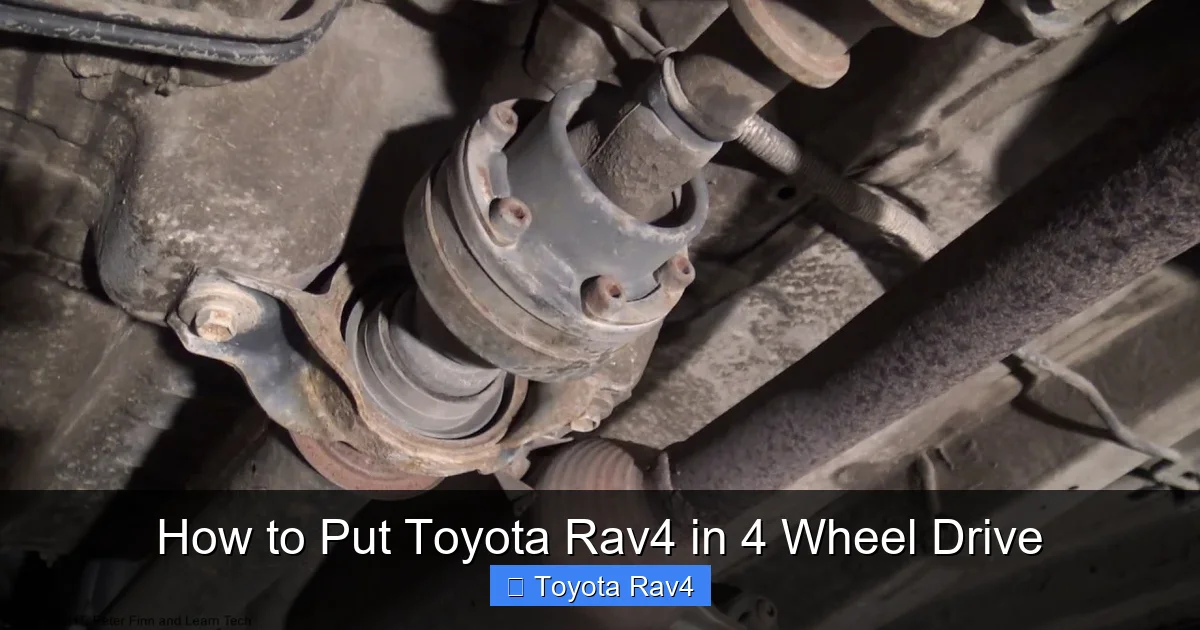
Visual guide about How to Put Toyota Rav4 in 4 Wheel Drive
Image source: i.ytimg.com
If you’re driving a first-generation Toyota RAV4—produced between 1994 and 2000—you’re working with a part-time 4WD system that requires manual engagement. This system is mechanically simple but demands careful handling. Here’s how to put your older RAV4 in 4 wheel drive safely and correctly.
Step-by-Step Guide for Manual 4WD Engagement
1. **Come to a complete stop.** This is critical. You must bring your vehicle to a full stop before shifting into 4WD. Attempting to engage 4WD while moving can damage the transfer case and drivetrain components.
2. **Shift the transmission into neutral.** With your foot on the brake, move the gear selector to the “N” (Neutral) position. This disengages the transmission and allows the transfer case to shift smoothly.
3. **Pull the 4WD lever.** Locate the transfer case lever between the front seats. It typically has markings for 2H (2WD High), 4H (4WD High), N (Neutral), and 4L (4WD Low). To engage 4WD High, pull the lever straight back from 2H to 4H. You should feel a firm click as it locks into place.
4. **Shift back into drive.** Once 4WD is engaged, move the transmission gear selector back to “D” (Drive) and resume driving.
5. **Disengage when no longer needed.** When road conditions improve, repeat the process in reverse: stop, shift to neutral, move the lever back to 2H, and return to drive.
When to Use 4H vs. 4L
Understanding the difference between 4H and 4L is essential for safe operation.
– **4H (4WD High):** Use this mode for slippery but passable conditions—such as wet roads, light snow, gravel, or muddy trails. It provides extra traction without sacrificing too much fuel efficiency. You can drive at normal highway speeds in 4H, but avoid using it on dry pavement.
– **4L (4WD Low):** This mode is for extreme off-road conditions—deep mud, steep inclines, or rocky terrain. It provides maximum torque and crawling speed but drastically reduces your top speed. Never exceed 25–30 mph in 4L, and only use it when absolutely necessary.
Important Tips for Older RAV4 4WD Use
– **Avoid dry pavement:** Never drive in 4WD on dry, paved roads. The part-time system lacks a center differential, which means the front and rear axles are locked together. This can cause drivetrain binding, especially during turns, leading to tire scrubbing and mechanical stress.
– **Engage before you need it:** Don’t wait until you’re already stuck to shift into 4WD. The system works best when engaged proactively, before traction is lost.
– **Check the indicator light:** Some older RAV4s have a dashboard light that confirms 4WD engagement. If it doesn’t illuminate, double-check that the lever is fully seated.
– **Practice in a safe area:** If you’re new to manual 4WD, practice shifting in an empty parking lot or quiet road to get comfortable with the process.
Engaging 4WD on Mid-Generation RAV4 Models (2001–2018)
The second and third generations of the Toyota RAV4 (2001–2018) introduced more advanced drivetrain options, including full-time AWD and part-time 4WD systems with electronic controls. These models offer greater flexibility and ease of use compared to their predecessors.
Electronic 4WD Systems with Lock Button
Many RAV4s from this era—especially those sold in North America—came equipped with an electronic part-time 4WD system. Instead of a mechanical lever, these vehicles use a button or switch to engage 4WD. Here’s how it works:
1. **Locate the 4WD button.** It’s usually found on the center console, near the gear shifter. It may be labeled “4WD LOCK,” “AWD LOCK,” or simply “4WD.”
2. **Press the button while driving.** Unlike older models, you don’t need to stop to engage 4WD. You can press the button at speeds up to 35–50 mph, depending on the model. The system will automatically shift into 4WD High.
3. **Watch for confirmation.** A light on the dashboard—often labeled “4WD” or “AWD LOCK”—will illuminate when the system is active.
4. **Disengage when no longer needed.** Press the button again to return to 2WD or automatic AWD mode.
Full-Time AWD Systems
Some mid-generation RAV4s, particularly those sold in Europe and Asia, came with full-time AWD systems. These systems are always active and require no driver input. Power is continuously sent to all four wheels via a center differential, providing balanced traction in all conditions.
If your RAV4 has a full-time AWD system, you won’t find a 4WD button or lever. Instead, the vehicle automatically adjusts torque distribution based on road conditions. This system is ideal for everyday driving in variable weather but offers less off-road capability than a part-time 4WD setup.
Tips for Mid-Generation RAV4 Owners
– **Use the lock button wisely:** The 4WD LOCK mode is designed for low-traction situations. Once you reach dry pavement or higher speeds (above 55 mph), disengage it to prevent drivetrain stress.
– **Don’t rely on 4WD for braking:** 4WD improves acceleration and traction but doesn’t enhance braking performance. Always maintain a safe following distance.
– **Monitor fuel economy:** Engaging 4WD increases fuel consumption. Use it only when necessary to save gas.
– **Check your owner’s manual:** Some models allow 4WD engagement up to 55 mph, while others limit it to 35 mph. Know your vehicle’s limits.
Modern RAV4 Models (2019–Present): Automatic AWD
The latest Toyota RAV4 models—starting with the 2019 redesign—feature advanced on-demand AWD systems that require no driver intervention. These systems are designed to be seamless, intelligent, and efficient.
How the Dynamic Torque Control AWD Works
The 2019 and newer RAV4 uses Toyota’s Dynamic Torque Control AWD system. Here’s how it operates:
– Under normal driving conditions, 100% of the engine’s power goes to the front wheels.
– Sensors monitor wheel speed, steering angle, throttle position, and traction.
– If slippage is detected (e.g., one wheel starts to spin), the system instantly sends up to 50% of the torque to the rear wheels.
– This happens automatically and within milliseconds—no buttons to press, no levers to pull.
This system is ideal for everyday driving, providing extra grip in rain, snow, or light off-road conditions without sacrificing fuel efficiency.
When You Might Still Need to “Engage” 4WD
Even though the system is automatic, some newer RAV4s—especially the TRD Off-Road and Adventure trims—come with a “4WD LOCK” button. This feature allows you to manually lock the AWD system for improved performance in challenging conditions.
To use it:
1. **Press the “4WD LOCK” button** (usually located near the gear shifter).
2. The system will lock the front and rear axles together, simulating a traditional 4WD setup.
3. A dashboard light will confirm activation.
4. **Disengage when no longer needed**—preferably before reaching 35–55 mph.
This mode is useful for deep snow, mud, or rocky trails but should not be used on dry pavement.
Hybrid RAV4 AWD Systems
The Toyota RAV4 Hybrid (available since 2016) uses a different AWD setup called “E-Four.” Instead of a mechanical driveshaft to the rear wheels, the hybrid system uses a separate electric motor to power the rear axle.
This system is fully automatic and highly efficient. The front wheels are driven by the gasoline engine, while the rear wheels are powered by an electric motor. The system seamlessly blends power from both sources, providing excellent traction and fuel economy.
There’s no need to engage anything—the E-Four system works silently in the background, activating only when needed.
Common Mistakes to Avoid When Using 4WD
Even with the right knowledge, it’s easy to make mistakes when using 4WD. Here are some common pitfalls and how to avoid them.
Driving in 4WD on Dry Pavement
This is the most common error, especially with part-time 4WD systems. Driving in 4WD on dry roads can cause “drivetrain wind-up,” where the front and rear axles rotate at slightly different speeds during turns. This creates stress on the transfer case, differentials, and axles, potentially leading to costly repairs.
**Solution:** Only use 4WD on slippery or loose surfaces. Return to 2WD or automatic mode as soon as conditions improve.
Engaging 4WD at High Speeds
Some drivers try to shift into 4WD while driving fast, especially in panic situations. This can damage the transfer case and clutch packs.
**Solution:** Always follow the manufacturer’s speed limits for 4WD engagement—usually under 35–55 mph. For manual systems, come to a complete stop.
Forgetting to Disengage 4WD
Leaving 4WD engaged unnecessarily reduces fuel economy and increases wear on components.
**Solution:** Make it a habit to check your drivetrain mode after driving in poor conditions. Disengage 4WD when you return to normal roads.
Using 4L inappropriately
4L is for extreme off-road use only. Using it on regular roads can destroy your drivetrain.
**Solution:** Reserve 4L for steep climbs, deep mud, or rocky trails. Never exceed 25 mph in this mode.
Ignoring Maintenance
4WD systems require regular servicing. Neglecting the transfer case, differentials, or AWD clutch packs can lead to failure.
**Solution:** Follow your owner’s manual for service intervals. Typically, transfer case fluid should be changed every 30,000–60,000 miles.
Tips for Safe and Effective 4WD Use
Using 4WD correctly isn’t just about flipping a switch—it’s about understanding when and how to use it for maximum benefit. Here are some practical tips to help you get the most out of your RAV4’s traction system.
Know Your Terrain
Different surfaces require different approaches:
– **Snow and ice:** Use 4H or AWD LOCK for better acceleration and control. Reduce speed and avoid sudden movements.
– **Mud and sand:** Engage 4H or 4L depending on depth. Maintain steady momentum to avoid getting stuck.
– **Rocky trails:** Use 4L for maximum torque and crawling speed. Proceed slowly and watch for obstacles.
– **Wet roads:** Automatic AWD is usually sufficient. Only use 4WD LOCK if you experience slippage.
Adjust Your Driving Style
4WD improves traction but doesn’t make you invincible. Remember:
– **Braking distance increases** in slippery conditions, even with 4WD.
– **Steering response may feel heavier** in 4WD mode.
– **Accelerate and brake gently** to maintain control.
Use Traction Aids When Needed
Even with 4WD, you might need extra help in extreme conditions. Consider carrying:
– **Traction mats or sand ladders**
– **Snow chains** (for icy roads)
– **A shovel and tow strap** (for emergencies)
Monitor Dashboard Warnings
Modern RAV4s have warning lights for AWD or 4WD issues. If you see a flashing “AWD” or “4WD” light, have your vehicle inspected immediately.
Practice in a Safe Environment
If you’re new to 4WD, practice in a controlled setting—like an empty parking lot or off-road course. Get familiar with how your RAV4 responds in different modes.
Conclusion
Putting your Toyota RAV4 in 4 wheel drive doesn’t have to be complicated. Whether you drive a classic 1996 model with a manual lever or a sleek 2023 hybrid with automatic AWD, the key is understanding your vehicle’s system and using it appropriately. For older RAV4s, remember to stop and shift carefully. For mid-generation models, use the electronic lock button wisely. And for the latest versions, trust the automatic system—but know when to engage the 4WD LOCK for extra capability.
Always prioritize safety, follow your owner’s manual, and avoid common mistakes like driving in 4WD on dry pavement. With the right knowledge and habits, your RAV4’s 4WD system will serve you well in rain, snow, mud, and beyond. So the next time you face slippery roads or a rugged trail, you’ll know exactly what to do—confidently and correctly.
Frequently Asked Questions
Can I drive my RAV4 in 4WD all the time?
No, you should not drive in 4WD on dry pavement, especially with part-time systems. It can cause drivetrain damage. Use 4WD only in slippery or off-road conditions, and return to 2WD or automatic mode when safe.
Do I need to stop to engage 4WD on a modern RAV4?
Most modern RAV4s with electronic AWD systems do not require you to stop. You can engage 4WD LOCK while driving, usually up to 35–55 mph, depending on the model.
What’s the difference between AWD and 4WD on a RAV4?
AWD (All-Wheel Drive) is typically full-time and automatic, sending power to all wheels as needed. 4WD (Four-Wheel Drive) is often part-time and manually engaged, offering more torque for off-road use.
Can I use 4WD in the rain?
Yes, 4WD or AWD can help improve traction in heavy rain. However, most modern RAV4s activate AWD automatically, so no action is needed. Avoid sudden maneuvers regardless.
How fast can I drive in 4WD mode?
Never exceed 55 mph in 4WD High. For 4WD Low, stay under 25–30 mph. Always refer to your owner’s manual for specific speed limits.
Why won’t my RAV4 engage 4WD?
Common causes include low transfer case fluid, a faulty sensor, or attempting to engage while moving too fast. Check your fluid levels and consult a mechanic if the issue persists.