
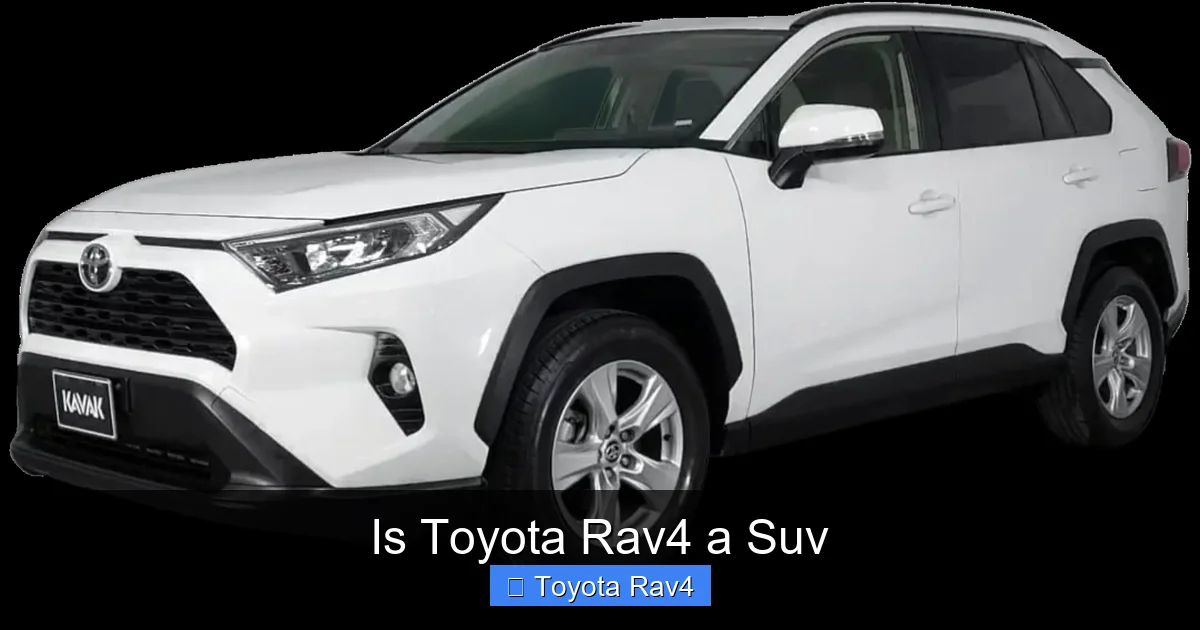
The Toyota RAV4 is absolutely a SUV—specifically, a compact crossover SUV that blends car-like comfort with off-road capability. Since its debut in the mid-1990s, it has redefined what a modern SUV can be, offering fuel efficiency, advanced safety, and versatile performance.
Key Takeaways
- The Toyota RAV4 is a compact SUV: It fits squarely within the compact crossover SUV category, combining passenger comfort with light off-road ability.
- It pioneered the modern crossover segment: The RAV4 was one of the first vehicles to blend SUV utility with car-based platforms, setting a trend followed by many automakers.
- Available in multiple powertrains: Choose from gasoline, hybrid, and plug-in hybrid (RAV4 Prime) versions, each offering different levels of efficiency and performance.
- Excellent safety and reliability ratings: The RAV4 consistently earns top marks from IIHS and NHTSA, plus high reliability scores from J.D. Power and Consumer Reports.
- Spacious interior and cargo room: Despite its compact size, the RAV4 offers generous legroom, headroom, and up to 69.8 cubic feet of cargo space with seats folded.
- Advanced tech and driver-assist features: Standard Toyota Safety Sense 2.0 includes adaptive cruise control, lane departure warning, and automatic emergency braking.
- Great for daily driving and weekend adventures: Whether commuting in the city or exploring mountain trails, the RAV4 handles it all with confidence.
📑 Table of Contents
- Is Toyota RAV4 a SUV? Let’s Set the Record Straight
- What Exactly Defines a SUV?
- The RAV4’s Evolution: From Compact Pioneer to Market Leader
- RAV4 Powertrains: Gas, Hybrid, and Plug-In Options
- Interior, Tech, and Cargo: What Makes the RAV4 Stand Out
- Driving Experience: On-Road Comfort and Off-Road Capability
- Reliability, Resale Value, and Ownership Costs
- Conclusion: Yes, the Toyota RAV4 Is a SUV—And a Great One at That
Is Toyota RAV4 a SUV? Let’s Set the Record Straight
If you’ve ever stood in a parking lot staring at a Toyota RAV4 and wondered, “Wait… is that really an SUV?”—you’re not alone. With its sleek design, car-like handling, and fuel-efficient engine, the RAV4 doesn’t always look like the rugged, boxy SUVs of the past. But make no mistake: the Toyota RAV4 is 100% a SUV—specifically, a compact crossover SUV that has become one of the most popular vehicles on the road today.
So why the confusion? The answer lies in how the automotive world has evolved. Back in the 1990s, SUVs were mostly body-on-frame trucks—big, heavy, and built for off-roading. They were great for hauling gear and tackling trails, but not so great for daily commutes or gas mileage. Then came the RAV4 in 1994, and everything changed. Toyota took a bold step by building a vehicle on a unibody platform—the same kind used in cars—but gave it SUV-like ground clearance, available all-wheel drive, and a taller ride height. The result? A vehicle that offered the best of both worlds: the comfort and efficiency of a car with the versatility and visibility of an SUV.
Fast forward to today, and the RAV4 has become the blueprint for modern crossovers. It’s not just a SUV—it’s the SUV that helped define what a SUV could be in the 21st century. Whether you’re navigating city streets, loading up for a road trip, or heading out on a light off-road adventure, the RAV4 delivers. And with multiple trims, powertrains, and tech features, it’s no surprise that it’s consistently one of the top-selling vehicles in the U.S.
What Exactly Defines a SUV?
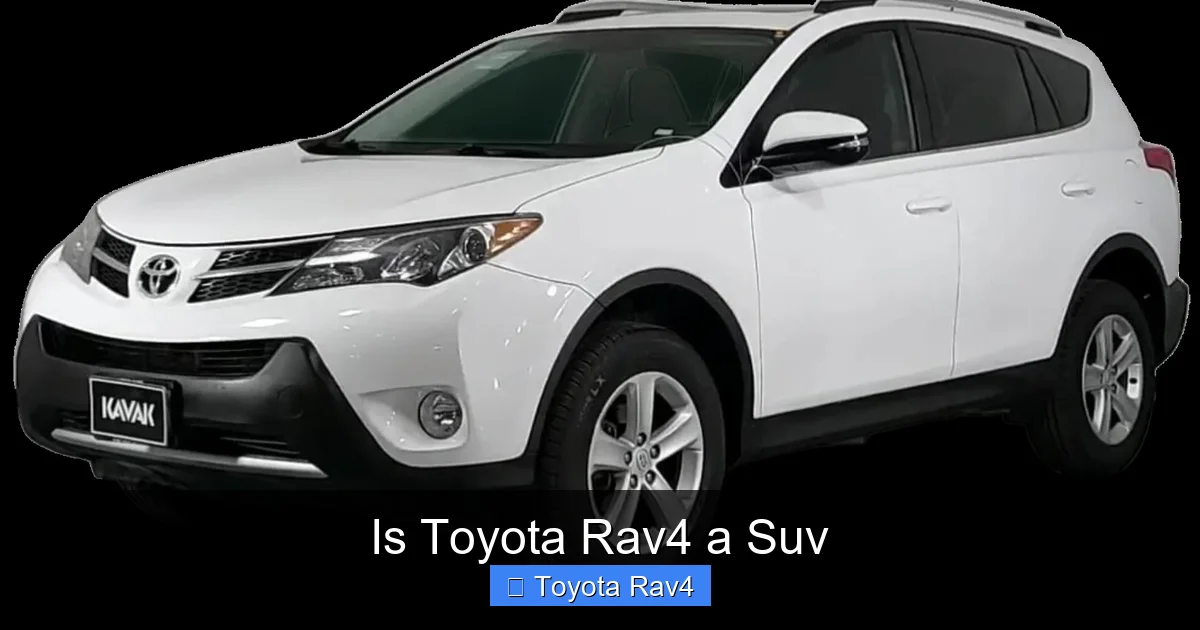
Visual guide about Is Toyota Rav4 a Suv
Image source: images.kavak.services
Before we dive deeper into the RAV4, let’s clear up what makes a vehicle a SUV in the first place. The term “SUV” stands for Sport Utility Vehicle, and while there’s no single official definition, most experts agree that SUVs share a few key traits:
- Higher ground clearance: SUVs sit higher off the ground than sedans or hatchbacks, giving them better visibility and the ability to handle rough roads.
- Available all-wheel or four-wheel drive: While not all SUVs come with AWD standard, most offer it as an option for better traction in rain, snow, or off-road conditions.
- Enclosed cargo area: Unlike pickup trucks, SUVs have a fully enclosed rear cargo space, often with a rear hatch door.
- Passenger and cargo versatility: SUVs are designed to carry people and gear comfortably, with fold-down rear seats for extra storage.
- Robust exterior styling: Even modern crossovers often have bold grilles, roof rails, and rugged accents that signal their utility heritage.
Now, let’s see how the RAV4 stacks up. With a ground clearance of 8.4 inches (on most trims), available AWD, a spacious cargo area, and a design that balances style with function, the RAV4 checks every box. It’s not a truck-based SUV like the Toyota 4Runner, but that doesn’t make it any less of a SUV—it just makes it a different kind of SUV.
Compact vs. Midsize: Where Does the RAV4 Fit?
One reason people question the RAV4’s SUV status is its size. It’s not a massive three-row SUV like the Toyota Highlander or a rugged off-roader like the Land Cruiser. Instead, it falls into the compact SUV category—a segment that’s exploded in popularity over the last two decades.
Compact SUVs are typically smaller than midsize models but larger than subcompacts like the Toyota C-HR or Nissan Kicks. They’re ideal for families, commuters, and outdoor enthusiasts who want more space than a sedan but don’t need the bulk of a larger SUV. The RAV4 measures about 180 inches long, seats five passengers comfortably, and offers up to 69.8 cubic feet of cargo space with the rear seats folded. That’s enough room for groceries, luggage, camping gear, or even a small mattress for a weekend getaway.
In comparison, the Honda CR-V and Mazda CX-5—two of the RAV4’s closest rivals—are also compact SUVs. But the RAV4 often edges them out in terms of cargo space, available AWD, and overall ruggedness. It’s not trying to be a luxury SUV or a full-size family hauler—it’s aiming to be the perfect all-around compact SUV, and it succeeds.
The RAV4’s Evolution: From Compact Pioneer to Market Leader
To truly understand why the RAV4 is a SUV, it helps to look at its history. When Toyota launched the first-generation RAV4 in 1994, it was a radical departure from the SUVs of the time. Most SUVs were built on truck platforms—think Ford Explorer or Jeep Cherokee—and were heavy, thirsty, and not very fun to drive on pavement. The RAV4, on the other hand, was built on a car platform (the Corolla’s), which made it lighter, more fuel-efficient, and easier to handle.
The original RAV4 was small—so small, in fact, that it was available in both three-door and five-door versions. It had a removable hardtop, a rear-mounted spare tire, and optional part-time four-wheel drive. It was quirky, practical, and ahead of its time. While it didn’t sell in huge numbers at first, it laid the foundation for a new kind of vehicle: the crossover SUV.
By the early 2000s, the RAV4 had evolved into a more mainstream compact SUV. The second generation (2001–2005) grew in size, added more power, and introduced a more refined interior. The third generation (2006–2012) brought even more space, better safety features, and a more car-like driving experience. But it was the fourth generation (2013–2018) that really cemented the RAV4’s place in the market. It offered a more aggressive design, improved fuel economy, and standard AWD on most trims.
Today’s fifth-generation RAV4 (introduced in 2019) is the most advanced yet. It features a bold, angular design inspired by Toyota’s off-road vehicles, a more rigid chassis, and a suite of standard safety tech. It’s also available in hybrid and plug-in hybrid (RAV4 Prime) versions, making it one of the most efficient SUVs in its class.
How the RAV4 Changed the Automotive Landscape
The RAV4 didn’t just succeed—it changed the game. Before its arrival, SUVs were mostly for off-roading or towing. After the RAV4, automakers realized there was a huge market for vehicles that offered SUV-like utility without the drawbacks of truck-based platforms. This led to the rise of crossovers like the Honda CR-V, Ford Escape, and Subaru Forester—all of which followed the RAV4’s lead.
In fact, the term “crossover” was practically invented because of vehicles like the RAV4. These vehicles “cross over” between cars and SUVs, offering the best of both. And while some purists argue that crossovers aren’t “real” SUVs, the reality is that most modern SUVs—including the RAV4—are crossovers. The distinction is mostly academic at this point.
What matters is that the RAV4 delivers what people want: space, safety, efficiency, and versatility. It’s not trying to be a truck. It’s trying to be the perfect everyday SUV—and it’s doing a fantastic job.
RAV4 Powertrains: Gas, Hybrid, and Plug-In Options
One of the reasons the RAV4 stands out in the crowded SUV market is its range of powertrain options. Whether you prioritize fuel economy, performance, or environmental impact, there’s a RAV4 for you.
Gasoline Engine: Reliable and Efficient
The standard RAV4 comes with a 2.5-liter four-cylinder engine that produces 203 horsepower and 184 lb-ft of torque. It’s paired with an eight-speed automatic transmission and is available with either front-wheel drive (FWD) or all-wheel drive (AWD). This engine is known for its smoothness, reliability, and decent fuel economy—around 28 mpg city and 35 mpg highway with FWD.
For most drivers, this engine is more than enough. It accelerates confidently, handles well, and doesn’t drink gas like older SUVs. Whether you’re merging onto the highway or driving through the city, the RAV4 feels responsive and composed.
Hybrid: The Sweet Spot for Efficiency
If you want even better fuel economy, the RAV4 Hybrid is the way to go. It uses the same 2.5-liter engine but adds two electric motors for a combined output of 219 horsepower. The hybrid system is intelligent—it can run on electric power alone at low speeds, switch to gas when needed, and even recharge the battery through regenerative braking.
The result? An impressive 41 mpg city and 38 mpg highway—making it one of the most fuel-efficient SUVs on the market. And unlike some hybrids, the RAV4 Hybrid doesn’t sacrifice performance. It actually accelerates faster than the gas-only version, thanks to the instant torque from the electric motors.
The hybrid also comes standard with AWD, using a rear electric motor to power the back wheels when needed. This gives it better traction in rain or snow without the complexity of a traditional mechanical AWD system.
Plug-In Hybrid: The RAV4 Prime
For those who want the ultimate in efficiency and performance, the RAV4 Prime is a game-changer. It’s a plug-in hybrid that combines the 2.5-liter engine with a larger battery and more powerful electric motors, delivering a combined 302 horsepower. That’s more than many midsize SUVs—and it can go from 0 to 60 mph in just 5.7 seconds.
But the real magic is in its electric range. The RAV4 Prime can travel up to 42 miles on electricity alone, making it perfect for short commutes or errands. Once the battery is depleted, it operates like a regular hybrid, so you never have to worry about running out of juice. With a full charge and a full tank, it can go over 600 miles between fill-ups.
Charging is simple: plug it into a standard 120-volt outlet overnight, or use a 240-volt Level 2 charger for a full charge in about 2.5 hours. Many owners report that they rarely need to use gas, especially if they charge daily.
Interior, Tech, and Cargo: What Makes the RAV4 Stand Out
Beyond its powertrains, the RAV4 shines in its interior design, technology, and practicality. It’s not the most luxurious SUV in its class, but it’s well-built, intuitive, and packed with features that make daily driving easier and more enjoyable.
Spacious and Comfortable Cabin
Step inside the RAV4, and you’ll find a cabin that’s both modern and functional. The dashboard is clean and driver-focused, with easy-to-reach controls and a standard 8-inch touchscreen (upgradable to 10.5 inches on higher trims). Materials are mostly hard plastic, but they’re well-assembled and durable—perfect for families or outdoor use.
Seating is comfortable for long drives, with good support and plenty of headroom and legroom. Even taller passengers will find plenty of space in the back seat, which has 37.8 inches of legroom—more than many competitors. The rear seats also recline slightly, adding to the comfort.
Tech and Infotainment
Toyota has made significant improvements to its infotainment system in recent years. The RAV4 comes standard with Apple CarPlay, Android Auto, and Amazon Alexa compatibility. Higher trims add wireless charging, a premium JBL audio system, and a digital rearview mirror that uses a camera to eliminate blind spots.
The available 10.5-inch touchscreen is responsive and easy to use, with crisp graphics and intuitive menus. Navigation is available, but most drivers will rely on smartphone integration for directions. Toyota also offers a Wi-Fi hotspot and over-the-air updates, so your RAV4 can stay up to date without a trip to the dealer.
Safety Features: Toyota Safety Sense 2.0
One of the RAV4’s biggest selling points is its safety. Every RAV4 comes standard with Toyota Safety Sense 2.0, a suite of advanced driver-assist technologies that includes:
- Pre-Collision System with Pedestrian Detection: Can detect vehicles, pedestrians, and cyclists and apply the brakes if a collision is imminent.
- Lane Departure Alert with Steering Assist: Warns you if you drift out of your lane and can gently steer you back.
- Dynamic Radar Cruise Control: Maintains a set distance from the car ahead, even in stop-and-go traffic.
- Automatic High Beams: Switches between high and low beams based on traffic.
- Road Sign Assist: Reads speed limit and other signs and displays them on the dashboard.
These features, combined with a strong body structure and eight airbags, help the RAV4 earn top safety ratings from the IIHS and NHTSA. It’s consistently named a Top Safety Pick+, the highest honor from the IIHS.
Cargo Space and Practicality
The RAV4 isn’t just safe and tech-savvy—it’s also incredibly practical. With the rear seats up, you get 37.5 cubic feet of cargo space. Fold them down, and that expands to 69.8 cubic feet—enough for a week’s worth of groceries, camping gear, or even a small piece of furniture.
The cargo area is wide and flat, with tie-down hooks, a 12-volt outlet, and an available power liftgate. There’s also under-floor storage for smaller items, and the rear seats split 60/40 for added flexibility. If you need even more space, the RAV4 offers optional roof rails and crossbars for bikes, kayaks, or cargo boxes.
Driving Experience: On-Road Comfort and Off-Road Capability
So, how does the RAV4 actually drive? In a word: confidently. It’s not a sports car, but it’s not a slouch either. The steering is light and precise, the suspension absorbs bumps well, and the ride is quiet and composed—even on rough roads.
On-Road Performance
On the highway, the RAV4 feels stable and secure. Wind and road noise are well-controlled, and the seats provide good support for long trips. The hybrid and Prime models are especially quiet, thanks to their electric motors. Even at highway speeds, you’ll barely hear the engine.
In the city, the RAV4 is easy to maneuver, with a tight turning radius and good visibility. Parking is a breeze, even in tight spots. And with available features like a 360-degree camera and parking sensors, you’ll never have to worry about bumping into anything.
Off-Road Ability: The RAV4 TRD Off-Road and Adventure Trims
While the RAV4 isn’t designed for serious rock crawling, it’s more capable off-road than most people realize. The Adventure and TRD Off-Road trims come with features like:
- Multi-Terrain Select: Lets you choose settings for mud, sand, rock, or snow.
- Downhill Assist Control: Helps maintain a steady speed on steep descents.
- Enhanced AWD system: With torque vectoring for better traction.
- Skid plates: Protect the engine, transmission, and fuel tank.
- All-terrain tires: Provide better grip on loose surfaces.
These trims can handle dirt roads, forest trails, and snowy mountain passes with ease. They’re not for extreme off-roading, but they’re perfect for weekend adventures, ski trips, or exploring national parks.
Reliability, Resale Value, and Ownership Costs
One of the biggest reasons people choose the RAV4 is its reputation for reliability. Toyota has long been known for building vehicles that last, and the RAV4 is no exception. According to J.D. Power and Consumer Reports, it consistently ranks among the most reliable compact SUVs.
Long-Term Durability
Many RAV4 owners report driving their vehicles well over 200,000 miles with minimal issues. Regular maintenance—like oil changes, tire rotations, and brake inspections—is all it takes to keep it running smoothly. The hybrid and Prime models are also built to last, with Toyota offering an 8-year/100,000-mile warranty on the hybrid battery.
Resale Value
The RAV4 holds its value better than most SUVs. According to Kelley Blue Book, it has one of the highest resale values in its class. That means if you decide to sell or trade it in a few years, you’ll get a good return on your investment.
Fuel and Maintenance Costs
Thanks to its efficient engines and hybrid options, the RAV4 is cheap to run. The gas model costs about $1,500 per year in fuel (based on 15,000 miles), while the hybrid drops that to around $1,000. The Prime can be even cheaper if you charge regularly.
Maintenance is also affordable. Toyota’s scheduled service is straightforward, and parts are widely available. Many repairs can be done at independent shops, saving you money compared to luxury brands.
Conclusion: Yes, the Toyota RAV4 Is a SUV—And a Great One at That
So, is the Toyota RAV4 a SUV? The answer is a resounding yes. It’s a compact crossover SUV that combines car-like efficiency with SUV versatility, making it ideal for families, commuters, and adventurers alike. From its pioneering origins to its modern hybrid and plug-in options, the RAV4 has consistently set the standard for what a modern SUV can be.
It’s not the biggest, fastest, or most luxurious SUV on the market—but it doesn’t need to be. What it offers is balance: reliability, safety, space, and efficiency, all wrapped in a stylish and capable package. Whether you’re driving to work, loading up for a road trip, or exploring a dirt trail, the RAV4 handles it all with confidence.
If you’re in the market for a SUV that does it all without breaking the bank, the Toyota RAV4 deserves a top spot on your list. It’s not just a SUV—it’s the SUV that changed the game.
Frequently Asked Questions
Is the Toyota RAV4 considered a compact SUV?
Yes, the Toyota RAV4 is classified as a compact crossover SUV. It offers more space than a subcompact SUV but is smaller than midsize models like the Highlander, making it ideal for daily driving and light off-roading.
Does the RAV4 have all-wheel drive?
Yes, all-wheel drive (AWD) is available on most RAV4 trims and comes standard on the Hybrid and Prime models. The AWD system improves traction in rain, snow, and off-road conditions.
Can the RAV4 go off-road?
While not a full off-roader, the RAV4—especially the Adventure and TRD Off-Road trims—can handle dirt roads, gravel paths, and snowy terrain thanks to features like Multi-Terrain Select and skid plates.
How much cargo space does the RAV4 have?
The RAV4 offers 37.5 cubic feet of cargo space behind the rear seats and up to 69.8 cubic feet with the seats folded down, making it one of the most spacious in its class.
Is the RAV4 Hybrid worth the extra cost?
Yes, the RAV4 Hybrid offers significantly better fuel economy (up to 41 mpg city) and comes standard with AWD. It’s ideal for drivers who want efficiency without sacrificing performance.
How reliable is the Toyota RAV4?
The RAV4 is highly reliable, consistently earning top scores from J.D. Power and Consumer Reports. Many owners report driving over 200,000 miles with proper maintenance.