
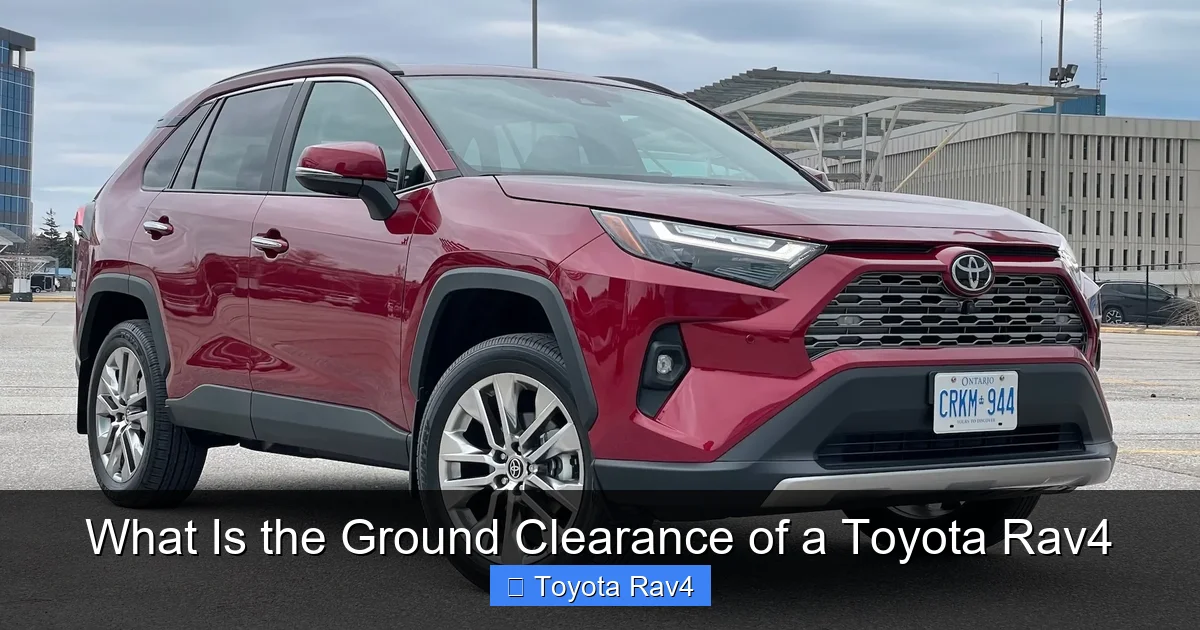
The Toyota RAV4 offers a ground clearance ranging from 8.4 to 8.6 inches, depending on the trim and drivetrain. This impressive clearance makes it one of the most capable compact SUVs for light off-roading and rough terrain, while still maintaining excellent on-road comfort and fuel efficiency.
Key Takeaways
- Ground clearance varies by trim: The RAV4 ranges from 8.4 to 8.6 inches, with Adventure and TRD Off-Road trims offering the highest clearance.
- All-wheel drive enhances capability: AWD models often have slightly higher clearance and better traction on uneven surfaces.
- Designed for light off-roading: The RAV4’s clearance allows it to handle gravel roads, snow, and mild trails with confidence.
- Improved over previous generations: Recent models have increased clearance compared to older versions, boosting versatility.
- Balances comfort and capability: High clearance doesn’t compromise ride quality or fuel economy.
- Compare with competitors: The RAV4 outperforms many rivals like the Honda CR-V and Nissan Rogue in ground clearance.
- Maintenance matters: Regular checks of suspension and underbody protect clearance and performance over time.
📑 Table of Contents
- What Is the Ground Clearance of a Toyota RAV4?
- Understanding Ground Clearance: Why It Matters
- Toyota RAV4 Ground Clearance by Trim and Model Year
- How the RAV4 Compares to Competitors
- Real-World Benefits of the RAV4’s Ground Clearance
- Maintaining Your RAV4’s Ground Clearance
- Conclusion: Is the RAV4’s Ground Clearance Right for You?
What Is the Ground Clearance of a Toyota RAV4?
When shopping for a compact SUV, one of the most important—and often overlooked—specifications is ground clearance. It’s the distance between the lowest point of your vehicle (usually the axle or underbody) and the ground. For the Toyota RAV4, this measurement isn’t just a number on a spec sheet—it’s a key factor that influences how well the vehicle handles rough roads, snow, gravel, and even light off-road adventures.
So, what is the ground clearance of a Toyota RAV4? The answer depends on the model year, trim level, and whether it’s equipped with front-wheel drive (FWD) or all-wheel drive (AWD). Across recent generations—especially from 2019 onward—the RAV4 typically offers between 8.4 and 8.6 inches of ground clearance. That’s notably higher than many of its competitors, making it a standout in the compact SUV segment.
But why does this matter? Ground clearance affects everything from your ability to drive over potholes and curbs to how confidently you can tackle a snowy driveway or a muddy trail. It also plays a role in water fording, underbody protection, and overall vehicle stability. The RAV4 strikes a smart balance: it’s high enough to be capable off the beaten path, yet low enough to maintain excellent fuel efficiency and a comfortable, car-like ride.
In this guide, we’ll dive deep into the ground clearance of the Toyota RAV4, exploring how it varies across trims, how it compares to rivals, and what it means for real-world driving. Whether you’re planning weekend camping trips, navigating city potholes, or just want a vehicle that can handle whatever life throws at it, understanding the RAV4’s ground clearance will help you make a smarter choice.
Understanding Ground Clearance: Why It Matters
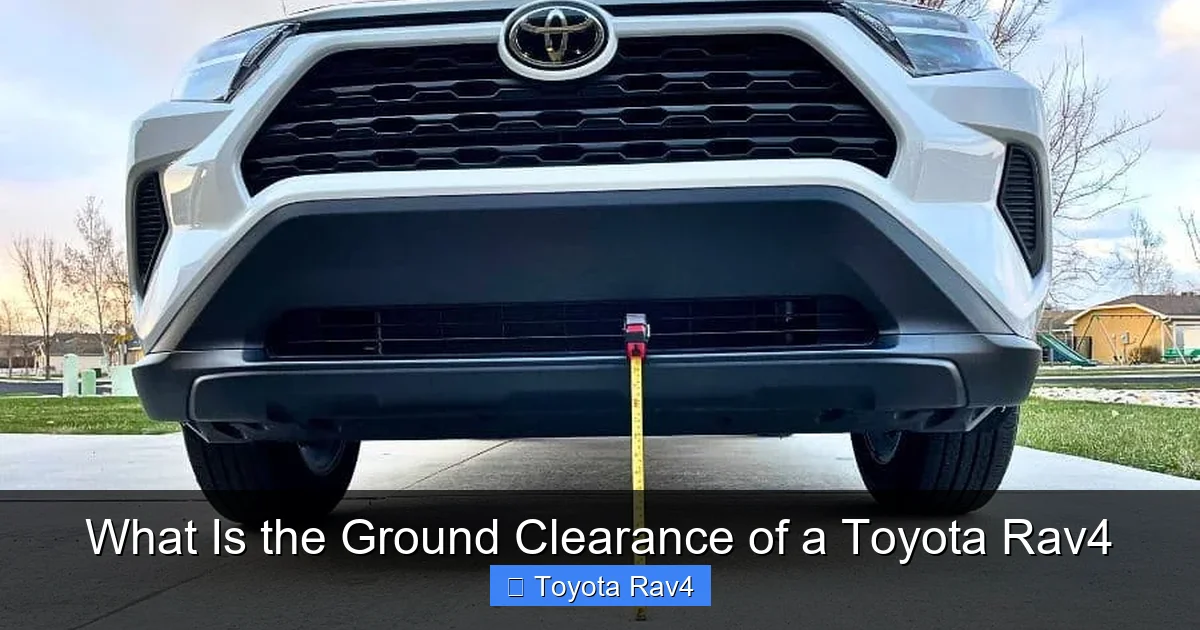
Visual guide about What Is the Ground Clearance of a Toyota Rav4
Image source: rav4hub.com
Before we get into the specifics of the RAV4, let’s take a moment to understand what ground clearance really means—and why it’s such a big deal for SUV buyers.
Ground clearance is the vertical distance from the ground to the lowest part of a vehicle’s undercarriage. This isn’t just about the tires; it includes components like the differential, exhaust system, fuel tank, and suspension parts. A higher clearance means those parts are less likely to scrape or get damaged when driving over obstacles.
For city drivers, ground clearance helps with steep driveways, speed bumps, and deep potholes. If you’ve ever heard that dreaded “scraping” sound when pulling into a parking garage, you know how important this can be. For rural or adventure-minded drivers, it’s even more critical. Whether you’re driving on gravel backroads, snow-covered paths, or rocky trails, adequate clearance keeps your vehicle safe and functional.
The Toyota RAV4 is designed with this balance in mind. It’s not a full-blown off-roader like the 4Runner, but it’s far more capable than a typical crossover. Its ground clearance gives it the confidence to handle light off-roading—think forest service roads, campgrounds, or muddy trails—without sacrificing the comfort and efficiency that make it a top seller.
How Ground Clearance Affects Performance
Higher ground clearance improves a vehicle’s approach, departure, and breakover angles—key metrics for off-road capability. The approach angle is how steep a slope the front of the vehicle can climb without hitting the ground. The departure angle is the same for the rear. Breakover angle measures the maximum angle the vehicle can traverse without the underbody scraping.
With 8.4 to 8.6 inches of clearance, the RAV4 has excellent breakover angle for its class. This means it can handle moderate inclines and dips without bottoming out. Combined with available AWD and terrain-select modes (on higher trims), the RAV4 becomes a surprisingly capable adventure vehicle.
But there’s a trade-off. Higher clearance can raise the vehicle’s center of gravity, potentially affecting handling and rollover risk. Toyota engineers have mitigated this with a well-tuned suspension and electronic stability control, ensuring the RAV4 remains stable and predictable, even on winding roads.
Real-World Examples of Ground Clearance in Action
Imagine you’re driving up a snowy mountain road to a cabin. Your RAV4’s high clearance prevents the undercarriage from getting stuck in deep snowdrifts. Or picture a weekend trip to a national park with uneven, rocky paths. The RAV4 can navigate those trails where a lower-slung SUV like the Honda CR-V might struggle.
Even in daily driving, ground clearance matters. Have you ever seen a car stuck halfway up a steep driveway? That’s often due to low clearance. The RAV4’s height helps it handle such situations with ease, making it a practical choice for homes with challenging access.
Toyota RAV4 Ground Clearance by Trim and Model Year
Now let’s get specific. The ground clearance of a Toyota RAV4 isn’t the same across all models. It varies depending on the trim level, drivetrain, and generation. Here’s a detailed breakdown to help you understand what to expect.
2019–2023 Toyota RAV4 (Fifth Generation)
The fifth-generation RAV4, introduced in 2019, marked a significant shift in design and capability. Toyota increased the ground clearance compared to the previous generation, making it more rugged and adventure-ready.
– **LE and XLE (FWD):** 8.4 inches
– **LE and XLE (AWD):** 8.4 inches
– **XLE Premium, Limited (AWD):** 8.4 inches
– **Adventure Trim (AWD):** 8.6 inches
– **TRD Off-Road Trim (AWD):** 8.6 inches
The Adventure and TRD Off-Road trims are specifically designed for off-road use. They feature enhanced suspension, all-terrain tires, and additional underbody protection. The extra 0.2 inches of clearance might not sound like much, but it makes a noticeable difference when driving over rocks or ruts.
2024 Toyota RAV4 Updates
For the 2024 model year, Toyota has maintained the same ground clearance across most trims. However, the TRD Off-Road and Adventure trims continue to offer 8.6 inches, reinforcing their role as the most capable versions of the RAV4.
It’s worth noting that the RAV4 Hybrid and RAV4 Prime (plug-in hybrid) also share the same clearance as their gas-only counterparts. This is a big advantage over some hybrids, which sometimes have lower clearance due to battery placement.
Older Generations (2013–2018)
If you’re considering a used RAV4, here’s what to know:
– **2013–2018 RAV4 (Fourth Generation):** 7.9 to 8.0 inches
– **2006–2012 RAV4 (Third Generation):** 7.7 to 8.1 inches (varies by drivetrain)
As you can see, the newer models offer significantly more clearance. The jump from 7.9 to 8.6 inches is a major improvement, especially for drivers who want more versatility.
Why the Difference Between Trims?
You might wonder why the Adventure and TRD Off-Road trims have more clearance than the base LE. It’s not just marketing—there are real mechanical differences.
These trims feature:
– Raised suspension components
– Skid plates for underbody protection
– All-terrain tires with deeper tread
– AWD with torque vectoring and terrain modes
These upgrades allow Toyota to safely increase the ride height without compromising safety or handling. The result is a vehicle that’s genuinely more capable off-road, not just styled to look the part.
How the RAV4 Compares to Competitors
When evaluating the ground clearance of a Toyota RAV4, it’s helpful to see how it stacks up against other popular compact SUVs. Let’s compare it to three key rivals: the Honda CR-V, Nissan Rogue, and Subaru Forester.
Toyota RAV4 vs. Honda CR-V
The Honda CR-V is one of the RAV4’s closest competitors. However, it falls short in ground clearance:
– **Honda CR-V (2023):** 7.8 inches (FWD), 8.0 inches (AWD)
That’s 0.4 to 0.6 inches less than the RAV4. While the CR-V is excellent for city driving and fuel efficiency, it’s less suited for rough terrain. If you frequently drive on gravel roads or need to handle snow, the RAV4’s extra clearance gives it a clear advantage.
Toyota RAV4 vs. Nissan Rogue
The Nissan Rogue offers:
– **Nissan Rogue (2023):** 8.0 inches (FWD), 8.2 inches (AWD)
Again, the RAV4 outperforms it, especially in AWD configurations. The Rogue is a comfortable and efficient SUV, but it’s not designed for off-road use. The RAV4’s higher clearance and available off-road trims make it a better choice for adventurous drivers.
Toyota RAV4 vs. Subaru Forester
The Subaru Forester is known for its off-road capability and standard AWD. Its ground clearance is:
– **Subaru Forester (2023):** 8.7 inches
Slightly higher than the RAV4, the Forester is a strong competitor for outdoor enthusiasts. However, the RAV4 offers more power (especially in the Hybrid and Prime versions), better fuel economy, and a more modern interior. The difference in clearance is minimal—just 0.1 to 0.3 inches—so it often comes down to personal preference.
Why the RAV4 Stands Out
While the Forester has a slight edge in clearance, the RAV4 wins in overall balance. It offers:
– Better fuel economy (especially the Hybrid)
– More advanced tech and safety features
– A wider range of trims, including plug-in hybrid options
– Strong resale value
For most buyers, the RAV4’s combination of capability, efficiency, and comfort makes it the better all-around choice.
Real-World Benefits of the RAV4’s Ground Clearance
Now that we’ve covered the numbers, let’s talk about what the RAV4’s ground clearance means in everyday life. This isn’t just about specs—it’s about how the vehicle performs when it matters.
Handling Rough Roads and Potholes
If you live in an area with poorly maintained roads, you know how frustrating potholes can be. A low-clearance vehicle can suffer underbody damage, tire punctures, or suspension issues. The RAV4’s 8.4 to 8.6 inches of clearance gives it a buffer, allowing it to glide over bumps and dips without scraping.
For example, a typical city pothole might be 6 to 8 inches deep. With 8.6 inches of clearance, the RAV4 can handle most of them without issue. That peace of mind is priceless, especially if you’re driving on rural roads or construction zones.
Winter and Snow Performance
Snow is another area where ground clearance shines. Deep snow can accumulate on roads, driveways, and parking lots. A vehicle with low clearance can get stuck or high-centered—meaning the underbody touches the snow while the wheels don’t.
The RAV4’s height helps it plow through snow more effectively. Combined with AWD and available snow modes, it’s a reliable winter vehicle. Many RAV4 owners report confidently driving in snowy conditions where other SUVs struggle.
Off-Road and Adventure Use
While the RAV4 isn’t a rock-crawling beast, it’s more than capable of handling light off-road trails. The Adventure and TRD Off-Road trims are designed for this purpose. With 8.6 inches of clearance, skid plates, and all-terrain tires, they can tackle:
– Gravel forest roads
– Muddy campgrounds
– Rocky paths with moderate obstacles
One owner shared a story of driving their TRD Off-Road RAV4 to a remote mountain lake. The trail had ruts, rocks, and a few stream crossings. The vehicle handled it all with ease, thanks in part to its high clearance and capable AWD system.
Steep Driveways and Parking Garages
Even in urban settings, ground clearance matters. Many modern homes and apartments have steep driveways or underground parking with sharp transitions. A low-slung SUV might scrape its front or rear bumper.
The RAV4’s height reduces this risk. Its approach and departure angles are well-designed, allowing it to navigate steep entries without damage. This is especially helpful in areas with heavy snow, where driveways are often plowed at sharp angles.
Maintaining Your RAV4’s Ground Clearance
High ground clearance is great, but it only lasts if you take care of your vehicle. Over time, suspension components can wear out, affecting ride height and performance. Here’s how to keep your RAV4 in top shape.
Regular Suspension Checks
The suspension system supports the vehicle’s weight and maintains ride height. Worn shocks, struts, or springs can cause the vehicle to sag, reducing effective ground clearance.
Have your suspension inspected during routine maintenance, especially if you notice:
– A rougher ride
– Uneven tire wear
– The vehicle sitting lower than usual
Replacing worn parts restores proper clearance and improves handling.
Protect the Underbody
The RAV4’s underbody is exposed to rocks, debris, and moisture. Over time, this can lead to rust or damage. Higher trims come with skid plates, but even base models benefit from underbody protection.
Consider applying a rust inhibitor or undercoating, especially if you drive in snowy or salty conditions. This helps preserve the vehicle’s structure and maintains clearance over the long term.
Tire Maintenance
Tires play a role in ground clearance. Worn or underinflated tires reduce the distance between the axle and the ground. Keep your tires properly inflated and replace them when tread depth falls below 4/32 of an inch.
For off-road use, consider upgrading to all-terrain tires. They provide better traction and can slightly increase effective clearance due to their larger diameter.
Avoid Overloading
Carrying heavy loads can compress the suspension, lowering the vehicle. The RAV4 has a maximum payload capacity of around 1,000 to 1,200 pounds, depending on the model. Stay within this limit to maintain proper ride height and handling.
If you frequently carry heavy gear, consider a roof rack instead of loading the cargo area. This keeps weight distributed and prevents sagging.
Conclusion: Is the RAV4’s Ground Clearance Right for You?
So, what is the ground clearance of a Toyota RAV4? It’s 8.4 to 8.6 inches—a range that places it among the highest in the compact SUV class. This clearance isn’t just a number; it’s a reflection of the RAV4’s design philosophy: to be a versatile, capable, and comfortable vehicle for a wide range of drivers.
Whether you’re navigating city streets, snowy highways, or weekend trails, the RAV4’s ground clearance gives you confidence. It outperforms rivals like the Honda CR-V and Nissan Rogue, and holds its own against the Subaru Forester. With trims like Adventure and TRD Off-Road, Toyota has created SUVs that are genuinely ready for adventure.
But capability doesn’t come at the cost of comfort or efficiency. The RAV4 remains fuel-efficient, especially in Hybrid and Prime versions, and offers a smooth, quiet ride. It’s a vehicle that balances practicality with performance.
If you value a vehicle that can handle both daily commutes and weekend getaways, the RAV4’s ground clearance is a major advantage. It’s one of the reasons the RAV4 has become one of the best-selling SUVs in the world.
So, the next time you’re shopping for a compact SUV, don’t just look at fuel economy or cargo space. Consider ground clearance—and see how the Toyota RAV4 stands tall above the rest.
Frequently Asked Questions
What is the ground clearance of a Toyota RAV4?
The Toyota RAV4 has a ground clearance of 8.4 to 8.6 inches, depending on the trim and drivetrain. Higher trims like Adventure and TRD Off-Road offer 8.6 inches for improved off-road capability.
Does the RAV4 Hybrid have the same ground clearance?
Yes, the RAV4 Hybrid and RAV4 Prime plug-in hybrid have the same ground clearance as their gas-only counterparts—8.4 to 8.6 inches—thanks to careful battery placement and suspension design.
Which RAV4 trim has the highest ground clearance?
The Adventure and TRD Off-Road trims have the highest ground clearance at 8.6 inches. These models also include off-road features like skid plates and all-terrain tires.
How does the RAV4’s ground clearance compare to the Honda CR-V?
The RAV4 has more ground clearance than the Honda CR-V. The CR-V offers 7.8 to 8.0 inches, while the RAV4 ranges from 8.4 to 8.6 inches, making it better for rough terrain.
Can the RAV4 handle off-road trails?
Yes, especially the Adventure and TRD Off-Road trims. With 8.6 inches of clearance, AWD, and terrain modes, the RAV4 can handle light off-road trails, gravel roads, and snow-covered paths.
Does ground clearance affect fuel economy?
Not significantly. While higher clearance can slightly increase aerodynamic drag, the RAV4’s efficient engines and hybrid options maintain excellent fuel economy despite its rugged design.