
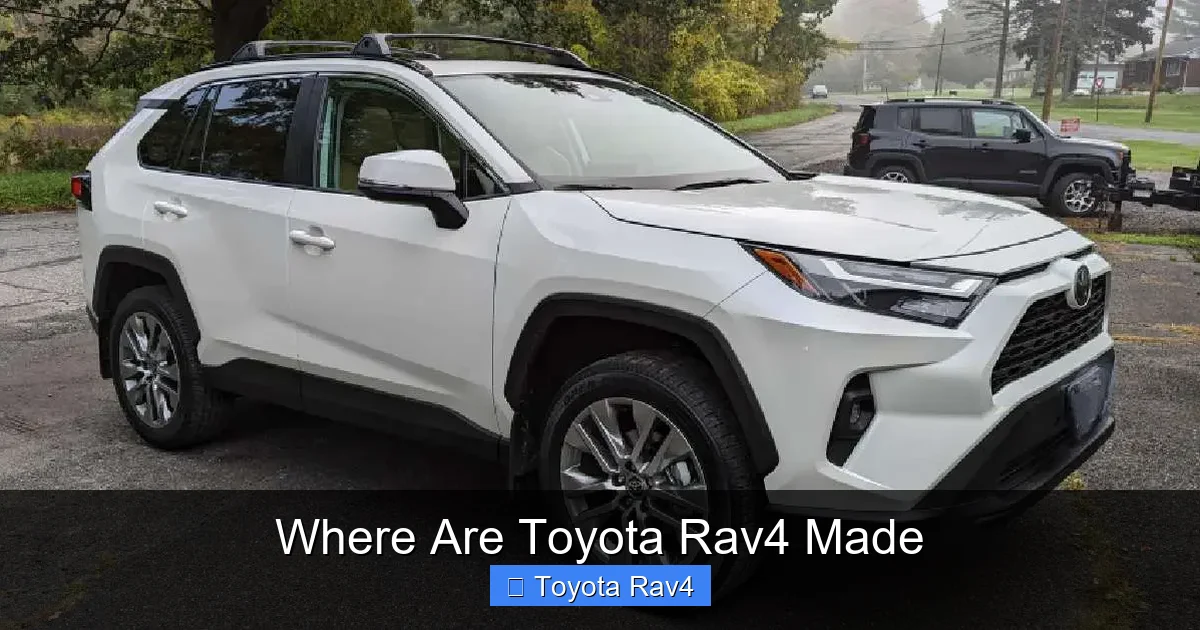
The Toyota RAV4 is manufactured in multiple countries worldwide, including Japan, the United States, Canada, and China. Each plant follows strict Toyota quality standards to ensure reliability and performance across global markets.
Key Takeaways
- Global Production Network: The Toyota RAV4 is built in several countries, including Japan, the U.S., Canada, and China, allowing Toyota to meet regional demand efficiently.
- U.S. Manufacturing Hub: The majority of RAV4s sold in North America are produced at Toyota’s plant in Georgetown, Kentucky, supporting local jobs and reducing shipping costs.
- Japanese Craftsmanship: The original RAV4 was developed and first produced in Japan, where Toyota maintains high engineering and quality control standards.
- Canadian Contribution: Toyota’s plant in Woodstock, Ontario, also produces the RAV4, primarily for the Canadian and U.S. markets, emphasizing fuel-efficient models.
- China’s Growing Role: With increasing demand in Asia, Toyota manufactures RAV4s in China through joint ventures, tailoring features to local preferences.
- Consistent Quality Worldwide: Despite being made in different countries, all RAV4s adhere to Toyota’s global quality standards, ensuring reliability and safety.
- Hybrid Models Made in Japan: Most hybrid versions of the RAV4 are still produced in Japan, reflecting advanced technology and engineering expertise.
📑 Table of Contents
- Where Are Toyota RAV4 Made? A Global Perspective
- The Origins: Where It All Began
- U.S. Production: The Heart of North American Sales
- Canadian Contributions: The Woodstock Plant
- Japanese Craftsmanship: The Home of Innovation
- Expanding Globally: Production in China and Beyond
- Quality Control: How Toyota Maintains Consistency
- What This Means for Buyers
- Conclusion
Where Are Toyota RAV4 Made? A Global Perspective
When you’re in the market for a reliable, versatile, and fuel-efficient compact SUV, the Toyota RAV4 often tops the list. It’s no surprise—this vehicle has been a best-seller for decades, praised for its durability, safety features, and all-around practicality. But have you ever wondered where your RAV4 actually comes from? Is it made in the U.S., Japan, or somewhere else entirely?
The answer isn’t as simple as one factory or country. The Toyota RAV4 is a truly global vehicle, manufactured in multiple locations around the world. This global production strategy allows Toyota to respond quickly to regional demands, reduce shipping costs, and support local economies. Whether you’re driving a RAV4 in Los Angeles, Toronto, or Tokyo, chances are it was built in a state-of-the-art facility that follows Toyota’s rigorous quality standards.
Understanding where the RAV4 is made can help you make a more informed decision when buying. It also gives insight into the vehicle’s design, features, and even potential resale value. In this article, we’ll take a deep dive into the global production network behind the Toyota RAV4, explore the key manufacturing plants, and explain what it means for you as a consumer.
The Origins: Where It All Began

Visual guide about Where Are Toyota Rav4 Made
Image source: drivinggeeks.com
The Toyota RAV4 first rolled off the assembly line in 1994, marking Toyota’s entry into the compact SUV segment. The name “RAV4” stands for “Recreational Active Vehicle with 4-wheel Drive,” a nod to its adventurous spirit and capability. The original model was developed and produced in Japan, specifically at Toyota’s Tahara plant in Aichi Prefecture. This facility has long been known for its precision engineering and high-quality output, making it a natural home for Toyota’s innovative new SUV.
At the time, the RAV4 was a bold move. Compact SUVs weren’t yet mainstream, and Toyota took a risk by blending car-like comfort with off-road capability. The first-generation RAV4 was available as a three-door or five-door model and quickly gained popularity in Japan and Europe. Its success paved the way for global expansion.
Over the years, as demand grew, Toyota realized it needed to produce the RAV4 closer to its customers. Shipping vehicles from Japan to North America or Europe was expensive and slow. So, the company began establishing manufacturing plants in key markets. This shift not only reduced delivery times but also allowed Toyota to tailor features to local preferences—like offering more fuel-efficient engines in Europe or rugged trims in the U.S.
Today, while the RAV4’s roots are firmly in Japan, its production has become a global effort. But that doesn’t mean quality has suffered. In fact, Toyota’s “Toyota Production System” ensures that every plant, no matter where it is, follows the same strict standards for safety, reliability, and craftsmanship.
U.S. Production: The Heart of North American Sales
If you’re buying a Toyota RAV4 in the United States, there’s a very good chance it was made right here in America. The majority of RAV4s sold in North America are produced at Toyota’s massive manufacturing complex in Georgetown, Kentucky. This facility, often called “Toyota Motor Manufacturing, Kentucky, Inc.” (TMMK), is one of the largest and most advanced automotive plants in the world.
Opened in 1988, TMMK was Toyota’s first wholly owned plant in the U.S. and has since become a cornerstone of the company’s North American operations. The plant spans over 8 million square feet and employs thousands of workers. It produces several popular Toyota models, including the Camry, Avalon, and, of course, the RAV4.
The RAV4 production line at TMMK is highly automated, with robots handling tasks like welding and painting, while skilled technicians oversee assembly and quality checks. The plant is designed for efficiency and sustainability—Toyota has implemented solar panels, water recycling systems, and zero-landfill waste practices to reduce its environmental impact.
One of the biggest advantages of U.S. production is faster delivery. Vehicles built in Kentucky can reach dealerships across the country in days, not weeks. This means you’re more likely to get the exact trim, color, and options you want without a long wait. It also supports the local economy, with thousands of jobs created directly and indirectly by the plant.
Interestingly, the Kentucky plant doesn’t just build gas-powered RAV4s. It also produces the RAV4 Hybrid, which has become one of the most popular hybrid SUVs in the U.S. The hybrid version combines a 2.5-liter four-cylinder engine with electric motors, delivering excellent fuel economy—up to 40 mpg in the city. This model is especially popular in states with high gas prices or strong environmental incentives.
Canadian Contributions: The Woodstock Plant
Just north of the U.S. border, Toyota operates another key RAV4 production facility in Woodstock, Ontario, Canada. The Woodstock plant, officially known as Toyota Motor Manufacturing Canada (TMMC), began producing the RAV4 in 2008 and has since become a vital part of Toyota’s North American supply chain.
The Woodstock facility was built specifically to meet growing demand for the RAV4 in Canada and the northern U.S. It’s a smaller plant compared to Georgetown, but it’s highly efficient and focused on quality. The plant employs over 2,000 workers and produces both gas and hybrid versions of the RAV4.
One unique aspect of the Woodstock plant is its emphasis on fuel efficiency. Many of the RAV4s built here are equipped with smaller, more efficient engines tailored to Canadian driving conditions—think cold winters and long highway commutes. The plant also prioritizes sustainability, using renewable energy sources and implementing energy-saving technologies throughout the production process.
For Canadian buyers, a RAV4 made in Woodstock means faster delivery and potentially lower prices due to reduced shipping and import costs. It also supports local jobs and strengthens Toyota’s presence in the Canadian market.
Interestingly, the Woodstock plant has also been a testing ground for new technologies. For example, it was one of the first Toyota facilities to integrate advanced driver-assistance systems (ADAS) into the RAV4 production line. Features like adaptive cruise control, lane departure warning, and automatic emergency braking are now standard on most RAV4 trims, and the Woodstock plant plays a key role in ensuring these systems are installed correctly.
Japanese Craftsmanship: The Home of Innovation
While North America is a major production hub, Japan remains the spiritual and technological home of the Toyota RAV4. The Tahara plant in Aichi Prefecture continues to produce RAV4s, especially the hybrid and plug-in hybrid (RAV4 Prime) models. These vehicles require advanced engineering and precision assembly, which the Japanese plants are uniquely equipped to handle.
The Tahara plant is one of Toyota’s most advanced facilities, known for its high level of automation and quality control. It uses cutting-edge robotics and AI-driven systems to monitor every stage of production. Workers undergo extensive training, and the plant operates on the principles of “kaizen”—continuous improvement—to ensure every vehicle meets Toyota’s exacting standards.
One of the key reasons hybrid RAV4s are still made in Japan is the complexity of the hybrid powertrain. The RAV4 Hybrid and RAV4 Prime combine gasoline engines with electric motors, high-voltage batteries, and sophisticated control systems. These components require specialized knowledge and equipment, which the Japanese plants have refined over decades.
Additionally, Japan is where many of the RAV4’s design and engineering decisions are made. The vehicle’s exterior styling, interior materials, and technology features are often developed in Toyota’s design studios in Japan before being adapted for global markets. This ensures that the RAV4 maintains a consistent brand identity, no matter where it’s built.
For buyers, a RAV4 made in Japan may carry a certain prestige—especially if it’s a hybrid or Prime model. These vehicles are often seen as the pinnacle of Toyota’s engineering, combining efficiency, performance, and reliability. While they may take longer to reach North American dealerships, many enthusiasts believe the wait is worth it.
Expanding Globally: Production in China and Beyond
As the RAV4’s popularity has grown worldwide, Toyota has expanded its production network to include other key markets. One of the most significant additions is China, where Toyota manufactures the RAV4 through joint ventures with local automakers.
In China, the RAV4 is produced by FAW-Toyota, a partnership between Toyota and First Automotive Works (FAW). The vehicles are built at plants in Tianjin and Changchun, and are tailored to meet the preferences of Chinese consumers. This includes features like larger infotainment screens, premium interior materials, and enhanced connectivity options.
China is the world’s largest automotive market, and local production allows Toyota to avoid high import tariffs and respond quickly to changing consumer demands. It also helps the company compete with domestic brands like Geely and BYD, which offer affordable SUVs with modern features.
While the Chinese-made RAV4s are built to Toyota’s global standards, there are some differences compared to models sold in the U.S. or Japan. For example, Chinese versions may have different suspension tuning to handle local road conditions, or unique safety features to meet regional regulations.
Toyota has also explored production in other regions, including Europe and Southeast Asia. While the RAV4 isn’t currently manufactured in Europe, Toyota has hinted at the possibility of local production in the future, especially as demand for hybrid and electric vehicles grows.
Quality Control: How Toyota Maintains Consistency
One of the biggest concerns for consumers is whether a vehicle made in one country is as good as one made in another. With the RAV4 being produced in multiple locations, it’s natural to wonder if quality varies from plant to plant.
The good news is that Toyota has a rigorous global quality control system in place. Every RAV4, regardless of where it’s built, must pass the same strict inspections and testing procedures. This includes checks for paint quality, panel alignment, engine performance, and safety systems.
Toyota’s “Global Body Line” system ensures that body panels are manufactured to exact specifications at every plant. Robots measure each component with precision, and any deviations are corrected immediately. This level of consistency is one reason why the RAV4 has such a strong reputation for build quality.
Additionally, Toyota conducts regular audits of its global plants to ensure compliance with company standards. These audits cover everything from worker training to environmental practices. Plants that fail to meet expectations are required to implement corrective actions.
For buyers, this means you can trust that a RAV4 made in Kentucky, Woodstock, or Tahara will offer the same reliability and performance. The only differences you might notice are in features, trim levels, or delivery times—not in quality.
What This Means for Buyers
So, where your RAV4 is made matters—but not in the way you might think. It doesn’t affect the vehicle’s reliability or safety. Instead, it influences things like availability, pricing, and features.
For example, if you’re in the U.S. and want a RAV4 Hybrid, you’ll likely get one made in Kentucky or Japan. The Kentucky model may arrive faster and cost slightly less, while the Japanese model might have more advanced hybrid technology. Similarly, Canadian buyers may prefer a Woodstock-built RAV4 for its local support and faster delivery.
Ultimately, the global production of the RAV4 is a strength, not a weakness. It allows Toyota to meet demand efficiently, support local economies, and offer a consistent product worldwide. As a buyer, you benefit from more choices, better availability, and competitive pricing.
Conclusion
The Toyota RAV4 is more than just a popular SUV—it’s a symbol of global collaboration and engineering excellence. From its origins in Japan to its current production in the U.S., Canada, and China, the RAV4 represents Toyota’s ability to adapt and innovate across borders.
Whether your RAV4 was built in Kentucky, Woodstock, or Tahara, you can trust that it was made with the same commitment to quality, safety, and reliability. The global production network ensures that Toyota can meet the needs of drivers around the world, while maintaining the high standards that have made the RAV4 a best-seller for nearly three decades.
So the next time you see a RAV4 on the road, take a moment to appreciate the journey it took to get there. It’s not just a car—it’s a global story of innovation, craftsmanship, and connection.
Frequently Asked Questions
Where is the Toyota RAV4 made for the U.S. market?
The majority of Toyota RAV4s sold in the U.S. are manufactured at the Toyota plant in Georgetown, Kentucky. This facility produces both gas and hybrid versions of the RAV4, ensuring fast delivery and local job creation.
Are all Toyota RAV4s made in Japan?
No, not all RAV4s are made in Japan. While the first RAV4 was developed and produced in Japan, today the vehicle is manufactured in multiple countries, including the U.S., Canada, and China, to meet global demand.
Where are Toyota RAV4 hybrids made?
Most Toyota RAV4 Hybrid models are produced in Japan at the Tahara plant, while some are also made in the U.S. at the Kentucky facility. The RAV4 Prime plug-in hybrid is primarily manufactured in Japan.
Is the RAV4 made in Canada?
Yes, the Toyota RAV4 is produced at the Toyota Motor Manufacturing Canada (TMMC) plant in Woodstock, Ontario. These vehicles are primarily sold in Canada and the northern U.S.
Does where the RAV4 is made affect its quality?
No, the quality of the RAV4 is consistent across all production locations. Toyota enforces strict global standards to ensure every vehicle meets the same high levels of safety, reliability, and performance.
Why does Toyota make the RAV4 in multiple countries?
Toyota produces the RAV4 in several countries to reduce shipping costs, respond quickly to regional demand, support local economies, and tailor features to local preferences, such as fuel efficiency or infotainment systems.