
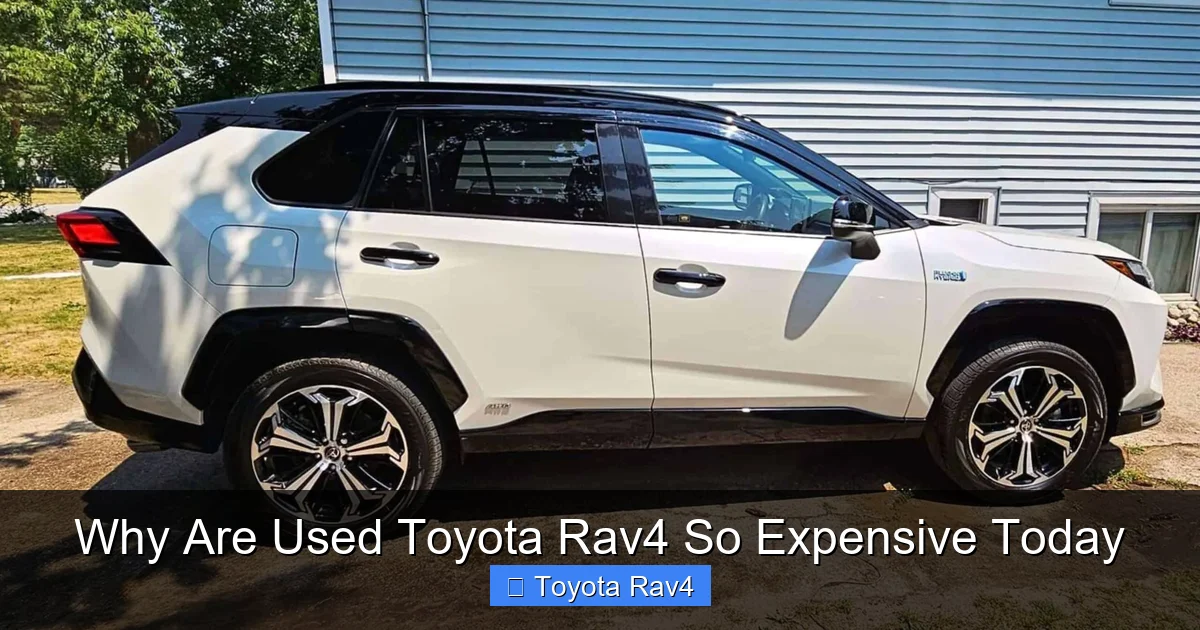
Used Toyota RAV4s command high prices today due to exceptional reliability, strong resale value, and ongoing supply shortages. With rising demand for fuel-efficient, versatile SUVs and limited inventory, buyers continue to pay premiums even for older models.
Key Takeaways
- High Demand and Low Supply: The used RAV4 market is tight due to fewer trade-ins and production delays, pushing prices up.
- Proven Reliability and Durability: Toyota’s reputation for long-lasting vehicles makes the RAV4 a top choice, increasing its used value.
- Strong Resale Value: RAV4s retain up to 60% of their value after three years, outperforming most competitors.
- Fuel Efficiency and Practicality: With rising gas prices, the RAV4’s efficient engines and cargo space make it highly desirable.
- Hybrid Model Popularity: The RAV4 Hybrid’s excellent fuel economy and lower emissions drive up demand and pricing.
- Global Supply Chain Issues: Pandemic-related disruptions reduced new car production, increasing reliance on used vehicles.
- Consumer Trust in Toyota: Buyers consistently rank Toyota as one of the most dependable brands, boosting confidence in used models.
📑 Table of Contents
- Why Are Used Toyota RAV4 So Expensive Today?
- High Demand Meets Limited Supply
- Toyota’s Reputation for Reliability and Durability
- Strong Resale Value and Depreciation Rates
- Fuel Efficiency and Rising Gas Prices
- Global Supply Chain and Production Challenges
- Consumer Preferences and Lifestyle Shifts
- Tips for Buyers and Sellers in the Current Market
- Conclusion
Why Are Used Toyota RAV4 So Expensive Today?
If you’ve shopped for a used SUV lately, you’ve probably noticed something surprising: the Toyota RAV4—even older models—is holding its value like a luxury vehicle. What was once considered an affordable, practical compact SUV is now commanding prices that rival new cars. So, why are used Toyota RAV4s so expensive today?
It’s not just one factor. A perfect storm of high demand, limited supply, and Toyota’s stellar reputation has created a market where used RAV4s sell fast and at premium prices. Whether you’re looking at a 2018 model with 50,000 miles or a 2020 hybrid with all the bells and whistles, you’ll likely pay more than you expected. But understanding the reasons behind this trend can help you make a smarter buying decision—or even justify the cost if you’re considering selling your own RAV4.
In this article, we’ll break down the key reasons behind the high price tags on used Toyota RAV4s. From supply chain disruptions to consumer preferences, we’ll explore how this once-humble SUV became a used car market powerhouse. Whether you’re a buyer, seller, or just curious, you’ll walk away with a clear picture of what’s driving the market—and what to expect in the future.
High Demand Meets Limited Supply

Visual guide about Why Are Used Toyota Rav4 So Expensive Today
Image source: rav4resource.com
One of the most straightforward reasons used Toyota RAV4s are so expensive is simple economics: high demand and low supply. Since the pandemic began in 2020, the automotive industry has faced unprecedented challenges. Factory shutdowns, semiconductor shortages, and shipping delays have drastically reduced the number of new vehicles hitting the market. As a result, many buyers who would normally purchase new cars have turned to the used market instead.
The RAV4, already one of the best-selling SUVs in the U.S., has been hit especially hard by this shift. With fewer new RAV4s available, demand for used models has skyrocketed. Dealerships and private sellers alike are seeing multiple offers on well-maintained RAV4s, often within days of listing. This competition drives prices upward, even for older or higher-mileage vehicles.
The Pandemic Effect on New Car Production
The global semiconductor shortage, which began in 2020, had a domino effect on car manufacturing. Toyota, like other automakers, had to slow or halt production at several plants. The RAV4, being a top seller, was prioritized—but even then, output couldn’t keep up with demand. This meant fewer new RAV4s were sold, which in turn reduced the number of trade-ins and lease returns feeding the used market.
For example, in 2021, Toyota sold over 430,000 RAV4s in the U.S.—the most of any SUV. But with production constraints, many buyers who wanted a new RAV4 had to wait months or settle for a used one. This backlog created a ripple effect, pushing used RAV4 prices higher as buyers competed for available inventory.
Trade-In and Lease Return Shortages
Another factor is the decline in trade-ins and lease returns. During the pandemic, many people held onto their cars longer due to financial uncertainty or remote work. Lease terms were extended, and fewer people traded in their vehicles. This meant fewer used RAV4s entered the market, tightening supply even further.
Additionally, when people did trade in their RAV4s, they often received high values—sometimes close to what they paid new. This encouraged owners to sell privately or trade up to another Toyota, keeping the best-used models in circulation but reducing overall availability.
Toyota’s Reputation for Reliability and Durability
While supply and demand play a big role, the real foundation of the used RAV4’s high value is Toyota’s reputation for reliability. For decades, Toyota has been synonymous with dependable, long-lasting vehicles. The RAV4, in particular, has earned praise for its durability, low maintenance costs, and ability to rack up hundreds of thousands of miles with minimal issues.
This reputation isn’t just marketing—it’s backed by data. According to J.D. Power and Consumer Reports, Toyota consistently ranks among the most reliable automakers. The RAV4 frequently appears on “best used SUV” lists, often recommended for buyers seeking a vehicle that will last 15–20 years with proper care.
Low Cost of Ownership
One reason buyers are willing to pay more for a used RAV4 is the long-term savings. Even if the upfront cost is high, the total cost of ownership is often lower than competitors. The RAV4 requires fewer repairs, has affordable parts, and benefits from strong dealer support. For example, a 2017 RAV4 with 80,000 miles might cost $22,000 today, but it could easily last another 100,000 miles with routine maintenance.
Compare that to a similarly priced used Honda CR-V or Ford Escape, and the RAV4 often comes out ahead in reliability surveys. This perceived value justifies the higher price tag for many buyers.
Proven Track Record Across Generations
The RAV4 has been in production since 1994, and each generation has built on Toyota’s reputation for quality. The third-generation RAV4 (2006–2012) is known for its ruggedness, while the fourth generation (2013–2018) introduced better fuel economy and modern features. The current fifth generation (2019–present) offers advanced safety tech, a refined interior, and hybrid options.
Because each generation has performed well over time, buyers trust that even a 10-year-old RAV4 will be a solid investment. This confidence reduces the perceived risk of buying used, allowing sellers to command higher prices.
Strong Resale Value and Depreciation Rates
Another key reason used RAV4s are expensive is their exceptional resale value. While most cars lose 20–30% of their value in the first year, the RAV4 depreciates much more slowly. According to Kelley Blue Book (KBB), the RAV4 retains about 60% of its value after three years—one of the best rates in the compact SUV segment.
This slow depreciation means that even a 3- or 4-year-old RAV4 still holds significant value. For example, a 2020 RAV4 LE that originally sold for $28,000 might still be worth $22,000–$24,000 today, depending on mileage and condition. That’s a much better return than many competitors.
Factors That Boost Resale Value
Several factors contribute to the RAV4’s strong resale value:
– **Brand Loyalty:** Toyota owners are more likely to buy another Toyota, creating a steady demand for used models.
– **High Safety Ratings:** The RAV4 consistently earns top marks from the IIHS and NHTSA, making it a top choice for families.
– **Standard Features:** Even base models come well-equipped with modern tech like Apple CarPlay, adaptive cruise control, and Toyota Safety Sense.
– **Hybrid Availability:** The RAV4 Hybrid, introduced in 2016, has become a major selling point. Hybrids generally hold their value better due to fuel savings and environmental appeal.
Comparison with Competitors
Let’s compare the RAV4 to its closest rivals. A 2020 Honda CR-V might retain about 55% of its value after three years, while a Ford Escape drops to around 50%. The Subaru Forester is close at 58%, but still slightly behind the RAV4. This small difference adds up over time, making the RAV4 a smarter long-term investment.
For buyers, this means paying more upfront but losing less money if they decide to sell later. For sellers, it means they can get top dollar even for older models.
Fuel Efficiency and Rising Gas Prices
With gas prices fluctuating and often reaching record highs, fuel efficiency has become a top priority for SUV buyers. The Toyota RAV4 excels in this area, especially with its hybrid variant. The standard RAV4 gets around 28–30 mpg combined, while the RAV4 Hybrid achieves an impressive 37–40 mpg.
In today’s economy, that kind of efficiency is a major selling point. A family driving 15,000 miles a year could save hundreds of dollars annually by choosing a RAV4 Hybrid over a less efficient SUV. This fuel savings translates into higher demand—and higher prices—for used RAV4s, particularly hybrid models.
The Rise of the RAV4 Hybrid
The RAV4 Hybrid has been a game-changer for Toyota. Introduced in 2016, it quickly became one of the most popular hybrid SUVs on the market. By 2020, hybrid models accounted for nearly 40% of all RAV4 sales. This popularity has carried over into the used market, where RAV4 Hybrids often sell for $2,000–$5,000 more than their gas-only counterparts.
For example, a 2019 RAV4 Hybrid XLE with 60,000 miles might list for $28,000, while a similar gas model goes for $24,000. The premium reflects both the fuel savings and the lower emissions, which appeal to environmentally conscious buyers.
Impact of Gas Price Volatility
When gas prices spike—like they did in 2022—demand for fuel-efficient vehicles surges. The RAV4, with its strong fuel economy and hybrid option, becomes even more attractive. This increased demand pushes up prices across the board, especially for well-maintained, low-mileage models.
Even when gas prices drop, the RAV4’s efficiency remains a selling point. Buyers know they’re getting a vehicle that will perform well regardless of fuel costs, making it a safe long-term choice.
Global Supply Chain and Production Challenges
The pandemic didn’t just affect new car production—it disrupted the entire supply chain. From microchips to steel, shortages have made it harder and more expensive to build vehicles. Toyota, despite its reputation for efficient manufacturing, hasn’t been immune.
These challenges have had a lasting impact on the used car market. With fewer new RAV4s being built, the used market has become the primary source for many buyers. This shift has created a seller’s market, where dealers and private sellers can set higher prices with confidence.
Semiconductor Shortages and Production Delays
Microchips are essential for modern vehicles, controlling everything from engine performance to infotainment systems. The global shortage, caused by pandemic-related factory closures and increased demand for electronics, forced automakers to cut production. Toyota reduced output by as much as 40% at some plants in 2021.
This meant fewer new RAV4s were available, pushing buyers toward used models. Even as production has recovered, the backlog remains, keeping used prices elevated.
Shipping and Logistics Issues
Beyond parts shortages, shipping delays have also played a role. Port congestion, container shortages, and rising freight costs have made it harder to move vehicles from factories to dealerships. This has slowed the flow of new RAV4s into the market, further tightening supply.
Additionally, international demand for the RAV4 remains strong. In markets like Canada, Australia, and Europe, the RAV4 is also a top seller. This global competition means fewer vehicles are available for the U.S. market, adding to the pressure on used prices.
Consumer Preferences and Lifestyle Shifts
Beyond economics and supply chains, changing consumer preferences have boosted demand for the RAV4. More people are choosing SUVs over sedans, and the RAV4 strikes the perfect balance between size, efficiency, and capability.
The SUV Boom
SUVs now account for over 50% of new vehicle sales in the U.S. Buyers love their higher driving position, cargo space, and versatility. The RAV4, as a compact SUV, offers all these benefits without the bulk of a full-size model. It’s ideal for city driving, weekend trips, and family errands.
This shift has made the RAV4 a household name. Even used models benefit from this trend, as buyers seek affordable entry points into the SUV market.
Remote Work and Outdoor Lifestyle Trends
The pandemic also changed how people live and work. With more remote work, many families moved to suburban or rural areas, increasing the need for reliable transportation. At the same time, outdoor activities like camping and hiking became more popular.
The RAV4, with its available all-wheel drive, roof rails, and ample cargo space, is perfectly suited for this lifestyle. Buyers are willing to pay a premium for a vehicle that supports their new routines.
Tips for Buyers and Sellers in the Current Market
Whether you’re looking to buy or sell a used RAV4, understanding the market is key. Here are some practical tips to help you navigate today’s high-price environment.
For Buyers: How to Get the Best Deal
– **Shop Early and Often:** Inventory changes quickly. Check listings daily and be ready to act fast.
– **Expand Your Search Radius:** Consider looking in nearby cities or states where prices might be lower.
– **Consider Older Models:** A well-maintained 2017 RAV4 can be just as reliable as a 2020 model and cost thousands less.
– **Get a Pre-Purchase Inspection:** Always have a trusted mechanic inspect the vehicle before buying.
– **Negotiate Smartly:** Even in a seller’s market, there’s often room for negotiation, especially on higher-mileage or base-trim models.
For Sellers: Maximize Your RAV4’s Value
– **Keep Detailed Maintenance Records:** A full service history increases buyer confidence and justifies a higher price.
– **Clean and Detail the Vehicle:** First impressions matter. A clean interior and exterior can boost offers.
– **Price Competitively:** Research similar listings to set a fair price. Overpricing can lead to a long wait.
– **Highlight Key Features:** Emphasize low mileage, hybrid engine, or recent upgrades in your listing.
Conclusion
So, why are used Toyota RAV4s so expensive today? The answer lies in a combination of strong demand, limited supply, and Toyota’s unmatched reputation for reliability. From pandemic-related production delays to rising gas prices and shifting consumer preferences, multiple forces have converged to create a market where even older RAV4s command premium prices.
But while the cost may be higher than expected, the value is real. Buyers are paying for a vehicle that’s proven to last, save money on fuel, and hold its value over time. For many, that peace of mind is worth the extra expense.
As the automotive industry continues to recover, prices may eventually stabilize. But for now, the used RAV4 remains one of the hottest—and most expensive—SUVs on the market. Whether you’re buying or selling, understanding these trends will help you make the best decision for your needs.
Frequently Asked Questions
Why are used Toyota RAV4s more expensive than other used SUVs?
Used RAV4s are pricier due to high demand, low supply, and Toyota’s reputation for reliability. They also retain value better than most competitors, making them a smart long-term investment.
Is it worth buying a used RAV4 in today’s market?
Yes, if you prioritize reliability, fuel efficiency, and resale value. While prices are high, the RAV4’s durability and low maintenance costs often justify the cost over time.
How much should I expect to pay for a used RAV4?
Prices vary by year, mileage, and trim, but a 2018–2020 model typically ranges from $22,000 to $28,000. Hybrid models often cost $2,000–$5,000 more.
Will used RAV4 prices go down soon?
Prices may stabilize as new car production improves, but strong demand and Toyota’s reputation suggest RAV4s will remain relatively expensive for the foreseeable future.
What should I look for when buying a used RAV4?
Check maintenance records, mileage, accident history, and whether it has Toyota Safety Sense. A pre-purchase inspection is highly recommended.
Are RAV4 Hybrids worth the extra cost?
Yes, especially if you drive frequently. The hybrid’s superior fuel economy (37–40 mpg) can save hundreds in gas annually, offsetting the higher upfront cost.