
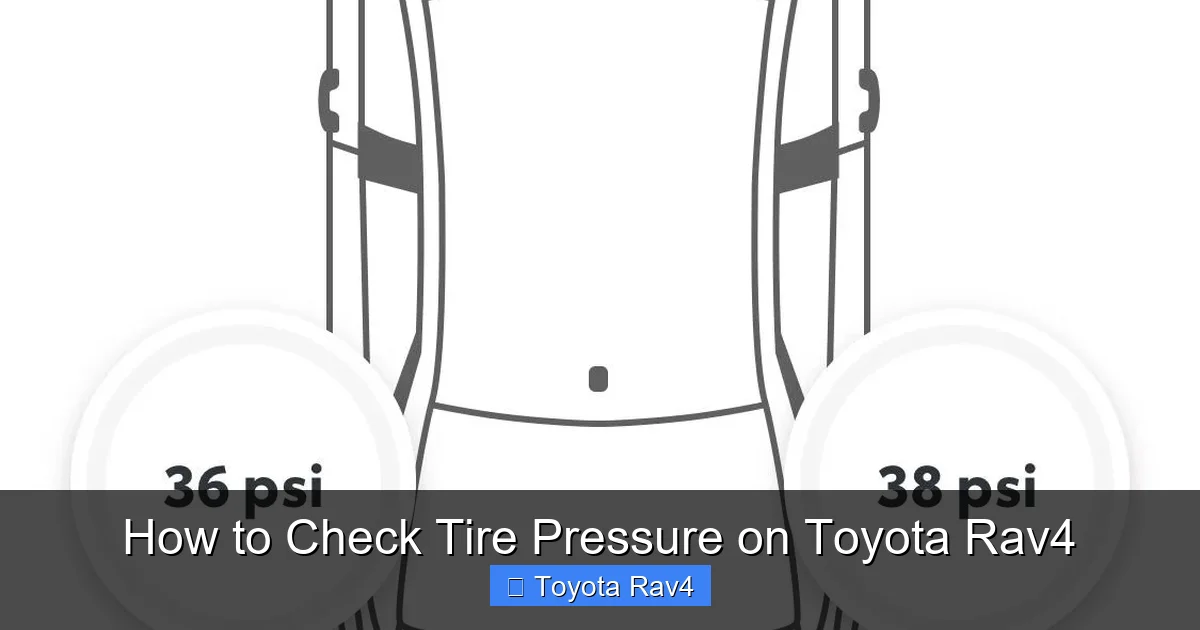
Checking tire pressure on your Toyota RAV4 is quick, easy, and essential for safety, fuel economy, and tire longevity. Whether you use the built-in TPMS or a manual gauge, regular checks help prevent blowouts and improve handling.
Key Takeaways
- Check tire pressure monthly: Regular checks help maintain optimal performance, fuel efficiency, and safety.
- Use the correct PSI: The recommended tire pressure for most Toyota RAV4 models is 33–35 PSI, found on the driver’s door jamb sticker.
- Leverage the TPMS: The Toyota RAV4 comes equipped with a Tire Pressure Monitoring System that alerts you when pressure is low.
- Check when tires are cold: For accurate readings, check pressure before driving or after the car has been parked for at least 3 hours.
- Use a quality tire gauge: Digital or analog gauges are affordable and ensure precise measurements.
- Don’t forget the spare tire: Include the spare in your routine checks to avoid being stranded with a flat.
- Adjust for load and weather: Increase pressure when carrying heavy loads or driving in extreme temperatures.
📑 Table of Contents
- Why Checking Tire Pressure Matters on Your Toyota RAV4
- Understanding Your Toyota RAV4’s Tire Pressure Monitoring System (TPMS)
- Finding the Correct Tire Pressure for Your RAV4
- How to Manually Check Tire Pressure on Your Toyota RAV4
- Maintaining Proper Tire Pressure: Tips and Best Practices
- Common Mistakes to Avoid When Checking Tire Pressure
- When to See a Professional
- Conclusion: Keep Your RAV4 Rolling Safely
Why Checking Tire Pressure Matters on Your Toyota RAV4
Your Toyota RAV4 is a reliable, versatile SUV built for city commutes, weekend adventures, and everything in between. But like any vehicle, it depends heavily on one critical component: the tires. Properly inflated tires aren’t just about smooth rides—they’re essential for safety, fuel efficiency, and the overall health of your vehicle. One of the simplest yet most impactful maintenance tasks you can do is checking your tire pressure regularly.
Underinflated tires can lead to poor handling, increased braking distances, and even blowouts—especially at high speeds. Overinflated tires, on the other hand, reduce the tire’s contact with the road, leading to uneven wear and a harsher ride. Both scenarios can compromise your safety and cost you more in the long run through reduced fuel economy and premature tire replacement. For RAV4 owners, staying on top of tire pressure is a small effort with big rewards.
The good news? Checking tire pressure on a Toyota RAV4 is straightforward, whether you’re using the built-in Tire Pressure Monitoring System (TPMS) or a manual tire gauge. With a few minutes each month, you can ensure your RAV4 performs at its best. In this guide, we’ll walk you through every step—from understanding your TPMS to manually checking each tire—so you can drive with confidence.
Understanding Your Toyota RAV4’s Tire Pressure Monitoring System (TPMS)
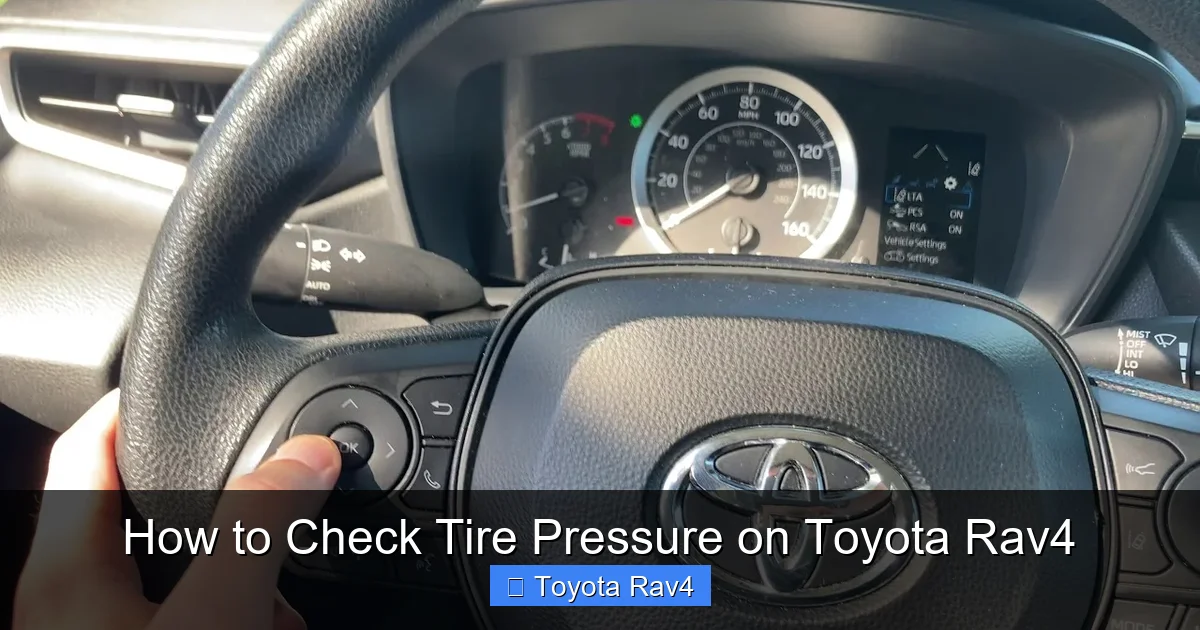
Visual guide about How to Check Tire Pressure on Toyota Rav4
Image source: i.ytimg.com
If you’ve ever seen a warning light on your dashboard that looks like a flat tire with an exclamation point, you’ve encountered the TPMS. The Toyota RAV4 comes standard with this safety feature, designed to alert you when one or more tires are significantly underinflated—typically 25% below the recommended pressure.
How the TPMS Works
The TPMS in your RAV4 uses sensors mounted inside each tire (usually attached to the valve stem) to monitor air pressure in real time. These sensors transmit data wirelessly to your vehicle’s onboard computer. If the pressure drops below the threshold, the system triggers a warning light on your dashboard. This usually appears as a yellow or orange icon in the shape of a tire cross-section with an exclamation mark.
It’s important to note that the TPMS is a warning system, not a replacement for manual checks. The sensors can’t tell you the exact PSI, and they may not detect slow leaks or gradual pressure loss until it becomes critical. Also, the system may need to be reset after inflating tires or rotating them—more on that later.
When the TPMS Light Comes On
If the TPMS light illuminates, don’t ignore it. Pull over safely and check your tire pressure as soon as possible. The light could indicate a flat tire, a slow leak, or simply that the tires have lost pressure due to cold weather. In some cases, the light may flash for a minute before staying on—this usually means the system is malfunctioning and needs professional diagnosis.
Keep in mind that the TPMS light may also come on temporarily after a sudden temperature drop. Cold air causes tire pressure to decrease, so it’s not uncommon to see the light in winter months. However, always verify the actual pressure with a gauge to be sure.
Limitations of the TPMS
While the TPMS is a helpful tool, it has limitations. It doesn’t provide precise pressure readings, so you won’t know if your tires are slightly underinflated—just that they’re below the safety threshold. Additionally, the sensors can fail over time due to battery depletion (typically after 5–10 years) or damage. If your TPMS light stays on even after inflating the tires, it may be time to have the sensors checked at a Toyota service center.
Finding the Correct Tire Pressure for Your RAV4
Before you check or adjust your tire pressure, you need to know what the correct pressure should be. Using the wrong PSI can affect handling, wear, and fuel economy. The good news is that Toyota makes this easy by providing the recommended tire pressure right on your vehicle.
Locating the Tire Pressure Sticker
The official tire pressure recommendation for your Toyota RAV4 is printed on a sticker located on the driver’s side door jamb. Open the driver’s door and look for a white or yellow label near the hinge. This sticker lists the recommended cold tire pressure for both front and rear tires, as well as the correct tire size and load index.
For most Toyota RAV4 models—whether it’s a 2020, 2021, 2022, or newer—the recommended pressure is typically **33 PSI** for normal driving conditions. Some higher-trim models or those with larger wheels may recommend **35 PSI**, so always refer to your specific sticker.
Why the Door Jamb Sticker Matters
You might wonder why you can’t just use the pressure listed on the tire sidewall. The number on the tire (e.g., “Max 44 PSI”) is the maximum pressure the tire can safely hold—not the recommended pressure for your vehicle. Using the maximum pressure can lead to a harsh ride and reduced traction.
The door jamb sticker, however, is tailored to your RAV4’s weight, suspension, and performance needs. It’s the most accurate guide for optimal tire pressure. Always use this number as your baseline.
Adjusting for Load and Conditions
The recommended pressure is for a fully loaded vehicle under normal conditions. If you’re carrying heavy cargo, towing a trailer, or driving in extreme heat or cold, you may need to adjust the pressure slightly.
For example, if you’re planning a long road trip with luggage and passengers, consider increasing the pressure by 2–3 PSI to support the extra weight. Conversely, in very cold weather, tire pressure can drop by about 1 PSI for every 10°F decrease in temperature. Check your tires more frequently in winter and top them off as needed.
How to Manually Check Tire Pressure on Your Toyota RAV4
Even with a TPMS, it’s smart to manually check your tire pressure at least once a month. This gives you precise readings and helps you catch issues before they trigger a warning light. Here’s a step-by-step guide to doing it right.
Gather Your Tools
You’ll need just a few simple items:
– A reliable tire pressure gauge (digital or analog)
– An air compressor (available at most gas stations)
– A notepad or phone to record readings (optional)
Digital gauges are often more accurate and easier to read, especially in low light. Analog (dial) gauges are durable and don’t require batteries. Either type works well—just make sure it’s calibrated and in good condition.
Check When Tires Are Cold
For the most accurate reading, check your tire pressure when the tires are “cold”—meaning the vehicle hasn’t been driven for at least 3 hours, or no more than 1–2 miles at low speed. Driving heats up the tires, increasing the internal air pressure and giving a falsely high reading.
If you’ve just driven your RAV4, wait a few hours before checking. If you’re in a hurry, note that the readings will be slightly higher than actual, so you may want to adjust accordingly.
Step-by-Step Tire Pressure Check
Follow these steps for each tire:
1. **Remove the valve cap:** Twist the small plastic cap on the tire’s valve stem counterclockwise. Keep it in a safe place—don’t lose it!
2. **Press the gauge onto the valve stem:** Firmly press the gauge straight onto the valve stem. You’ll hear a brief hiss of air—that’s normal. Hold it steady until the reading stabilizes.
3. **Read the pressure:** On a digital gauge, the number will appear on the screen. On an analog gauge, read the dial where the needle points.
4. **Compare to recommended PSI:** Check your reading against the number on the door jamb sticker. If it’s lower, add air. If it’s higher, release some air by pressing the gauge’s release button or using a small tool.
5. **Replace the valve cap:** Screw the cap back on securely to prevent dirt and moisture from entering the valve.
Repeat this process for all four tires, including the spare if your RAV4 has one.
Adding Air at a Gas Station
Most gas stations have air compressors with built-in pressure gauges. Here’s how to use them safely:
– Park close enough to reach all tires with the air hose.
– Set the compressor to the desired PSI (e.g., 33 PSI).
– Attach the hose to the valve stem and press the lever to add air.
– Check the pressure frequently with your handheld gauge—don’t rely solely on the station’s gauge, as it may be inaccurate.
– Stop when you reach the correct pressure.
Tip: If you overinflate, don’t panic. Simply press the center pin in the valve stem with a small tool (like a key or the back of your gauge) to release air slowly.
Maintaining Proper Tire Pressure: Tips and Best Practices
Checking tire pressure isn’t a one-and-done task. To get the most out of your Toyota RAV4, make it part of your regular maintenance routine. Here are some practical tips to keep your tires in top shape.
Check Monthly—Without Fail
Set a reminder on your phone or calendar to check tire pressure once a month. A good time is the first weekend of each month or when you get your oil changed. Consistency is key—small pressure losses can add up over time.
Inspect Tires Visually
While checking pressure, take a moment to look at each tire. Check for:
– Cracks, bulges, or cuts in the sidewall
– Embedded objects like nails or glass
– Uneven wear patterns (which could indicate alignment or suspension issues)
If you notice anything unusual, have it inspected by a professional.
Rotate Your Tires Regularly
Toyota recommends rotating your RAV4’s tires every 5,000 to 7,500 miles to promote even wear. When you rotate, take the opportunity to check the pressure on all tires—including the spare. This ensures balanced performance and extends tire life.
Reset the TPMS After Inflation or Rotation
After adding air or rotating tires, your RAV4’s TPMS may need to be reset so it recognizes the new pressure levels. Here’s how:
1. Turn the ignition to “ON” (don’t start the engine).
2. Press and hold the TPMS reset button (usually located under the steering column or in the glove box—check your owner’s manual).
3. Hold it for 3–5 seconds until the TPMS light blinks three times.
4. Release the button and start the engine.
The system will recalibrate over the next 10–20 minutes of driving. If the light stays on, double-check your tire pressure or visit a service center.
Watch for Seasonal Changes
Tire pressure fluctuates with temperature. In winter, check your tires more often—cold mornings can cause pressure to drop suddenly. In summer, avoid overinflating, as heat can cause pressure to rise and increase the risk of a blowout.
Common Mistakes to Avoid When Checking Tire Pressure
Even experienced drivers make mistakes when checking tire pressure. Avoid these common pitfalls to ensure accurate readings and safe driving.
Checking Hot Tires
One of the biggest errors is checking tire pressure right after driving. Heat expands air, giving a falsely high reading. Always wait until tires are cold for the most accurate measurement.
Ignoring the Spare Tire
Many drivers forget the spare tire, but it’s just as important. A flat spare won’t help you in an emergency. Include it in your monthly checks.
Using a Faulty Gauge
A broken or inaccurate gauge can lead to underinflated or overinflated tires. Test your gauge by comparing it to another one or using it at a gas station with a known-good compressor.
Overinflating to “Be Safe”
Some drivers think more air equals better performance. But overinflated tires reduce grip, increase wear in the center of the tread, and make the ride rougher. Stick to the recommended PSI.
Not Replacing Valve Caps
Valve caps keep dirt and moisture out of the valve stem. Missing caps can lead to slow leaks or sensor damage in TPMS-equipped tires. Always replace them after checking pressure.
When to See a Professional
While most tire pressure checks can be done at home, there are times when you should visit a Toyota service center or tire shop.
– If the TPMS light stays on after inflating the tires.
– If you notice a slow leak that won’t hold air.
– If your tires show signs of damage or uneven wear.
– If you’re unsure about the correct pressure for your specific RAV4 model or tire size.
Professionals have the tools and expertise to diagnose and fix issues quickly, ensuring your safety and peace of mind.
Conclusion: Keep Your RAV4 Rolling Safely
Checking tire pressure on your Toyota RAV4 is one of the easiest and most effective ways to maintain your vehicle’s performance, safety, and efficiency. With the help of the built-in TPMS and a simple tire gauge, you can stay on top of this essential task in just a few minutes each month.
By following the steps in this guide—using the correct PSI, checking when tires are cold, and maintaining a regular schedule—you’ll extend the life of your tires, improve fuel economy, and enjoy a smoother, safer ride. Whether you’re commuting to work or heading out on a weekend adventure, properly inflated tires give you the confidence to drive anywhere.
So grab your gauge, check those tires, and keep your RAV4 in peak condition. Your safety—and your wallet—will thank you.
Frequently Asked Questions
How often should I check the tire pressure on my Toyota RAV4?
You should check your tire pressure at least once a month, or before long trips. Regular checks help maintain safety, fuel efficiency, and tire longevity.
What is the recommended tire pressure for a Toyota RAV4?
The recommended tire pressure for most Toyota RAV4 models is 33–35 PSI. Always check the sticker on the driver’s door jamb for the exact number for your vehicle.
Can I rely solely on the TPMS to monitor tire pressure?
No, the TPMS is a warning system and doesn’t provide exact pressure readings. It’s best to manually check your tires monthly with a gauge for accuracy.
Why does my TPMS light come on in cold weather?
Cold temperatures cause air to contract, lowering tire pressure. The TPMS light may come on in winter even if your tires are properly inflated—check with a gauge and add air if needed.
Do I need to check the spare tire on my RAV4?
Yes, include the spare tire in your monthly checks. A flat spare won’t help in an emergency, and it’s often overlooked.
How do I reset the TPMS after inflating my tires?
Turn the ignition to “ON,” press and hold the TPMS reset button (usually under the steering column) for 3–5 seconds until the light blinks, then release. Drive for 10–20 minutes to complete the reset.