
Knowing how to see tire pressure on Toyota RAV4 is essential for safety, fuel efficiency, and tire longevity. This guide covers every method—from the built-in TPMS display to manual checks—so you can monitor your tires with confidence, no matter which RAV4 model you drive.
Key Takeaways
- All modern Toyota RAV4 models come equipped with a Tire Pressure Monitoring System (TPMS). This system alerts you when tire pressure is too low, helping prevent blowouts and improve fuel economy.
- You can view real-time tire pressure readings directly on the instrument cluster or multi-information display (MID). The exact method varies by model year and trim level.
- Older RAV4 models (pre-2013) may only show a warning light, not individual tire pressures. In these cases, you’ll need a manual gauge or aftermarket TPMS tool.
- Resetting the TPMS after inflating tires is crucial for accurate readings. Most RAV4 models allow you to reset the system using buttons on the steering wheel or dashboard.
- Check tire pressure monthly and before long trips. Properly inflated tires improve handling, reduce wear, and increase gas mileage.
- Use a quality digital tire pressure gauge for manual checks. Even with TPMS, it’s wise to double-check pressures manually for accuracy.
- Seasonal temperature changes affect tire pressure. Cold weather can cause pressure to drop, so monitor more frequently in winter.
📑 Table of Contents
- Why Tire Pressure Matters in Your Toyota RAV4
- Understanding the Toyota RAV4 Tire Pressure Monitoring System (TPMS)
- How to See Tire Pressure on Toyota RAV4: Step-by-Step Guide by Model Year
- How to Reset the TPMS on Your Toyota RAV4
- Manual Tire Pressure Checks: Why They’re Still Important
- Tips for Maintaining Proper Tire Pressure Year-Round
- Conclusion
Why Tire Pressure Matters in Your Toyota RAV4
Driving a Toyota RAV4 is a great experience—smooth handling, excellent fuel economy, and all-weather capability. But one thing that can quietly undermine all those benefits? Incorrect tire pressure. Whether you’re cruising down the highway or navigating city streets, your tires are the only part of your vehicle touching the road. That’s why knowing how to see tire pressure on Toyota RAV4 isn’t just a nice-to-know—it’s a must-know.
Underinflated tires increase rolling resistance, which means your engine has to work harder. This leads to lower gas mileage and higher emissions. Overinflated tires, on the other hand, reduce the tire’s contact patch with the road, leading to uneven wear and a harsher ride. Both scenarios can compromise your safety, especially in wet or snowy conditions. The RAV4, with its all-wheel-drive system and active safety features, performs best when all four tires are properly inflated.
Thankfully, Toyota has made it easier than ever to monitor tire pressure. Since 2007, all new vehicles sold in the U.S. are required to have a Tire Pressure Monitoring System (TPMS), and the RAV4 is no exception. But not all TPMS systems are created equal. Depending on your RAV4’s model year and trim, you might have a basic warning light or a full digital readout showing the exact PSI in each tire. Understanding how your specific RAV4 displays tire pressure will help you stay proactive about maintenance and avoid costly repairs down the road.
Understanding the Toyota RAV4 Tire Pressure Monitoring System (TPMS)
Visual guide about How to See Tire Pressure on Toyota Rav4
Image source: carcarelab.com
The Tire Pressure Monitoring System (TPMS) in your Toyota RAV4 is designed to alert you when one or more tires are significantly underinflated—typically 25% below the recommended pressure. There are two main types of TPMS: direct and indirect. The RAV4 uses a direct TPMS, which means each tire has a sensor that measures actual air pressure and sends that data wirelessly to the vehicle’s computer.
These sensors are mounted inside the wheel, usually attached to the valve stem, and are powered by small batteries that last about 5 to 10 years. When the system detects low pressure, it triggers a warning light on your dashboard—usually a yellow or orange icon that looks like a flat tire with an exclamation point. On newer RAV4 models, this light may flash for a minute before staying on, indicating a system fault or dead sensor battery.
But here’s the good news: many RAV4 models go beyond just a warning light. Starting around 2013, Toyota began equipping higher trims and newer models with a multi-information display (MID) that shows real-time tire pressure readings for each individual tire. This feature is incredibly helpful because it lets you see exactly which tire is low and by how much, so you don’t have to guess.
It’s important to note that the TPMS is not a replacement for regular manual checks. Sensors can fail, batteries die, and the system may not detect slow leaks right away. That’s why it’s still essential to check your tire pressure manually at least once a month using a reliable gauge. Think of the TPMS as your first line of defense, and manual checks as your backup plan.
How TPMS Sensors Work in the RAV4
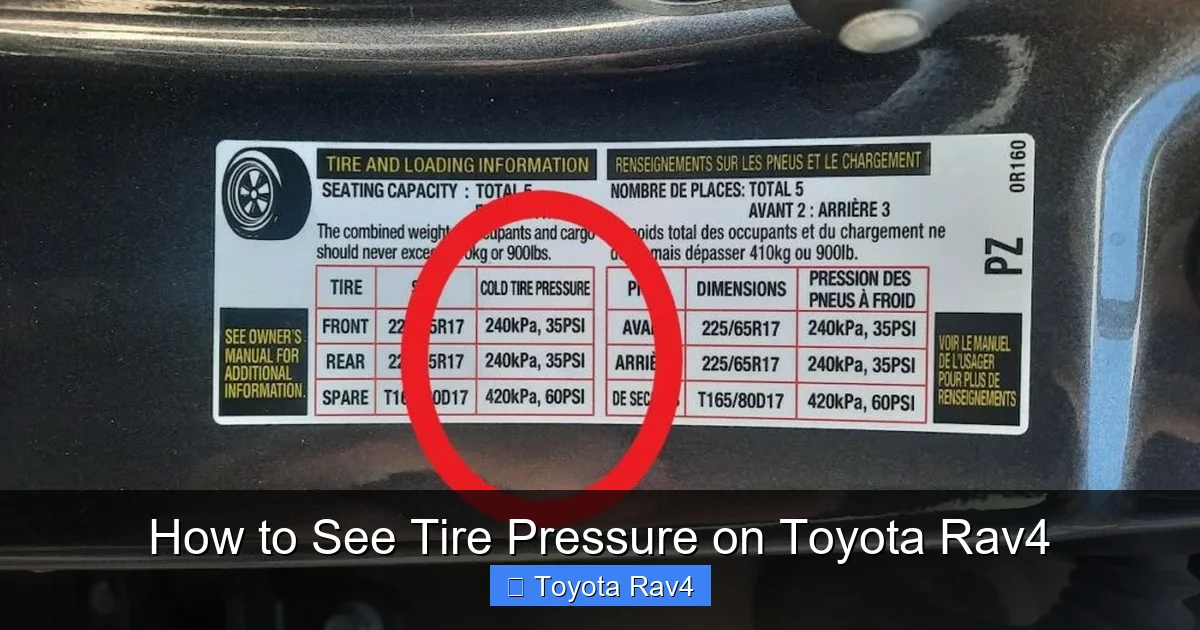
Each TPMS sensor in your RAV4’s tire transmits pressure and temperature data to the vehicle’s onboard computer via radio frequency (RF) signals. These signals are picked up by a central receiver, which then processes the information and displays it on your dashboard or MID. The system is calibrated to the recommended tire pressure for your specific RAV4 model, which you can find on the driver’s side door jamb sticker.
When you inflate or deflate a tire, the sensor detects the change and updates the reading. However, if you’ve recently rotated your tires or replaced a sensor, the system may need to be reset so it can correctly identify which sensor corresponds to which wheel position. This is especially important on RAV4 models with individual tire pressure displays.
One common issue RAV4 owners face is a TPMS warning light that won’t turn off even after inflating the tires. This usually means the system needs to be reset. On most models, this can be done through the MID menu or by holding a reset button. We’ll cover the exact steps for different RAV4 generations later in this guide.
TPMS Light vs. Individual Tire Readings: What’s the Difference?
Not all RAV4 models show the same level of detail when it comes to tire pressure. Here’s a quick breakdown:
– **Basic TPMS (Pre-2013 models):** These vehicles typically only display a warning light when pressure is low. You won’t see individual PSI readings, so you’ll need a manual gauge to check each tire.
– **Advanced TPMS (2013 and newer, especially higher trims):** These models often include a digital display that shows the exact pressure in each tire—front left, front right, rear left, and rear right. This is incredibly useful for pinpointing issues quickly.
If you’re unsure which type your RAV4 has, check your owner’s manual or look for a “Tire Pressure” option in the MID menu. Even if your RAV4 doesn’t show individual readings, the TPMS light is still a valuable tool—just remember to follow up with a manual check.
How to See Tire Pressure on Toyota RAV4: Step-by-Step Guide by Model Year
The method for viewing tire pressure on your Toyota RAV4 depends largely on the model year and trim level. Below, we’ll walk you through the process for different generations, so you can find the right approach for your vehicle.
2013–2018 Toyota RAV4 (Fourth Generation)
The fourth-generation RAV4, produced from 2013 to 2018, was the first to widely include individual tire pressure readings on higher trims like the Limited and Sport models. Here’s how to access them:
1. **Turn on the ignition** (you don’t need to start the engine).
2. **Press the “DISP” or “INFO” button** on your steering wheel until you see the multi-information display (MID).
3. **Navigate to the “Settings” or “Vehicle Settings” menu** using the arrow buttons.
4. **Select “Tire Pressure”** from the list.
5. **Press “OK” or “Enter”** to view the current pressure in each tire.
The display will show four values, one for each tire, in PSI (pounds per square inch). If a tire is low, it may be highlighted or show a warning icon. Make sure to check the recommended pressure on the door jamb sticker—usually around 32–35 PSI for most RAV4 models.
If you don’t see a “Tire Pressure” option, your RAV4 may only have the basic TPMS warning light. In that case, you’ll need to use a manual gauge.
2019–2023 Toyota RAV4 (Fifth Generation)
The fifth-generation RAV4, introduced in 2019, features a more modern infotainment system and improved MID. Most trims, including the LE, XLE, and Limited, now come with individual tire pressure monitoring. Here’s how to check:
1. **Start the vehicle or turn the ignition to “ON.”**
2. **Use the steering wheel controls** to access the MID.
3. **Scroll to “Vehicle Settings” or “Maintenance.”**
4. **Select “Tire Pressure Monitor.”**
5. **View the real-time readings** for all four tires.
On some models, you can also access this information through the Toyota app if your vehicle is connected. The app can send alerts if tire pressure drops below a certain threshold, making it a great tool for remote monitoring.
2006–2012 Toyota RAV4 (Third Generation)
Older RAV4 models from this era typically only have a TPMS warning light—no individual readings. When the light comes on, it means one or more tires are underinflated. To check the actual pressure:
1. **Use a digital tire pressure gauge.**
2. **Remove the valve cap** from each tire.
3. **Press the gauge onto the valve stem** and read the PSI.
4. **Compare to the recommended pressure** on the door jamb sticker.
After inflating the tires, you may need to reset the TPMS system. On most 2006–2012 RAV4 models, this is done by:
– Driving the vehicle at speeds above 20 mph for at least 10 minutes.
– Or, using a TPMS reset tool if the light remains on.
2024 Toyota RAV4 and Hybrid Models
The latest 2024 RAV4 models, including the Hybrid and Prime plug-in hybrid, come with enhanced TPMS features. In addition to real-time pressure readings, some trims offer predictive alerts based on driving patterns and temperature changes.
To view tire pressure:
1. **Access the MID via the steering wheel controls.**
2. **Navigate to “Vehicle Status” or “Maintenance.”**
3. **Select “Tire Pressure.”**
4. **Review the PSI for each tire.**
The 2024 RAV4 Hybrid also integrates with the Toyota app, allowing you to check tire pressure remotely and receive notifications if a tire loses pressure while parked.
How to Reset the TPMS on Your Toyota RAV4
After inflating your tires or rotating them, you’ll need to reset the TPMS so the system recognizes the new pressures. Failing to do this can leave the warning light on, even if all tires are properly inflated.
Manual Reset Method (Most 2013–2023 Models)
1. **Ensure all tires are inflated to the recommended PSI.**
2. **Turn the ignition to “ON” (do not start the engine).**
3. **Press and hold the TPMS reset button** (usually located under the steering column or near the fuse box). You may need to remove a panel to access it.
4. **Hold the button for 3–5 seconds** until the TPMS light blinks three times.
5. **Release the button and start the vehicle.**
6. **Drive at speeds above 20 mph for 10–15 minutes** to allow the system to recalibrate.
Note: The exact location of the reset button varies by model year. Check your owner’s manual for specifics.
Using the Multi-Information Display (MID)
On newer RAV4 models with a digital display:
1. **Access the MID via the steering wheel.**
2. **Go to “Settings” > “Vehicle Settings” > “TPMS Reset.”**
3. **Select “Reset” and confirm.**
4. **Drive the vehicle for 10–15 minutes** to complete the process.
This method is more user-friendly and doesn’t require locating a physical button.
When to Seek Professional Help
If the TPMS light remains on after resetting and inflating the tires, there may be a faulty sensor, dead battery, or wiring issue. In this case, visit a Toyota service center or trusted mechanic. They can diagnose the problem and replace sensors if needed. Sensor batteries typically last 5–10 years, so older RAV4s may need replacements.
Manual Tire Pressure Checks: Why They’re Still Important
Even with advanced TPMS technology, manual tire pressure checks are essential. Here’s why:
– **Sensors can fail:** Batteries die, and sensors can malfunction.
– **Slow leaks may not trigger alerts:** A small puncture might not cause a rapid pressure drop.
– **Temperature affects readings:** Cold weather can cause pressure to drop by 1 PSI for every 10°F decrease.
How to Check Tire Pressure Manually
1. **Use a quality digital tire pressure gauge.** Analog gauges are less accurate.
2. **Check tires when they’re cold.** Driving heats up the tires and increases pressure, giving a false reading.
3. **Remove the valve cap** and press the gauge firmly onto the stem.
4. **Read the PSI and compare to the recommended level** (found on the driver’s door jamb).
5. **Add or release air as needed.**
6. **Recheck and replace the valve cap.**
Pro tip: Keep a portable air compressor in your RAV4 for quick top-offs during trips.
Recommended Tire Pressure for Toyota RAV4
The ideal tire pressure for your RAV4 depends on the model year, trim, and tire size. However, most RAV4s recommend:
– **32–35 PSI** for standard tires.
– **33–36 PSI** for hybrid or all-wheel-drive models.
Always refer to the sticker on the driver’s side door jamb for the exact specification. Never rely solely on the tire sidewall, as it shows the maximum pressure, not the recommended level.
Tips for Maintaining Proper Tire Pressure Year-Round
Keeping your RAV4’s tires properly inflated isn’t a one-time task—it’s an ongoing habit. Here are some practical tips to help you stay on top of it:
– **Check monthly:** Set a reminder on your phone to check tire pressure every 30 days.
– **Inspect before long trips:** Long drives generate heat, which can exacerbate underinflation.
– **Adjust for seasons:** In winter, check more frequently as cold weather reduces pressure.
– **Don’t forget the spare:** If your RAV4 has a full-size spare, check its pressure too.
– **Use nitrogen (optional):** Some drivers prefer nitrogen-filled tires for more stable pressure, though regular air works fine for most.
Common Mistakes to Avoid
– **Overinflating to improve fuel economy:** This reduces traction and wears out the center of the tread.
– **Ignoring the TPMS light:** Even if the car drives fine, low pressure can cause blowouts.
– **Checking hot tires:** Always wait at least 3 hours after driving to check pressure.
Conclusion
Knowing how to see tire pressure on Toyota RAV4 is a simple but powerful way to protect your investment, improve safety, and save money on fuel and repairs. Whether your RAV4 has a basic warning light or a full digital display, staying informed about your tire pressure is key to a smooth and safe ride.
Modern RAV4 models make it easier than ever to monitor tire pressure in real time, but don’t forget the value of manual checks. Combine technology with good habits, and you’ll keep your RAV4 performing at its best for years to come. Remember: proper tire pressure isn’t just about compliance—it’s about confidence on the road.
Frequently Asked Questions
How often should I check the tire pressure on my Toyota RAV4?
Check your tire pressure at least once a month and before long trips. Cold weather can cause pressure to drop, so increase frequency in winter months.
Why is my TPMS light on even after inflating the tires?
The TPMS system may need to be reset after inflating the tires. Drive the vehicle for 10–15 minutes or use the reset button or MID menu to recalibrate the system.
Can I drive with the TPMS light on?
You can drive short distances, but it’s not safe. Low tire pressure increases the risk of blowouts, poor handling, and reduced fuel efficiency. Inflate the tires as soon as possible.
Do I need special tools to check tire pressure on a RAV4?
No special tools are needed. A standard digital tire pressure gauge works perfectly. For resetting the TPMS, some models require a reset button or menu navigation.
What PSI should my Toyota RAV4 tires be?
Most RAV4 models recommend 32–35 PSI. Check the sticker on the driver’s side door jamb for the exact specification for your vehicle.
Can I replace TPMS sensors myself?
While possible, replacing TPMS sensors requires specialized tools and programming. It’s best left to a professional mechanic or Toyota service center.